Comparisons
November 25, 2026


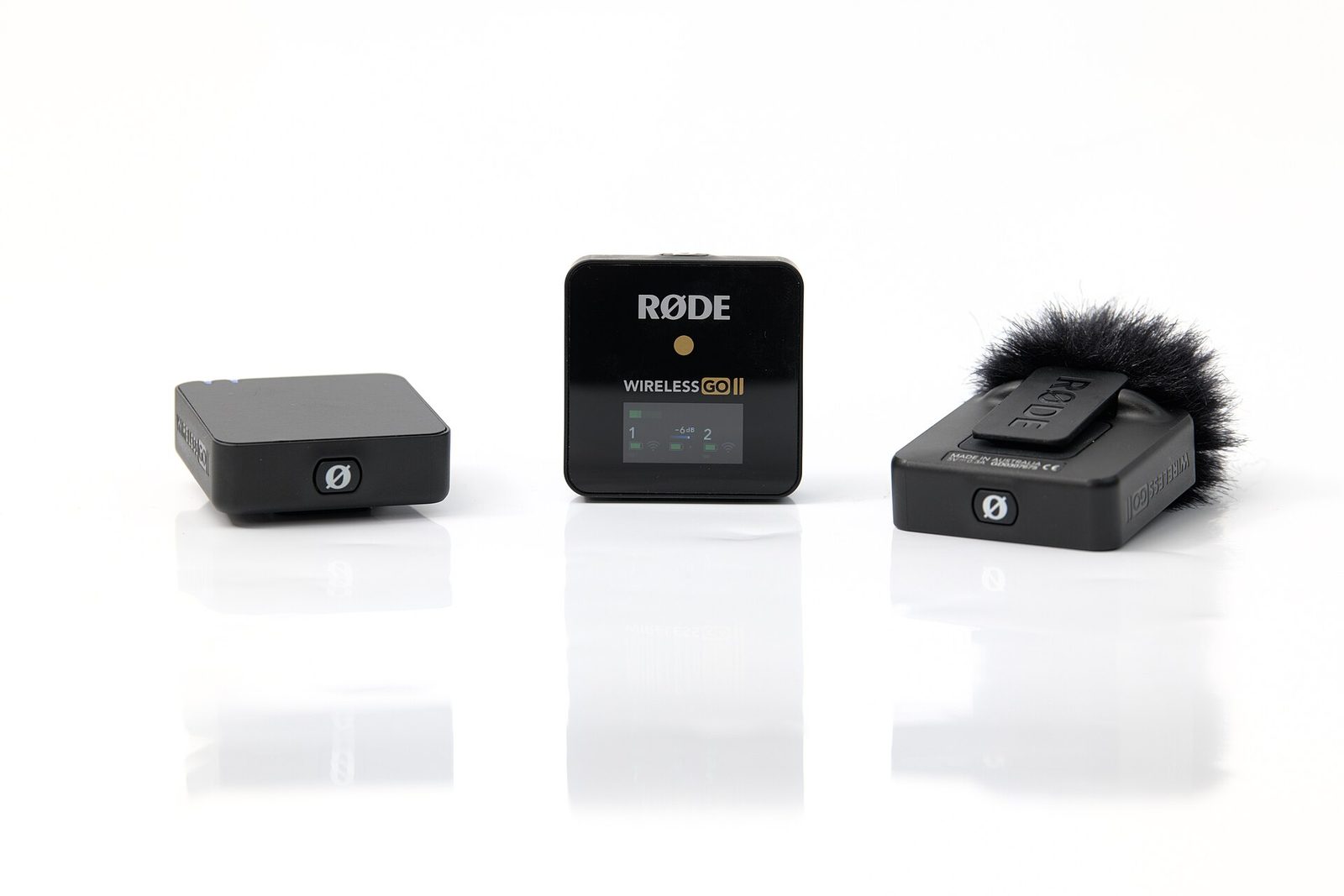
The RØDE Wireless GO (Gen 3) records two people for $169.99 at B&H and Sweetwater (Sep 2026) and keeps a 32-bit float backup inside each transmitter. The Nomono Sound Capsule records two, three or four people with four wireless Stellar Mics, adds an 8-mic ambisonic array and includes 12 months of Nomono Studio Premium, all for $1,188. Choose by guest count and by what you need after recording.
RØDE sells this kit as the Wireless GO (Gen 3), and many buyers search for it as the Wireless GO III. Guest count, spatial capture, software and price separate it from the Sound Capsule. Both clip a small transmitter to each speaker, both keep a recording on the device if the wireless link drops, and both travel well. The RØDE figures below come from RØDE's Wireless GO (Gen 3) page (checked Oct 2026) and current US retail pricing. The Nomono figures come from the Sound Capsule product page.
| Spec | Nomono Sound Capsule | RØDE Wireless GO (Gen 3) |
|---|---|---|
| People per system | 4 | 2 |
| Mics supplied | 4 Stellar wireless mics | 2 transmitters with built-in mics |
| Recorder | Space Recorder, no phone or laptop needed | Receiver into camera, phone or computer |
| Format and clip protection | 16-bit/48 kHz voice with auto-levelling on every mic, 24-bit/48 kHz spatial | 32-bit float on board |
| On-device recording | Up to 12 h (64 GB) on the Space Recorder, plus a 40-min lossless buffer per Stellar Mic | On-board recording in each transmitter |
| Level control | Auto-levelling on every mic | GainAssist, safety channel |
| Spatial audio | 8-mic ambisonic array, Dolby Atmos-ready | None |
| Software | 12 months of Nomono Studio Premium included | Hardware only |
| Price | $1,188 | $199 list, $169.99 at B&H (Sep 2026) |
Two is the ceiling on a single Wireless GO (Gen 3). The kit pairs two transmitters with one receiver, which is ideal for a host and one guest. A three or four-person panel needs a second kit, a camera, recorder or interface that can take both receivers, and up to four onboard files that have no shared timecode, so you line them up by hand in your editor.
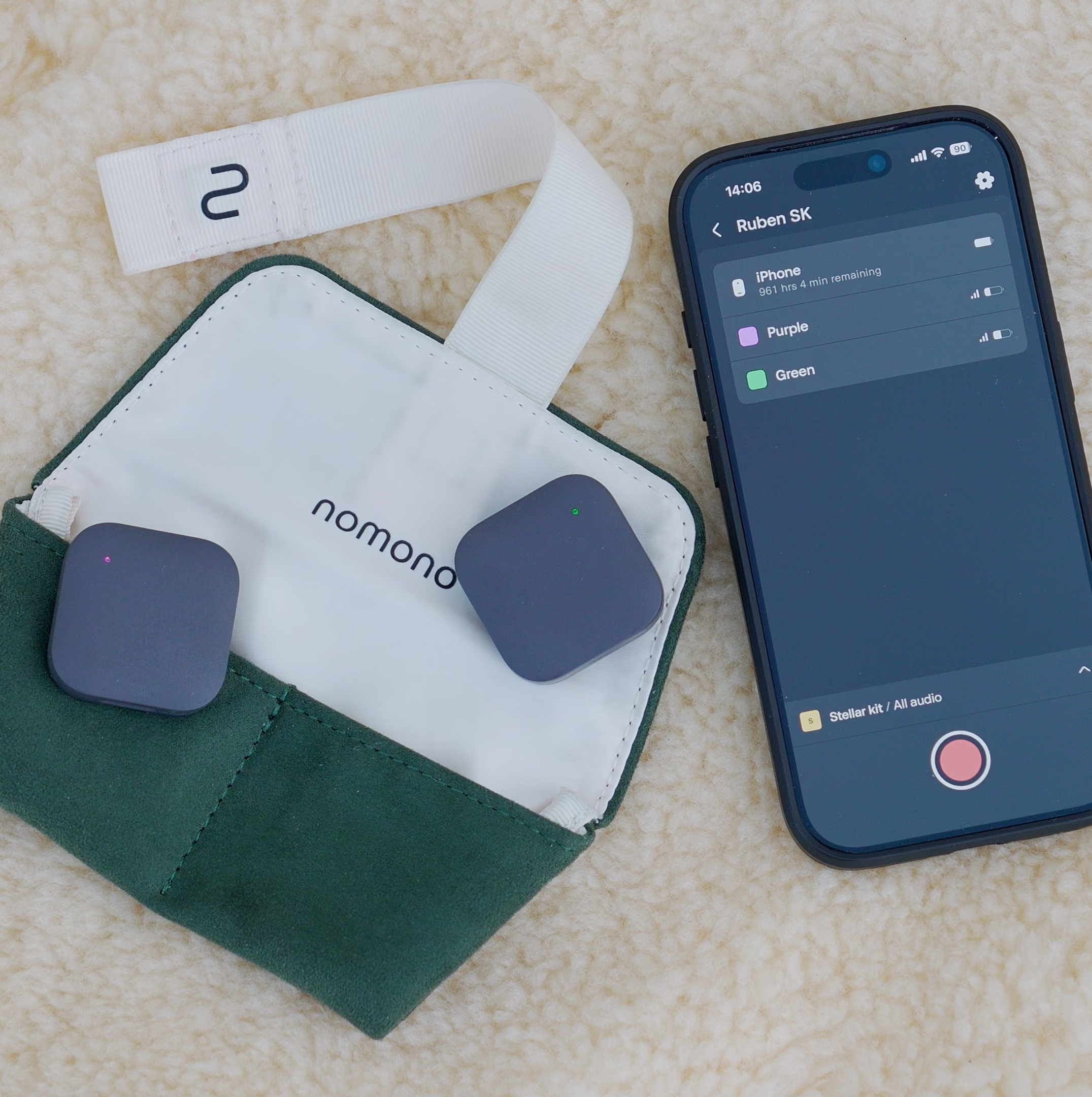
The Sound Capsule covers two-, three- and four-person shows from one case. Up to four Stellar Mics record into one Space Recorder alongside the spatial track, with no phone or laptop needed, and the session uploads over Wi-Fi to Nomono Studio automatically. The recorder runs up to 10 hours, or 25 hours with the charging case. If your show regularly has more than two voices, read how to record a 4-person podcast before buying a second lav kit.

Both systems protect your levels. Each Wireless GO (Gen 3) transmitter records 32-bit float internally, and RØDE also offers GainAssist for automatic levels and a safety channel for camera work.
Nomono protects every take with auto-levelling on every mic, so nobody sets or rides gain during the session. Voice is recorded in 16-bit/48 kHz, which gives 96 dB of dynamic range, more than a voice uses from whisper to shout, and the spatial track is 24-bit/48 kHz. Read why Nomono records voice in 16-bit. After the session, AI noise removal and audio enhancement in Nomono Studio cleans up every track.
The Sound Capsule's Space Recorder carries an 8-mic ambisonic array that records the room at the same time as the four voice mics. That spatial track is what makes it Dolby Atmos-ready, and Nomono Studio Premium includes spatial capture, spatial export and ambisonics download. The Wireless GO (Gen 3) does not capture spatial audio. Two lav mics give you two voice tracks and nothing about the place.
For a talk show delivered in stereo, that gap costs you nothing. For documentary, travel or branded work where the location is part of the story, it matters. Our guide to spatial audio for podcasts covers when it is worth it.
A Sound Capsule session uploads over Wi-Fi to Nomono Studio, where tracks are enhanced, transcribed and edited. The price includes 12 months of Nomono Studio Premium, a plan that costs $948 billed yearly on its own, with 10 hours per month of AI enhancement, 600 GB of storage, two editors, unlimited reviewers and unlimited transcriptions. One-click audio-video sync is included on every plan, and a paid plan keeps the lifetime hardware warranty active. You can also export over USB and edit elsewhere.
A Wireless GO session ends with files on the transmitters or on whatever device the receiver feeds. You move them to a computer and edit in software you already pay for. RØDE does not sell an editing or transcription service with the kit.
RØDE's price covers the hardware only, so add your own editing and transcription tools to its column. Nomono's price also covers 12 months of Nomono Studio: editing, transcription and AI noise removal.
| Setup | Price | Software |
|---|---|---|
| Wireless GO (Gen 3), 2 people | $169.99 | Your own editing software |
| Two Wireless GO kits, 4 people | $339.98 | Add a recorder and editing software |
| Stellar Kit, 2 people | $348 | 12 months of Nomono Studio Professional included ($348 billed yearly on its own) |
| Sound Capsule, 2 to 4 people | $1,188 | 12 months of Nomono Studio Premium included ($948 billed yearly on its own) |
RØDE prices are B&H street prices from September 2026. Nomono prices are from the Nomono Studio plans page. For full budgets by team size, see the podcast equipment cost guide.
Buy for the format you record most weeks. People stepping up from an entry wireless lav kit usually hit the limit at the third guest, and a second kit fixes the mic count without fixing alignment, room sound or the edit.
| Your situation | Buy | Why |
|---|---|---|
| Solo host or one guest, tight budget | Wireless GO (Gen 3) | Two mics, 32-bit float, $169.99 |
| Two people, no editor in-house | Stellar Kit | Two mics plus Nomono Studio Professional |
| Three or four guests on location | Sound Capsule | Four mics, one recorder, no mixer |
| Documentary, travel, live sound | Sound Capsule | Spatial track records alongside voices |
| Loud, unpredictable levels | Wireless GO (Gen 3) | 32-bit float on board |
Price and size are RØDE's strongest arguments. RØDE quotes up to 260 m line-of-sight range on its Series IV 2.4 GHz transmission, more than most interviews need. On-board recording in each transmitter makes the backup a real safety net, and 32-bit float protects against level mistakes.
For two voices, Nomono also makes the Stellar Kit: two Stellar Mics with 15 hours of battery each and a 40-minute lossless buffer, for $348 with 12 months of Nomono Studio Professional included, a plan that costs $348 billed yearly on its own. If you also want timecode at two people, our comparison of the Sound Capsule vs RØDE Wireless PRO covers RØDE's higher tier. For placement tips that apply to any lav kit, see lavalier mic placement.

Recording three or four people?
Sound Capsule records four wireless mics and a spatial track on one recorder, with 12 months of Nomono Studio Premium included.
Not with one kit. A single Wireless GO (Gen 3) has two transmitters and one receiver. Four people need two kits, a device that accepts both receivers, and manual alignment of the files afterward.
Four wireless Stellar Mics, a Space Recorder with an 8-mic ambisonic array, a charging case and 12 months of Nomono Studio Premium, a plan that costs $948 billed yearly on its own, with editing, unlimited transcriptions and 10 hours per month of AI enhancement. For two voices, the Stellar Kit is $348 with 12 months of Nomono Studio Professional included.
With auto-levelling on every mic. Voice is recorded in 16-bit/48 kHz, which gives 96 dB of dynamic range, more than a voice uses from whisper to shout, and the spatial track is 24-bit/48 kHz. Each Stellar Mic also keeps a 40-minute lossless buffer. The Wireless GO (Gen 3) protects against clipping with 32-bit float on board. Read why Nomono records voice in 16-bit.
The Stellar Kit: two Stellar Mics, a charging dock and a travel sleeve, for $348 with 12 months of Nomono Studio Professional included. It needs no phone or laptop and uploads straight to Nomono Studio. The Sound Capsule covers two-, three- and four-person shows.
Only Nomono. The Sound Capsule's 8-mic ambisonic array records a spatial track and is Dolby Atmos-ready. The Wireless GO (Gen 3) records voice only, which is fine for stereo shows.
Yes. The kit records audio but does not include an editor or transcription service, so you supply your own. Nomono includes 12 months of Nomono Studio with either the Sound Capsule or the Stellar Kit.
Nomono Studio Premium continues at $99/month, or $79/month billed yearly. Nomono Studio Professional is $39/month, or $29/month billed yearly. A paid plan keeps the lifetime hardware warranty active. You can also move to Nomono Studio Free, and the hardware keeps working either way. You get an email 30 days before the first year ends.
Written by Ruben Åeng, Lead Audio Engineer at Nomono
Audio engineer and Product Manager for spatial audio products at Nomono, with 15 years of experience in film and television sound. Before joining in 2021 he worked as a production sound mixer, dialogue editor and sound designer, with credits including the Oscar-nominated short “Night Ride”.
Enjoy free express shipping to the listed locations within 2–5 business days.
 Austria
 Belgium
 Bulgaria
 Croatia
 Cyprus
 Czech Republic
 Denmark
 Estonia
 Finland
 France
 Germany
 Greece
 Hungary
 Ireland
 Italy
 Latvia
 Lithuania
 Luxembourg
 Malta
 Netherlands
 Norway
 Poland
 Portugal
 Romania
 Slovakia
 Slovenia
 Spain
 Sweden
 United Kingdom
 United States