Podcasting guides
October 20, 2026


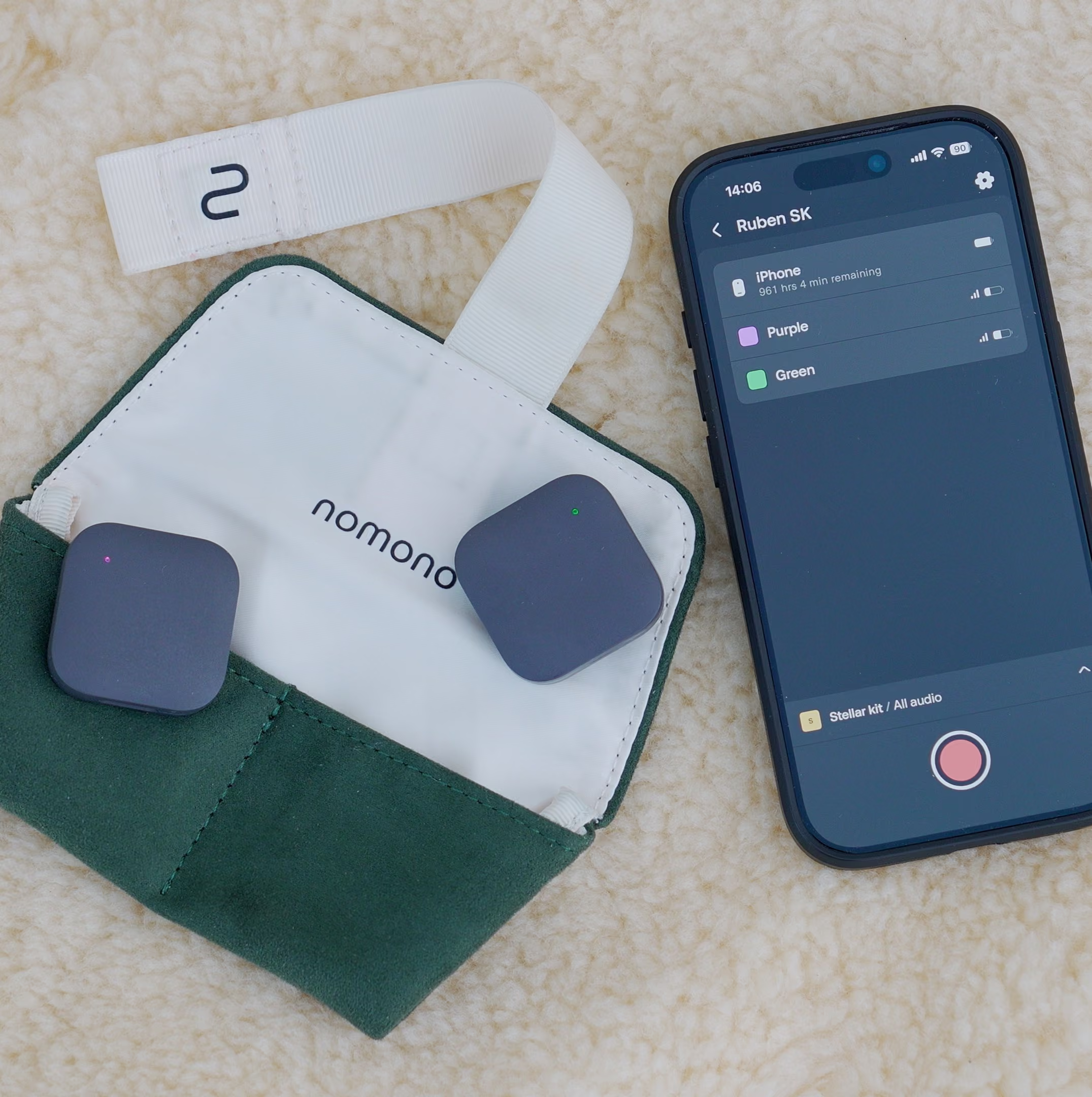
The Nomono Sound Capsule is a portable four-person recording system built around two pieces of hardware: four Stellar wireless lav mics and a Space Recorder with an 8-mic ambisonic array. Every session captures four mono WAVs plus a 4-track ambisonic WAV, and the whole kit weighs 2.9 pounds with its charging case.
The table below lists each feature of the Nomono Sound Capsule and the job it does. The sections that follow cover each one in the depth it deserves, because half of these are things owners tell us they discovered months after buying the kit.
| Feature | What it does | Where it lives |
|---|---|---|
| Four Stellar Mics | Wireless lav capture for up to four speakers, one mono WAV each | Hardware |
| 8-mic ambisonic array | Records the room as a 4-track spatial WAV | Space Recorder |
| Cold shoe mounting | Puts a Stellar Mic on your camera for reference audio | Stellar Mics |
| Tripod thread | Mounts the Space Recorder on any camera stand, 360 camera on top | Space Recorder |
| Ring charging pins | Charges the recorder in any orientation in the case | Space Recorder |
| Case accessories | Windbreakers, charging cable, and extra magnets ship in the case | Charging case |
| Advanced Menu | Reboot, Flight Mode, and manual update checks | Space Recorder |
| USB-C local transfer | Moves files straight to a computer with cloud uploads disabled | Space Recorder |
| Studio app | Manages settings and firmware updates from your phone | Software |
| Studio Cloud | Cloud enhancement, editing, collaboration, and export | Software |
The four Stellar Mics in the Sound Capsule handle voice capture, one mic per speaker, each recording its own mono WAV. Wireless lavs are not news on their own. What owners tend to miss is the mounting flexibility we built in. Each Stellar Mic slides into the cold shoe mount on a camera, which gives you reference audio from the camera's perspective, a real time-saver when you line up audio and video later. For handheld work, put a Stellar Mic on a pole and you have a clean single-mic rig; I have run street interviews exactly that way, with the rest of the kit still in the case. The same Stellar Mics ship with our smaller Stellar Kit, so techniques transfer between the two products.
The Space Recorder is the hub of the Sound Capsule, and its 8-mic ambisonic array is the feature that separates the kit from a standard wireless lav system. While the Stellar Mics capture each voice in isolation, the array captures the room itself as a spatial recording: the laughter to your left, the traffic behind you, the acoustics of the space you chose. That spatial bed is what makes spatial audio with Nomono possible without any extra gear, and it is the reason documentary teams use the recording as more than a safety track. We have written before about creating immersive soundscapes with Nomono, and every technique in that piece starts with this array.
The Space Recorder has a standard camera-stand thread on its base, so it drops into gear you already own: tripods, light stands, clamps. No proprietary mount, no adapter to lose. The thread also works the other way. A 360 camera mounts directly on top of the Space Recorder, which puts your spherical video and your ambisonic audio at the same point in space. Pair that with Nomono's spatial audio positioning and you get matched spherical capture for immersive projects. Placement at eye level on a stand also improves the ambisonic image compared with a tabletop, so the thread earns its keep on ordinary podcast shoots too.
The ring of connectors around the Space Recorder's thread mount is the charging interface, and the circular layout is deliberate. Because the pins form a complete ring, the recorder charges no matter how you rotate it when you set it in the charging case. There is no alignment step and no fiddling in the dark at the end of a shoot day, and it removes the classic failure mode of docked chargers: the device that looked seated but never charged. The Stellar Mics seat into the same case, so one case charges the entire 2.9-pound kit.
The charging case carries more than the recorder and mics. Inside, you also get a charging cable, windbreakers sized for both the Space Recorder and the Stellar Mics, and extra magnets for clipping the mics to clothing. Wind protection is the windbreakers' obvious job, but foam also cuts plosives when someone speaks close to a mic, and I use them indoors for exactly that reason: guests pop their p's, and the foam takes the edge off before it hits the file. The spare magnets matter on real shoots too, since a magnet dropped in long grass otherwise ends a lav position for the day.
Every Sound Capsule session produces five files: one mono WAV per Stellar Mic, so up to four isolated voice tracks, plus a 4-track ambisonic WAV from the Space Recorder's array. Isolated tracks mean you can fix one person's audio without touching anyone else's, the biggest editing advantage over a recorder that sums everything to stereo. The ambisonic file keeps a spatial mix available even if today's deliverable is plain stereo. We covered the editing side in our guide to podcast editing and audio quality; most producers cut the mono tracks and keep the ambisonic file as a room bed or as insurance.
Local file transfer over USB-C is built in for anyone who prefers a manual workflow or works somewhere without a connection. From the Advanced Menu you can disable cloud uploads entirely, then plug the Space Recorder into a computer and copy the WAV files directly. Field producers working off-grid asked for this early on, and so did teams whose security policies rule out automatic uploads. Nothing about the recording changes; you get the same four mono WAVs and the ambisonic file, delivered over a cable instead of the cloud. Back online, switch uploads on again and the kit returns to automatic behavior.
Hold the down-arrow button on the Space Recorder for five seconds and an Advanced Menu appears that most owners never find on their own. From here you can reboot the device, enable Flight Mode, and force a check for firmware updates in case you missed a prompt. Flight Mode covers airline rules on radios and doubles as the right setting for long-term storage between projects. The manual update check earns its place the night before a shoot: run it, confirm the firmware is current, and no update prompt appears while the guest is seated.
The Studio app manages the Sound Capsule's settings and firmware from your phone, so the button-and-menu route on the recorder itself is optional rather than required. Updates, device settings, and status checks all run through the app, which is quicker than on-device menus once the recorder is mounted on a stand out of comfortable reach. On location, the app is how I confirm the kit is ready without breaking down the setup, and it uses the same account as the cloud side, so one login covers phone, hardware, and browser.
Studio Cloud is where Sound Capsule recordings go after capture: uploads land in the cloud, where you enhance, edit, collaborate, and export. Enhancement cleans up the tracks, the editor works on the isolated files, and collaborators comment and edit in the browser rather than passing project files around. Studio also runs Audio/Video Sync, which launched in March 2026 on all plans and matches your Nomono audio to camera footage automatically. We walk through that workflow in how to sync Nomono audio with your camera. For teams recording away from a studio, the combination of hardware capture and cloud processing is the whole point, as our guide to recording a podcast outside the studio lays out.
The Sound Capsule sells through the Premium plan: $1,188 upfront for year one, which covers the Sound Capsule hardware and 12 months of Studio Cloud Premium, then $99 per month after the first year (verified on nomono.co/studio-pricing, September 2026). The smaller Stellar Kit follows the same model on the Professional plan at $348 upfront for year one, then $29 per month. Buyers weighing the two kits usually decide on the ambisonic array, since the spatial recording is the Sound Capsule's defining feature. Independent owner experiences are collected on the Nomono reviews page if you want field reports beyond ours.
The Nomono Sound Capsule combines four Stellar wireless lav mics with a Space Recorder that carries an 8-mic ambisonic array. Each session records four mono WAVs plus a 4-track ambisonic WAV. The 2.9-pound kit includes a charging case, and recordings flow into Studio Cloud for enhancement, editing, and export.
Four people can be recorded at once, one Stellar Mic per speaker, each on its own isolated mono WAV file. The Space Recorder's ambisonic array captures the room at the same time, so a four-person conversation produces five files in total: four voice tracks plus the 4-track spatial recording.
Yes. The Advanced Menu on the Space Recorder lets you disable cloud uploads and transfer files to a computer over USB-C instead. Recordings are identical either way; only the delivery route changes. When you are back online, re-enable uploads and the kit resumes sending sessions to Studio Cloud automatically.
Hold the arrow-down button on the Space Recorder for five seconds and the Advanced Menu opens. From there you can reboot the device, enable Flight Mode for travel or long-term storage, force a firmware update check, and disable cloud uploads for USB-C file transfer. Settings can also be managed through the Studio app.
Yes, in two ways. Each Stellar Mic slides into a camera's cold shoe mount to capture reference audio from the camera's perspective, and the Space Recorder's tripod thread lets a 360 camera mount directly on top of it. Audio/Video Sync in Studio Cloud then matches the recordings to your footage automatically.
The charging case ships with a charging cable, windbreakers sized for both the Space Recorder and the Stellar Mics, and extra magnets for attaching the mics to clothing. The windbreakers also work as plosive filters for close speech indoors, and the spare magnets cover the ones that inevitably go missing on location.
Yes. The 4-track ambisonic WAV recorded by the Space Recorder's 8-mic array gives you a spatial bed, so you can deliver a spatial mix without recording anything extra. Producers who publish in stereo today still keep that option open, since the ambisonic file sits alongside the four mono voice tracks in every session.
The Sound Capsule costs $1,188 upfront for year one on the Premium plan, which includes the hardware and 12 months of Studio Cloud Premium, then $99 per month afterward (nomono.co/studio-pricing, September 2026). The smaller Stellar Kit runs $348 upfront for year one on the Professional plan, then $29 per month.
The Sound Capsule adds the Space Recorder's 8-mic ambisonic array, which records the room as a spatial file alongside the four isolated voice tracks. The Stellar Kit is the lighter option built around Stellar Mics without the ambisonic hub. Both feed the same Studio Cloud workflow.
Ruben Åeng is Lead Audio Engineer at Nomono, where he works on the recording hardware covered in this guide.
Enjoy free express shipping to the listed locations within 2–5 business days.
 Austria
 Belgium
 Bulgaria
 Croatia
 Cyprus
 Czech Republic
.svg) Denmark
Denmark Estonia
 Finland
 France
 Germany
 Greece
 Hungary
 Ireland
 Italy
Italy Latvia
 Lithuania
 Luxembourg
 Malta
Malta Netherlands
 Norway
 Poland
 Portugal
 Romania
 Slovakia
 Slovenia
 Spain
Spain Sweden
 United Kingdom
 United States