Comparisons
November 9, 2026



The Hollyland Lark Max has been replaced by the Lark Max 2, a wireless kit that records 32-bit float internally, supports timecode and launched at $279 for the two-person Ultimate Combo and $319 for the Combo 4-Person Version (Hollyland, May 2025). The Nomono Sound Capsule records two, three or four people on separate tracks plus a spatial track, with 12 months of Nomono Studio Premium included, for $1,188.
Many buyers still search for the original Lark Max, so we cover it alongside its successor. Lark Max figures come from Hollyland's Lark Max page, Lark Max 2 figures from Hollyland's Lark Max 2 page and Hollyland's May 2025 launch announcement, checked Nov 2026. Nomono figures come from the Sound Capsule page.
| Spec | Sound Capsule | Lark Max (original) | Lark Max 2 |
|---|---|---|---|
| People per kit | 2 to 4 | 2 | 2, or 4 with the 4-Person Version |
| Four voices on one receiver | Four separate tracks on one recorder | No | Up to 4 TX, output summed to mono or stereo |
| Format and clip protection | 16-bit/48 kHz voice with auto-levelling on every mic, 24-bit spatial | 24-bit/48 kHz | 32-bit float, timecode |
| On-device storage | Up to 12 h (64 GB), plus a 40-min lossless buffer per Stellar Mic | 8 GB, 14 h per mic | 8 GB internal backup per mic |
| Battery | 10 h, 25 h with case | TX 7.5 h, RX 9 h, 22 h with case | TX 11 h, 36 h with case |
| Noise handling | Auto-levelling, AI in Nomono Studio | ENC noise cancellation | AI noise cancellation |
| Spatial audio | 8-mic ambisonic, Dolby Atmos-ready | None | None |
| Software | 12 months of Nomono Studio Premium included | Hardware only | Hardware only |
| Price | $1,188 | Superseded | $279 Ultimate Combo, $319 4-Person (launch) |
Hollyland built the Lark Max for videographers and solo creators who need two clean voices straight into a camera or phone. The original records 24-bit/48 kHz, keeps an 8 GB backup of up to 14 hours of uncompressed WAV on each transmitter, offers environmental noise cancellation, and quotes 820 ft (250 m) line-of-sight range. The Lark Max 2 adds 32-bit float internal recording, timecode and AI noise cancellation, and one receiver can pair with up to four transmitters. The Ultimate Combo includes two transmitters, a camera receiver, a USB-C receiver and two monitoring earphones.
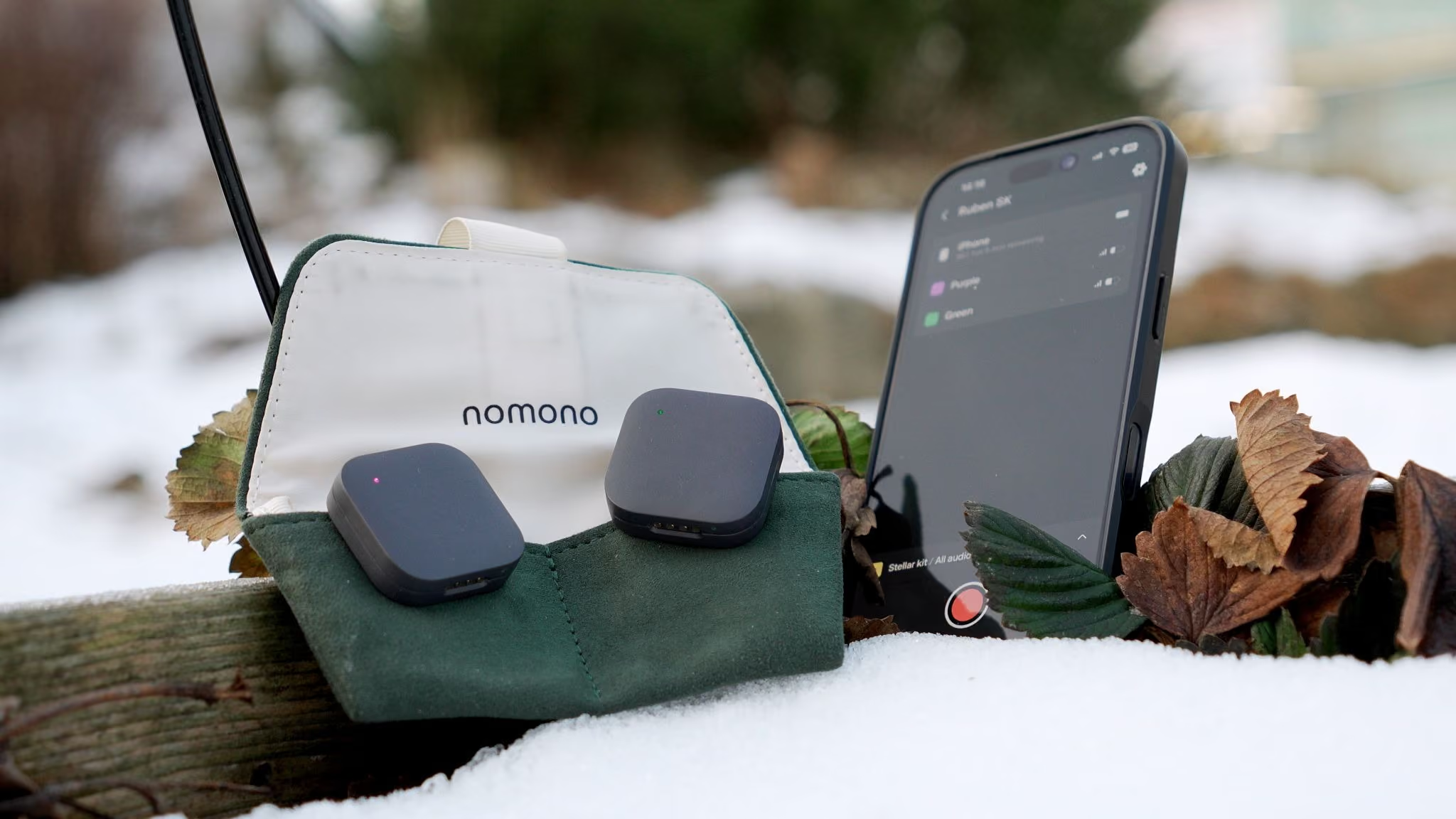
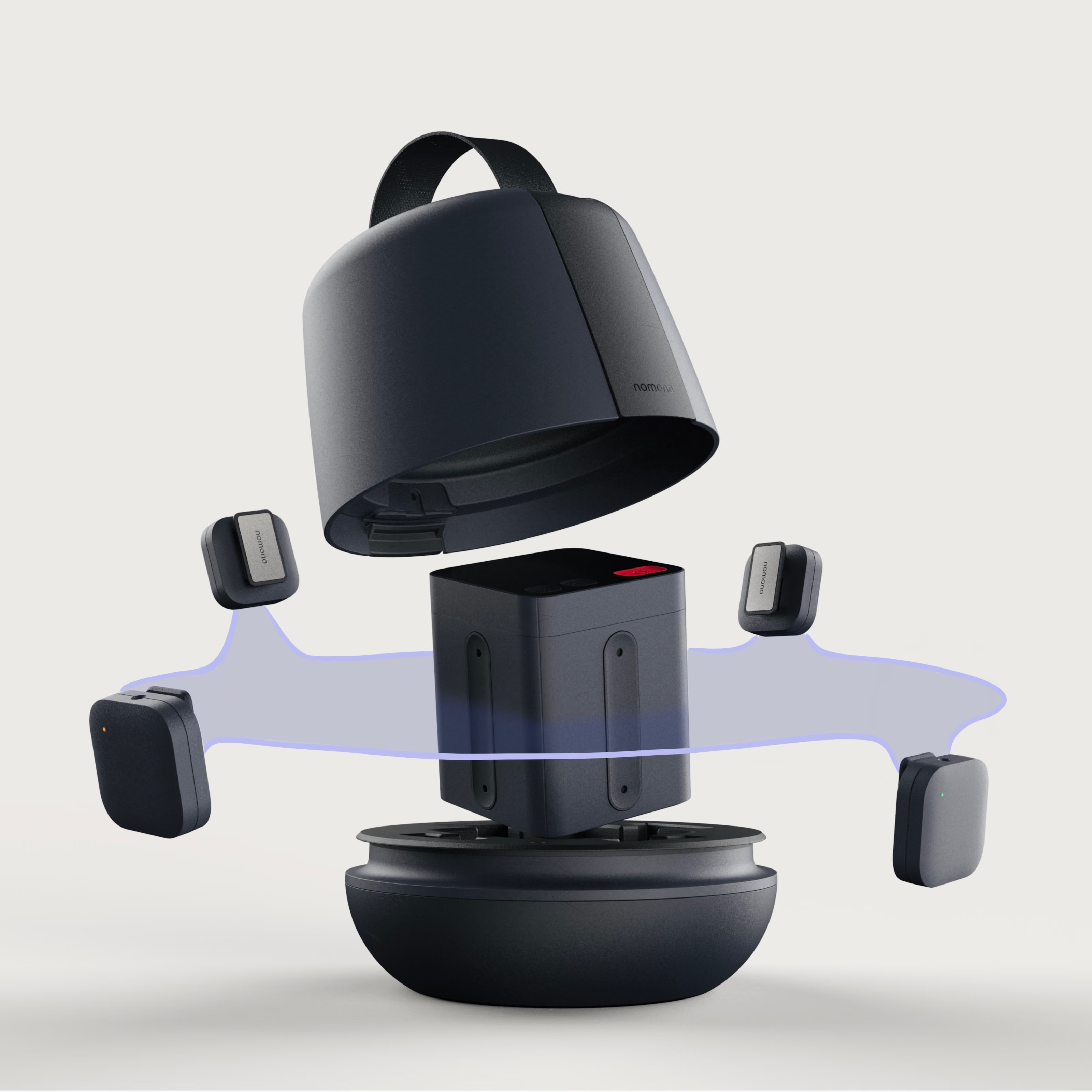
Nomono designed the Sound Capsule for two-, three- and four-person conversations recorded away from a studio. The kit is a Space Recorder with an 8-mic ambisonic array, four Stellar wireless mics and a charging case, 2.9 lb in total. It records without a phone or laptop, is ready to record in under 10 seconds, stores up to 12 hours on board, and uploads over Wi-Fi to Nomono Studio automatically, where AI noise removal and audio enhancement and transcription are included.
Guest count is where the two systems differ most. The two-person Lark Max kits cover a host and one guest. The Lark Max 2 receiver can also pair with up to four transmitters, with the Combo 4-Person Version or two added transmitters, but Hollyland notes that in that mode the receiver does not output four discrete tracks: the voices are summed to mono, or to two stereo channels, and wireless monitoring is unavailable. Separate tracks per voice come from each transmitter's internal recording, which you copy off and line up in the edit, with timecode helping if your camera or recorder supports it.
The Sound Capsule covers two-, three- and four-person shows and records every voice on its own track on one recorder, plus the room. Separate tracks let you fix crosstalk, drop a cough or balance a quiet speaker in post, and each Stellar Mic keeps a 40-minute lossless buffer. It needs one case, no phone or laptop, and is ready to record in under 10 seconds. Our guide to recording a podcast outside the studio covers mic placement and room choice for those sessions.

The original Lark Max records 24-bit/48 kHz. The Lark Max 2 moved to 32-bit float internal recording, which protects against clipped or very quiet takes.

Nomono protects every take with auto-levelling on every mic, so nobody sets or rides gain. Voice is recorded in 16-bit/48 kHz, which gives 96 dB of dynamic range, more than a voice uses from whisper to shout. Read why Nomono records voice in 16-bit. After the session, Nomono Studio applies noise removal and enhancement. For what matters more than bit depth in most rooms, read what makes a recording sound professional.
Nomono includes the work after recording. Sessions upload over Wi-Fi to Nomono Studio, and the price includes 12 months of Nomono Studio Premium, a plan that costs $948 billed yearly on its own, with 10 hours per month of AI enhancement, 600 GB of storage, two editors, unlimited reviewers, unlimited transcriptions, spatial export and cloud editing. One-click audio-video sync is included on every plan, and a paid plan keeps the lifetime hardware warranty active.
Hollyland hands you audio files. Editing, transcription and video sync come from tools you buy separately, which adds a recurring cost on top of the hardware.
Hollyland's hardware costs less. The comparison that matters depends on how many voices you record, whether you need a separate track for each, and whether you already pay for editing and transcription.
| Cost line | Lark Max 2 Ultimate | Stellar Kit | Sound Capsule |
|---|---|---|---|
| Voices covered | 2 | 2 | 2 to 4 on separate tracks, plus spatial |
| Price | $279 at launch | $348 | $1,188 |
| Editing and transcription | Not included | 12 months of Nomono Studio Professional included ($348 billed yearly on its own) | 12 months of Nomono Studio Premium included ($948 billed yearly on its own) |
| Clip protection | 32-bit float | Auto-levelling, 40-min buffer per mic | Auto-levelling, 40-min buffer per mic |
Lark Max 2 prices are Hollyland's launch prices (May 2025). Nomono prices are from the Nomono Studio plans page. After year one, Nomono Studio Premium continues at $99/month, or $79/month billed yearly, and Nomono Studio Professional at $39/month, or $29/month billed yearly. A paid plan keeps the lifetime hardware warranty active, and you can also move to Nomono Studio Free with the hardware still working. For two-person shows, the Stellar Kit includes two Stellar Mics, a charging dock, a travel sleeve and magnets, 15 hours of battery and a 40-minute lossless buffer per mic, and 12 months of Nomono Studio Professional with 6 hours per month of AI enhancement.
| Scenario | Buy | Why |
|---|---|---|
| Solo creator, camera interviews, tight budget | Lark Max 2 | Two mics, 32-bit float, $279 at launch |
| Two-person show that needs editing and transcripts | Stellar Kit | Nomono Studio Professional included |
| Four-person roundtable on location | Sound Capsule | Four separate tracks and spatial, one case |
| Spatial or Dolby Atmos delivery | Sound Capsule | Ambisonic array built in |
| Loud, unpredictable live audio | Lark Max 2 | 32-bit float headroom |
| Several editors on one episode | Sound Capsule | Premium includes two editors |
Hollyland suits two-person creators who want small, affordable mics for camera work. The Sound Capsule records a complete show: a separate track for every voice, the room in spatial audio, and recording and post in one place. For other two-channel comparisons, see Sound Capsule vs Sennheiser Profile Wireless and Sound Capsule vs RØDE Wireless GO (Gen 3).
Recording three or four people?
Sound Capsule records four wireless mics and a spatial track on one recorder, with 12 months of Nomono Studio Premium included.
It has been superseded by the Lark Max 2, which adds 32-bit float internal recording and timecode. Hollyland still lists the original Lark Max page, but new buyers should compare against the Lark Max 2.
Yes, for a two-person show in a reasonable room. Each transmitter keeps an internal backup recording and offers noise cancellation. Its limits are two voices per kit, no spatial track and no editing tools included.
The original Lark Max records 24-bit/48 kHz. The Lark Max 2 records 32-bit float internally. The Nomono Sound Capsule protects against clipping with auto-levelling on every mic and records voice in 16-bit/48 kHz, which gives 96 dB of dynamic range, more than a voice uses from whisper to shout. Read why Nomono records voice in 16-bit.
The original Lark Max records two people per kit. The Lark Max 2 receiver can pair with up to four transmitters, but in that mode it sums the voices to mono or two stereo channels rather than four discrete tracks, so separate tracks come from each transmitter's internal recording, aligned afterward. The Sound Capsule records four wireless mics on separate tracks plus a spatial track on one recorder.
$1,188. That covers the Space Recorder with its 8-mic ambisonic array, four Stellar wireless mics, the charging case and 12 months of Nomono Studio Premium, a plan that costs $948 billed yearly on its own.
The Sound Capsule records up to 10 hours, or 25 hours with its charging case. Hollyland quotes about 7.5 hours per original Lark Max transmitter and 22 hours with the case, and about 11 hours per Lark Max 2 transmitter, or 36 hours with the case.
Yes, on guest count. The Stellar Kit is a two-mic Nomono kit at $348 with 12 months of Nomono Studio Professional included, a plan that costs $348 billed yearly on its own. Each Stellar Mic runs 15 hours and keeps a 40-minute lossless buffer, and recordings upload to Nomono Studio with no phone or laptop needed.
Written by Ruben Åeng, Lead Audio Engineer at Nomono
Audio engineer and Product Manager for spatial audio products at Nomono, with 15 years of experience in film and television sound. Before joining in 2021 he worked as a production sound mixer, dialogue editor and sound designer, with credits including the Oscar-nominated short “Night Ride”.
Enjoy free express shipping to the listed locations within 2–5 business days.
 Austria
 Belgium
 Bulgaria
 Croatia
 Cyprus
 Czech Republic
 Denmark
 Estonia
 Finland
 France
 Germany
 Greece
 Hungary
 Ireland
 Italy
 Latvia
 Lithuania
 Luxembourg
 Malta
 Netherlands
 Norway
 Poland
 Portugal
 Romania
 Slovakia
 Slovenia
 Spain
 Sweden
 United Kingdom
 United States