Comparisons
November 5, 2026



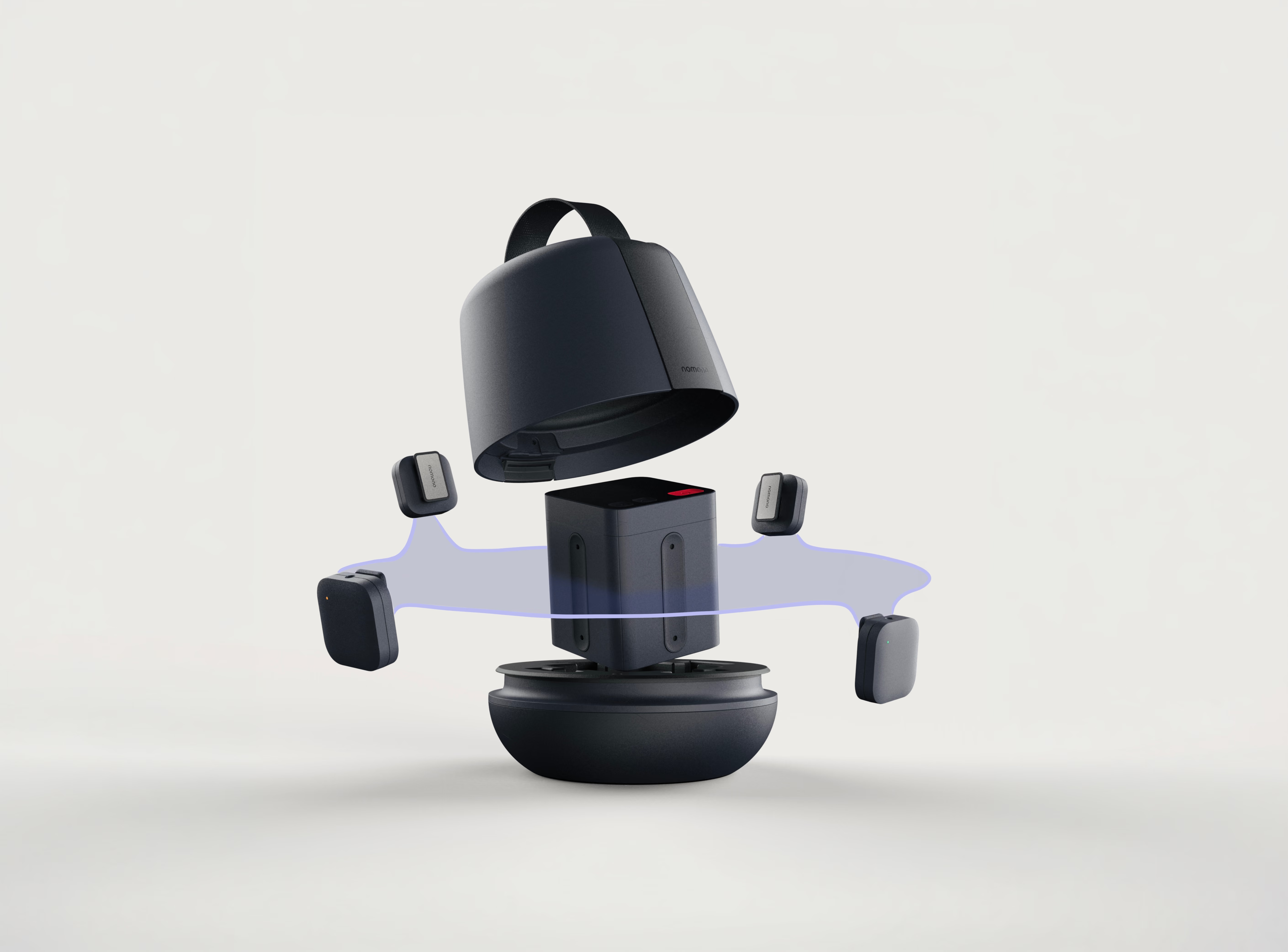
The Sennheiser Profile Wireless 2-channel set records two people, costs $329 at Sweetwater (Oct 2026), and keeps a backup recording inside each clip-on mic. The Nomono Sound Capsule records four people plus a spatial track on one recorder for $1,188. Two voices favor Sennheiser or the Stellar Kit. Three or four favor the Sound Capsule.
Four things decide this comparison: how many people the system records, what format it writes, whether it captures the room, and what happens to the files afterward. Sennheiser figures come from the Sweetwater listing and Sennheiser's firmware announcement, checked Oct 2026. Nomono figures come from the Sound Capsule page.
| Spec | Nomono Sound Capsule | Sennheiser Profile Wireless |
|---|---|---|
| People per system | 4 | 2 |
| Mics supplied | 4 Stellar wireless mics | 2 clip-on transmitters |
| Internal format | 16-bit/48 kHz voice, 24-bit/48 kHz spatial | 24-bit/48 kHz, 32-bit float via firmware |
| On-device storage | Up to 12 h (64 GB) | 16 GB per mic, up to 30 h |
| Battery | Up to 10 h, 25 h with case | Up to 7 h |
| Level control | Auto-levelling on every mic | Safety channel at reduced gain |
| Spatial audio | 8-mic ambisonic array, Dolby Atmos-ready | None |
| Extras | Charging case, USB export | Charging bar doubles as handheld mic |
| Software | First year of Studio Cloud included | Hardware only |
| Price | $1,188 | $329 at Sweetwater (Oct 2026) |
Independent review: KitPlus tests the Sennheiser Profile Wireless.
Two is the ceiling on one Profile Wireless set. It ships with two clip-on transmitters and a single two-channel receiver, and Sennheiser also sells a 1-channel version. A four-person panel means two complete sets, two receivers feeding two inputs or devices, and four files you line up by hand afterward. It works, but it is a lot of moving parts for a weekly show.
Nomono built the Sound Capsule around four people, and it is ready to record in under 10 seconds. Four Stellar Mics record into one Space Recorder along with the spatial track, no phone or laptop is needed during the session, and the recording uploads to Studio Cloud automatically. If panels are your regular format, our guide to multi-guest panel recording goes deeper on mic count and placement.
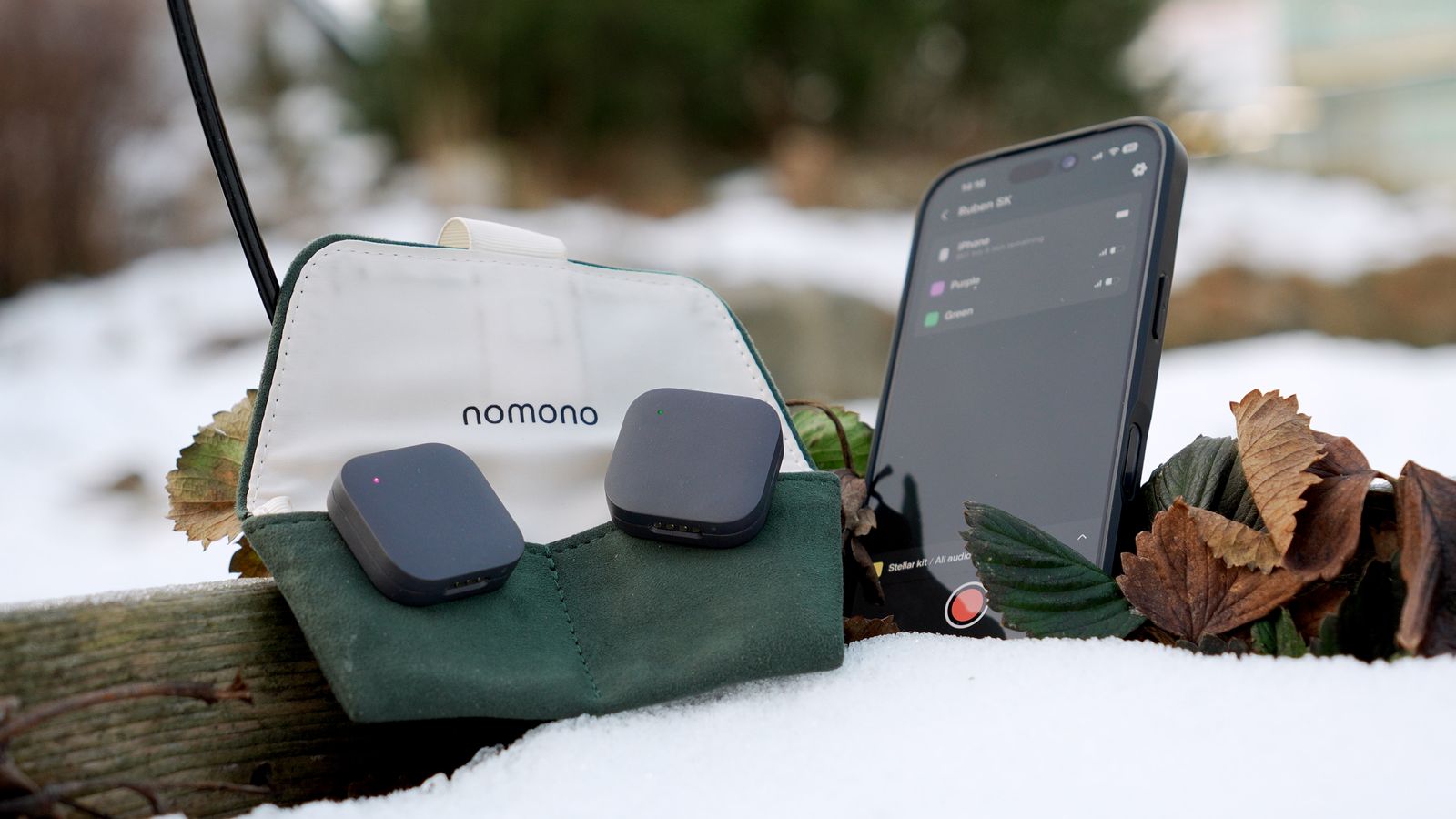
If you only ever record two people, compare the Profile Wireless with the Stellar Kit instead. It includes two Stellar Mics, a charging dock, a travel sleeve and magnets, with 15 hours of battery, and costs $348 with Studio Cloud Professional included. See our podcast kit for 2 people guide for the full two-person picture.
Sennheiser records uncompressed 24-bit/48 kHz inside each clip-on mic, and in May 2025 it released a firmware update that adds 32-bit float to all Profile Wireless systems. With current firmware, a guest who laughs or leans into the mic is far less likely to leave you with a clipped file you can't fix. A safety channel mode also records a backup at reduced gain.
Nomono does not record 32-bit float. Voice tracks are 16-bit/48 kHz and the spatial track is 24-bit/48 kHz. The Sound Capsule handles levels with auto-levelling on every mic, so nobody rides gain during a take, then Studio Cloud applies AI noise removal and audio enhancement afterward. The honest summary: a sudden loud peak is more recoverable on the Sennheiser. If clip-proof capture is your top requirement, weigh that.
The Profile Wireless records voices, and the room arrives only as whatever the clip-on mics pick up. The Sound Capsule's Space Recorder carries an 8-mic ambisonic array that records the space alongside the four voice tracks. That spatial track makes it Dolby Atmos-ready, and Studio Cloud Premium includes spatial capture, spatial export and ambisonics download.
For a stereo interview show, this does not matter. For documentary, travel or brand work where the location is part of the story, it is a deliverable a two-channel clip-on system cannot produce. Our guide to spatial audio for podcasts explains when it is worth the effort.
With the Profile Wireless, files come off the mics or your camera and go into whatever editor and transcription tool you already use. Sennheiser does not include an editing or transcription service.
With the Sound Capsule, the session uploads to Studio Cloud, and the price includes the first year of Studio Cloud Premium. Premium includes 600 minutes per month of AI enhancement, 600 GB of storage, two editors, unlimited reviewers and unlimited transcriptions. Audio/video sync is free on every plan, which helps if you film your interviews. You can also export over USB and keep editing in your own software.
Sennheiser's price covers the hardware only. Nomono's price also covers cloud editing, transcription and AI noise removal.
| Item | Profile Wireless | Stellar Kit | Sound Capsule |
|---|---|---|---|
| People | 2 | 2 | 4 |
| Price | $329 | $348 | $1,188 |
| Cloud editing and transcription | Not included | First year of Studio Cloud included | First year of Studio Cloud included |
| Spatial track | No | No | Yes |
Full plan details are on the Studio Cloud pricing page.
| Your situation | Buy | Why |
|---|---|---|
| Two-person video, existing editor | Profile Wireless | 32-bit float, handheld bar, $329 |
| Two-person audio, no editing setup | Stellar Kit | Studio Cloud Professional included |
| Three or four guests on location | Sound Capsule | Four mics, one recorder |
| Spatial or Dolby Atmos delivery | Sound Capsule | Ambisonic array built in |
| Loud, unpredictable levels | Profile Wireless | More headroom to rescue peaks |
The Profile Wireless is the better buy for many two-person creators. It is compact, the charging bar works as a handheld interview mic, each transmitter has a locking 3.5 mm input for an external lav, and the internal recording gives you a backup if the wireless link drops. Buying a four-mic Sound Capsule for a two-person show means paying for capacity you will not use.
The Sound Capsule wins once a third person sits down, when you want the room as part of the mix, or when your team would rather not stitch together separate editing and transcription tools. For another two-channel comparison, see Sound Capsule vs RØDE Wireless GO (Gen 3), and for the wider field, our podcasting equipment buyer's guide.

Recording more than two people?
Sound Capsule records four wireless mics and a spatial track on one recorder, with Studio Cloud Premium included.
Yes, with current firmware. The system records uncompressed 24-bit/48 kHz, and Sennheiser's May 2025 firmware update added 32-bit float to all Profile Wireless systems. Update the firmware before relying on it.
No. Voice tracks are 16-bit/48 kHz and the spatial track is 24-bit/48 kHz. Nomono uses auto-levelling on every mic instead, then AI noise removal and enhancement in Studio Cloud. A clipped peak is easier to recover on the Sennheiser.
Not with one set. The 2-channel set has two transmitters and one receiver. Four people need two sets, two receiver inputs and manual alignment of the files afterward, while the Sound Capsule records four wireless mics on one recorder.
Compare the Profile Wireless with the Stellar Kit rather than the Sound Capsule. Sennheiser wins on price at $329 and on 32-bit float. The Stellar Kit costs $348 and includes Studio Cloud Professional with unlimited transcriptions and 360 minutes per month of AI enhancement.
No editing or transcription service is included. You transfer files from each mic's 16 GB of storage, or record into your camera, and edit in your own software. Nomono includes Studio Cloud with both of its hardware kits.
Sennheiser quotes up to 7 hours for the Profile Wireless. The Sound Capsule records up to 10 hours, or 25 hours with the extra power from its charging case. On a multi-day shoot without reliable power, the Nomono case gives more margin.
Yes. After the first year you can stay on the Free plan or continue Studio Cloud from $29/month (Professional) or $99/month (Premium); the hardware keeps working either way. Premium keeps the AI enhancement minutes, storage, spatial export and second editor.
Written by Ruben Åeng, Lead Audio Engineer at Nomono
Audio engineer and Product Manager for spatial audio products at Nomono, with 15 years of experience in film and television sound. Before joining in 2021 he worked as a production sound mixer, dialogue editor and sound designer, with credits including the Oscar-nominated short “Night Ride”.
Enjoy free express shipping to the listed locations within 2–5 business days.
 Austria
 Belgium
 Bulgaria
 Croatia
 Cyprus
 Czech Republic
 Denmark
 Estonia
 Finland
 France
 Germany
 Greece
 Hungary
 Ireland
 Italy
 Latvia
 Lithuania
 Luxembourg
 Malta
 Netherlands
 Norway
 Poland
 Portugal
 Romania
 Slovakia
 Slovenia
 Spain
 Sweden
 United Kingdom
 United States