Podcasting guides
October 22, 2026


A podcast setup without a mixing board pairs microphones that set their own levels with a recorder or app that captures each voice on its own track. For four people on location, the Nomono Sound Capsule records four wireless mics with no console. A solo host at a desk needs only a USB mic like the Shure MV7+, and four wired mics fit the Zoom H6essential or PodTrak P4next.
A podcast mixer does three jobs: it sets and rides microphone levels, it routes audio to a recorder and to headphones, and it applies processing such as compression or noise reduction while you record. Modern gear splits those jobs across simpler parts. Automatic gain and 32-bit float recording remove most of the need to ride levels. Recorders and wireless kits that write each voice to its own track handle the routing. Noise removal and enhancement happen after the session in software.
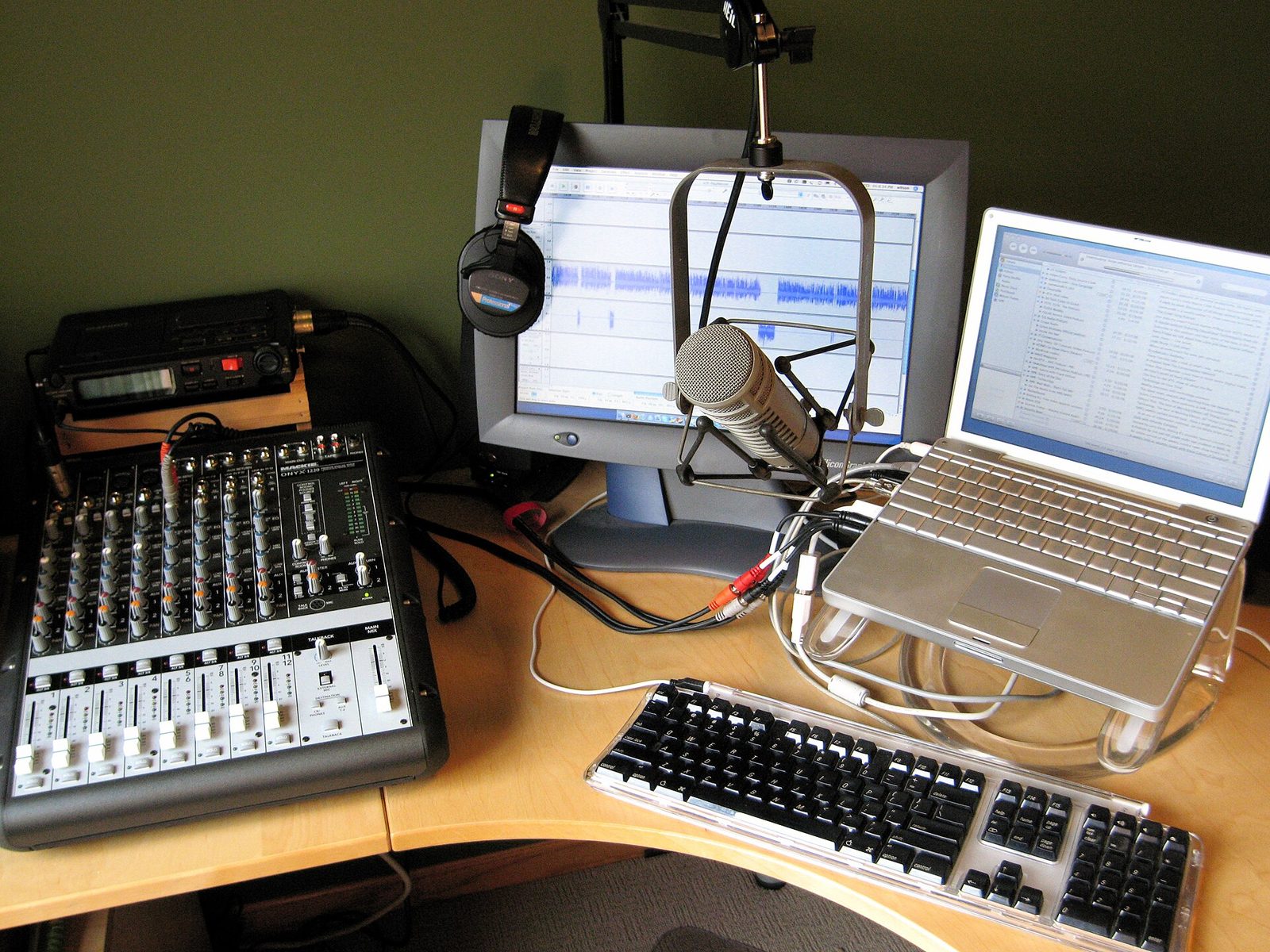
What a mixer still does better is live work. The RØDECaster Pro II ($699 list, $595 at Sweetwater, Sep 2026) has 4 combo XLR inputs, 76 dB of gain, APHEX processing, 64 SMART pads, mix-minus and Bluetooth for phone guests. Nothing on this list replaces the sound pads or the Bluetooth caller line. If you are weighing a console against a portable recorder head to head, our Sound Capsule vs RØDECaster Pro II comparison covers that decision in detail.
Prices are US list prices from the maker plus street prices where noted, checked in late September 2026. Street prices move, so check before you buy.
| Setup | Price | People | Levels | Records to | Wins when |
|---|---|---|---|---|---|
| Nomono Sound Capsule | $1,188 | 4 wireless | Auto-levelling per mic | Space Recorder, then Studio Cloud | Four people on location |
| Nomono Stellar Kit | $348 | 2 wireless | Auto-levelling | Studio app, then Studio Cloud | Solo or duo with cloud editing |
| Shure MV7+ | $299 ($319 with stand) | 1 wired | Real-time denoiser | Computer via USB-C, or XLR | Solo host at a desk |
| Zoom H6essential | $329.99 list | 4 wired XLR/TRS | 32-bit float | microSD | Four wired mics, no gain setting |
| Tascam Portacapture X8 | $499 launch, $399 at Sweetwater | 4 wired XLR/TRS | 32-bit float | microSD | Four wired mics, touchscreen |
| Zoom PodTrak P4next | $179.99 list, $149.99 Sweetwater sale | 4 wired XLR | Manual, 70 dB gain | microSD | Lowest-cost four-mic box |
| RØDE Wireless GO (Gen 3) | $199 list, $169.99 street | 2 wireless | 32-bit float on board | Transmitters (40+ h) | Two people on a budget |
| DJI Mic 3 | $329 list with case, $259 at B&H | 2 wireless | 32-bit float on board | Transmitters, camera output | Duo filmed on camera |
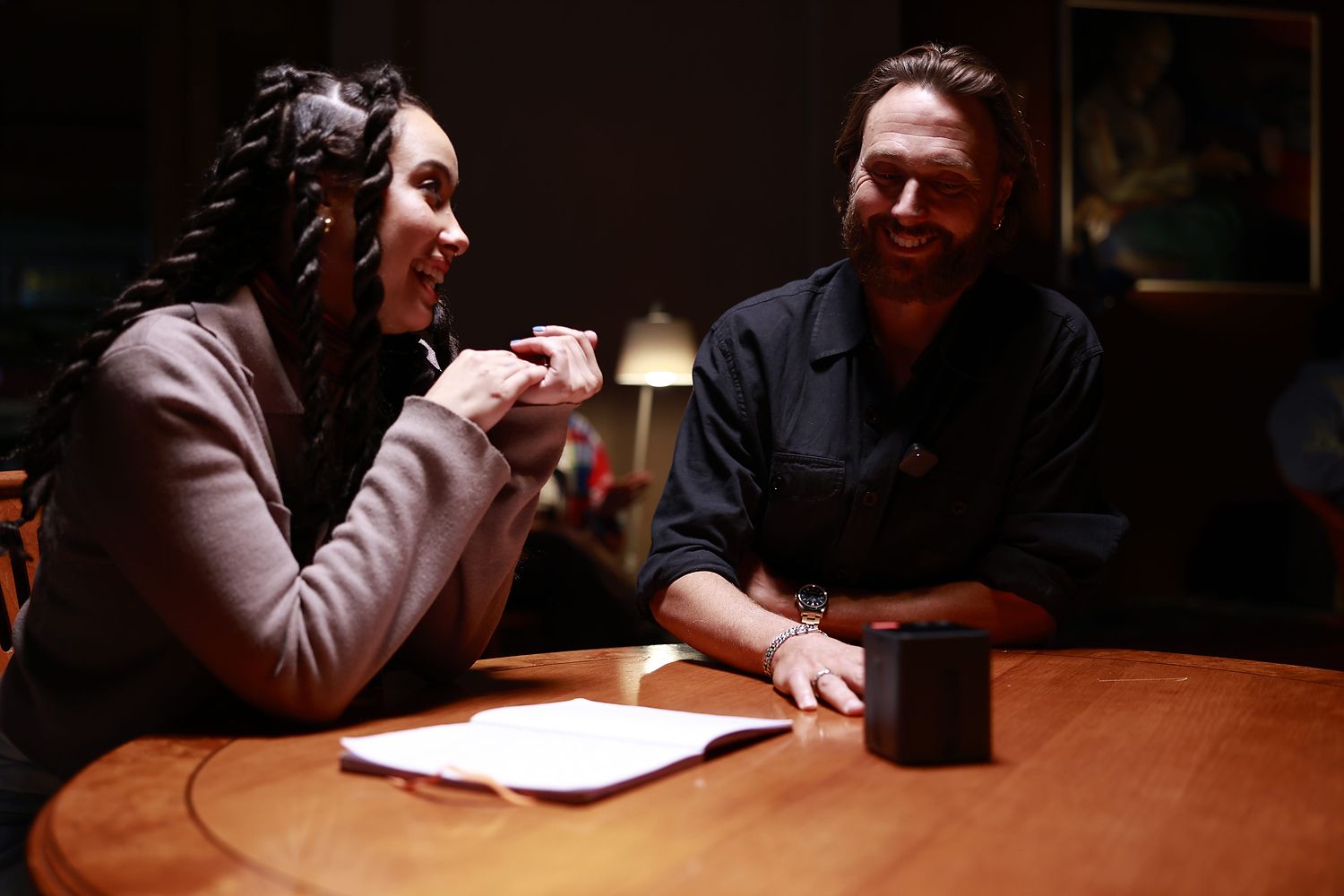
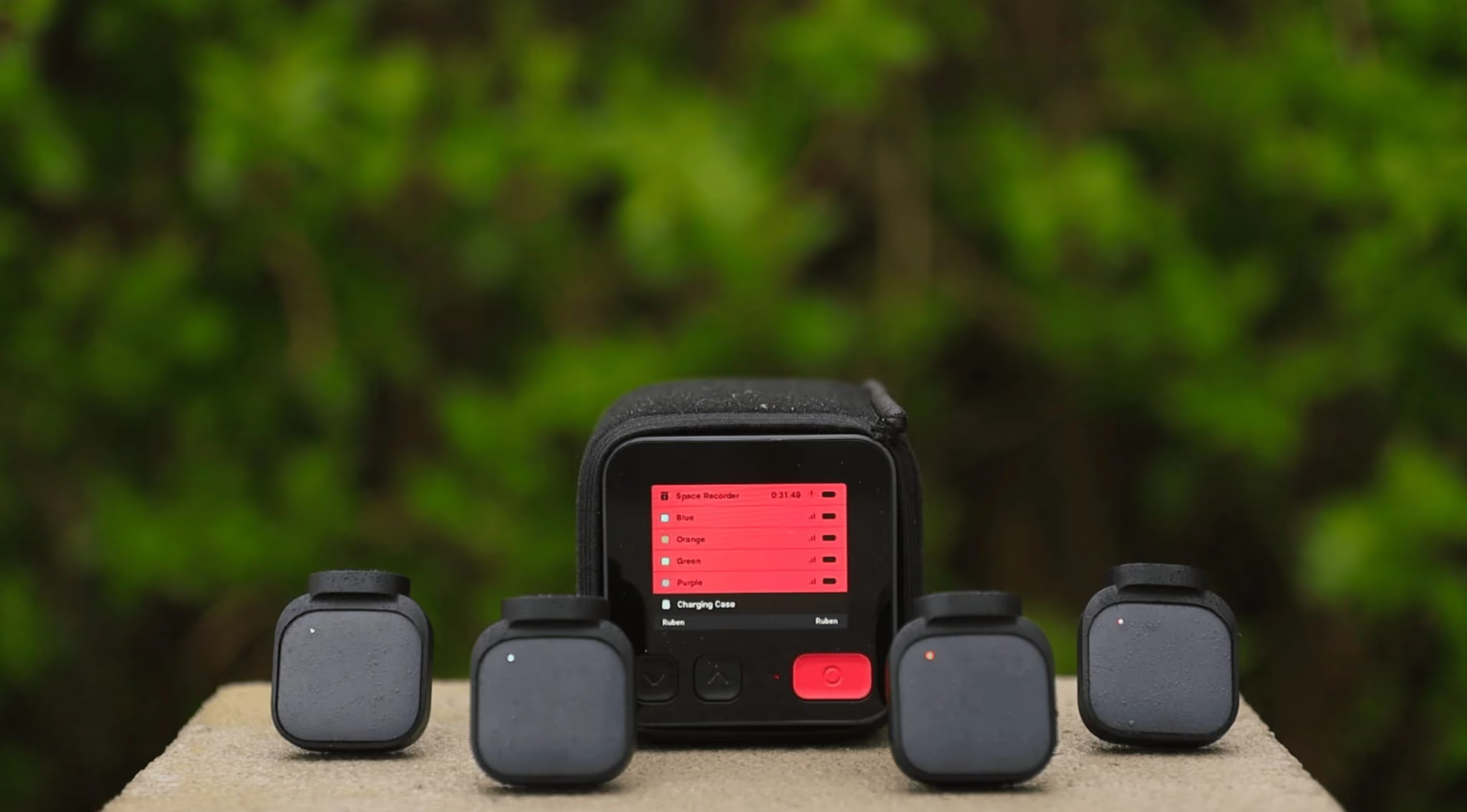
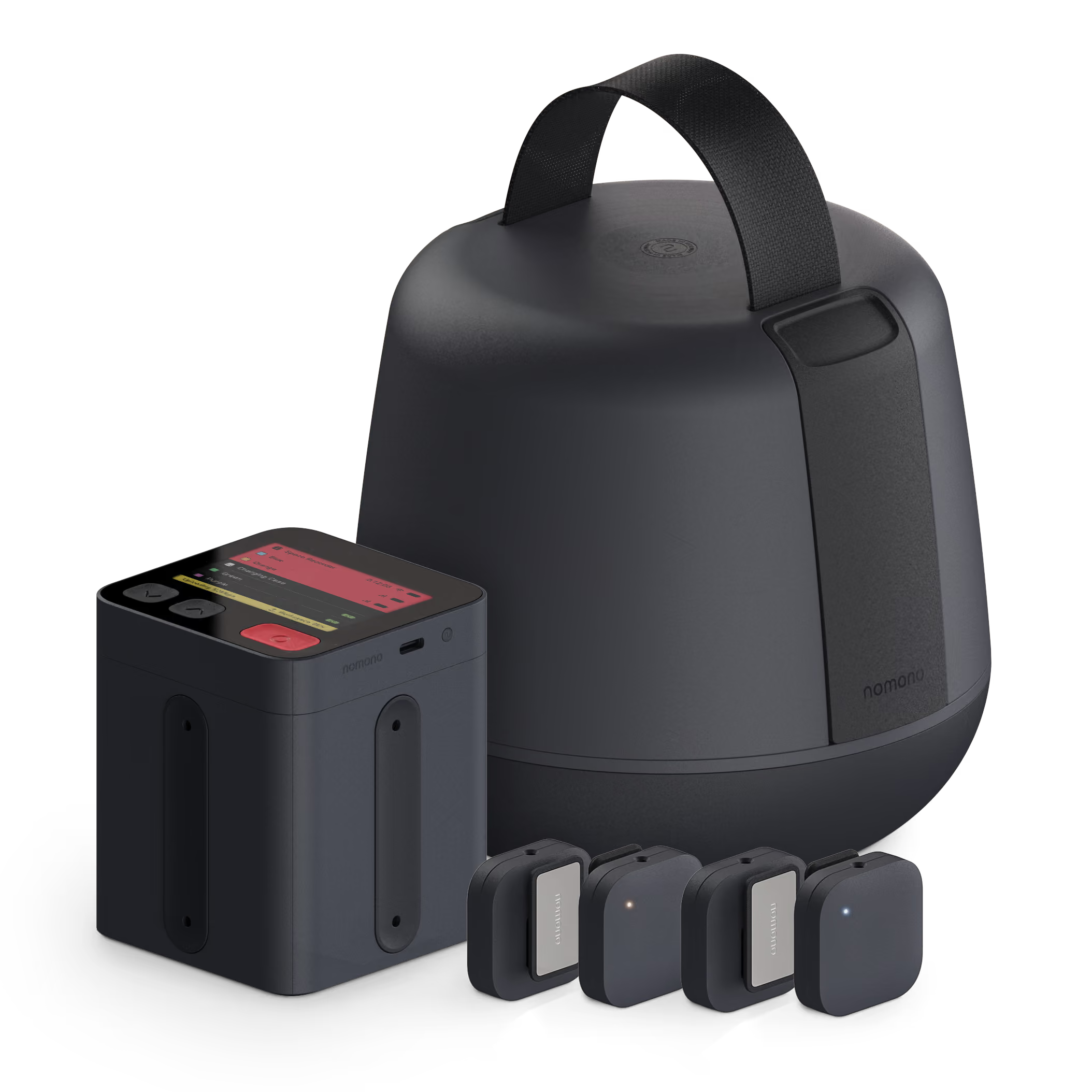
Four people away from a studio desk is the hardest case to solve without a console, and the Nomono Sound Capsule is built for it. One case holds the Space Recorder, which has an 8-mic ambisonic array, plus four Stellar wireless mics and the charging case. The whole kit weighs 2.9 lb (1.3 kg). It records for up to 10 hours, with another 15 hours from the case, and stores up to 12 hours internally (64 GB).
Each mic is levelled automatically, so nobody watches meters during the conversation. The recorder runs without a phone or laptop, writes each voice as its own 16-bit/48 kHz track alongside a 24-bit/48 kHz spatial track, and uploads to Studio Cloud automatically, with USB export as a fallback. In Studio Cloud you get AI noise removal and audio enhancement, transcription and cloud editing.
The Sound Capsule is $1,188, and the price includes the first year of Studio Cloud Premium: 600 minutes of AI enhancement a month, 600 GB of storage, two editors, unlimited reviewers and unlimited transcriptions. Plan details are on the Studio Cloud pricing page.
It does not record 32-bit float. Voice tracks are 16-bit/48 kHz, so a guest who suddenly shouts has less headroom than on the RØDE, DJI, Zoom H6essential or Tascam options here. Nomono's answer is auto-levelling on every mic, which handles normal swings in volume but is not the same safety net. There are also no XLR inputs, so a collection of dynamic mics you already own cannot plug in. For a full four-person comparison including wired options, see our guide to the best 4-person podcast setups.
One host recording in the same room every week needs one good microphone and nothing else. The Shure MV7+ costs $299, or $319 with the stand. It connects over USB-C straight to a computer, or over XLR if you later add an interface. A real-time denoiser cleans up room noise, and Shure's MOTIV Mix software handles settings.
The Nomono Stellar Kit is the alternative when the host moves around or records guests in other rooms. It has two wireless Stellar mics with 15 hours of battery, works with the Studio app on your phone, and uploads to Studio Cloud. It is $348 and includes the first year of Studio Cloud Professional, with 360 minutes of AI enhancement a month and unlimited transcriptions. Pick the MV7+ if the show never leaves the desk. Pick the Stellar Kit if it does, and you want editing and transcripts in the same place.
Two-person shows have the most choice, and both leading wireless kits record 32-bit float on the transmitters. The RØDE Wireless GO (Gen 3) is $199 list and $169.99 street at B&H and Sweetwater. It has two transmitters and more than 40 hours of onboard recording, but no timecode. For an audio-only duo on a budget, it is hard to beat.
The DJI Mic 2 has been replaced by the DJI Mic 3 ($329 list with charging case, $259 at B&H). The Mic 3 records 32-bit float on each transmitter, supports timecode and has a 3.5 mm output to feed a camera. Choose it when the podcast is filmed and you want the audio landing in the camera as well. Our podcast kit for 2 people guide goes deeper on two-person options.
Four XLR mics around a table still need four XLR inputs, but none of these boxes is a mixing board. The Zoom H6essential ($329.99) has four XLR/TRS inputs and records 32-bit float, so there is no gain to set before you roll. The Tascam Portacapture X8 ($499 at launch, $399 at Sweetwater) also records 32-bit float with four XLR/TRS inputs and adds a touchscreen, which some non-technical teams find easier to drive.
The Zoom PodTrak P4 has been replaced by the PodTrak P4next ($179.99 list, $149.99 on sale at Sweetwater). It has four XLR inputs, four headphone outputs, 70 dB of gain, mix-minus for phone or computer guests and four sound pads. It runs on two AA batteries or USB power and records 24-bit/48 kHz to microSD. There is no 32-bit float, so levels need setting before you start.

| Your situation | Buy this | Why |
|---|---|---|
| Four guests in hotels, offices or borrowed rooms | Nomono Sound Capsule | Four wireless mics, auto-levelling, no laptop |
| Solo host, same desk every week | Shure MV7+ | One USB-C mic, no interface |
| Solo or duo who want editing and transcripts | Nomono Stellar Kit | Two mics plus a year of Studio Cloud |
| Two people, filmed on camera | DJI Mic 3 | 32-bit float, timecode, camera output |
| Two people, audio only, tight budget | RØDE Wireless GO (Gen 3) | 32-bit float at $169.99 street |
| Four wired mics you already own | Zoom H6essential | 32-bit float, no gain staging |
| Four wired mics, non-technical team | Tascam Portacapture X8 | 32-bit float with a touchscreen |
| Four wired mics plus phone guests | Zoom PodTrak P4next | Mix-minus and four headphone outs |
Live production is the real cost. Physical faders, sound pads, live processing and Bluetooth caller lines exist for shows that go out live or that fire jingles during the take. A mixer-free workflow moves that work after the session, into cloud editing or a desktop editor. Call-in and live shows should keep the console. Interview shows, narrative shows and anything recorded on location generally do not need one.
Remote guests are the other gap. None of the wireless kits here connects a caller. The PodTrak P4next and the RØDECaster Pro II both offer mix-minus for that job. For the room and technique side of a mixer-free recording, our four fixes for a better-sounding podcast apply to every setup on this list.
Record four people without a mixer
Sound Capsule records four wireless mics on one recorder, levels each one automatically and uploads to Studio Cloud.
No. For most interview and narrative shows a mixer is optional. Mics with automatic levelling, recorders that capture separate tracks and post-production software cover level setting, routing and processing between them. A mixer earns its place on live shows, call-in formats and productions that fire sound effects during the take.
For four people recorded on location, the Nomono Sound Capsule records four wireless mics on one recorder with auto-levelling on each, at $1,188. If your four mics are wired XLR, the Zoom H6essential and Tascam Portacapture X8 add 32-bit float, and the PodTrak P4next is the cheapest option.
Yes, for a solo host in one room. The Shure MV7+ connects over USB-C, has a real-time denoiser and needs no interface. Once a second person joins, a single USB mic stops being enough, and a two-person wireless kit or a multi-input recorder makes more sense.
A two-person wireless kit like the RØDE Wireless GO (Gen 3) is $169.99 street, a four-input recorder like the PodTrak P4next is $149.99 on sale, and a solo USB mic like the Shure MV7+ is $299. Wired recorders also need mics, cables and stands. Nomono's kits are $348 or $1,188, with the first year of Studio Cloud included. After the first year you can stay on the Free plan or continue Studio Cloud from $29/month (Professional) or $99/month (Premium); the hardware keeps working either way.
Not in itself. Audio quality depends mostly on the mic, the room and mic placement, which a mixer never fixed. What you lose is live processing and live control, not recording quality.
Yes. The Nomono Sound Capsule records four Stellar wireless mics as separate voice tracks on the Space Recorder, with no cables between guests and no laptop. Most wireless lav kits, including the RØDE and DJI options here, ship with two transmitters.
In this group, only the Sound Capsule. Its 8-mic ambisonic array records a 24-bit/48 kHz spatial track alongside the voice tracks, and it is Dolby Atmos-ready. Our guide to spatial audio for podcasts explains when that is worth it.
Written by Ruben Åeng, Lead Audio Engineer at Nomono
Audio engineer and Product Manager for spatial audio products at Nomono, with 15 years of experience in film and television sound. Before joining in 2021 he worked as a production sound mixer, dialogue editor and sound designer, with credits including the Oscar-nominated short “Night Ride”.
Enjoy free express shipping to the listed locations within 2–5 business days.
 Austria
 Belgium
 Bulgaria
 Croatia
 Cyprus
 Czech Republic
 Denmark
 Estonia
 Finland
 France
 Germany
 Greece
 Hungary
 Ireland
 Italy
 Latvia
 Lithuania
 Luxembourg
 Malta
 Netherlands
 Norway
 Poland
 Portugal
 Romania
 Slovakia
 Slovenia
 Spain
 Sweden
 United Kingdom
 United States