Comparisons
November 10, 2026



The Zoom F3 is a two-input, 32-bit float field recorder at $299.99 list for engineers who bring their own microphones. The Nomono Sound Capsule is a wireless recording system for two, three or four people, with a spatial track and 12 months of Nomono Studio Premium included, for $1,188. Choose the F3 for mic choice and timecode. Choose the Sound Capsule for two-, three- and four-person sessions you want to set up in seconds and turn around fast.
The F3 is a small, clean front end for microphones you choose. The Sound Capsule is an all-in-one system that covers capture and post in one purchase. F3 specs come from Zoom's F3 page, checked Oct 2026. Nomono specs come from the Sound Capsule page.

| Spec | Nomono Sound Capsule | Zoom F3 |
|---|---|---|
| Price | $1,188 | $299.99 list |
| Mics included | 4 Stellar wireless mics | None |
| Inputs | 4 wireless mics, no XLR | 2 locking XLR |
| Format | 16-bit/48 kHz voice, 24-bit/48 kHz spatial | 32-bit float WAV, up to 192 kHz |
| Level control | Auto-levelling on every mic | 32-bit float, dual A/D converters |
| Storage | Up to 12 h on board (64 GB) | microSD up to 1 TB |
| Battery | 10 h, 25 h with case | About 8 h on alkaline AA (48 kHz, 32-bit float) |
| Spatial audio | 8-mic ambisonic, Dolby Atmos-ready | None |
| Timecode | One-click audio-video sync in Nomono Studio | Optional TCA-1 adapter |
| Software | 12 months of Nomono Studio Premium included | Recorder only |
| Weight | 2.9 lb full kit | 242 g with batteries, mics extra |
Microphone choice is the F3's biggest advantage. Two XLR inputs take whatever you plug in: a shotgun on a boom, a broadcast dynamic, a pair of condensers. The Sound Capsule has no XLR inputs, so the four Stellar Mics are the only mics it records. If you have spent years building a mic collection, the F3 lets you keep using it.
Zoom also leads on removable storage and timecode. The F3 records to microSD cards up to 1 TB. The Sound Capsule stores up to 12 hours (64 GB) on board and uploads to Nomono Studio over Wi-Fi between sessions. And the optional TCA-1 adapter adds timecode accurate to within 0.5 frames over 24 hours, which matters on multi-camera shoots cut to the frame.
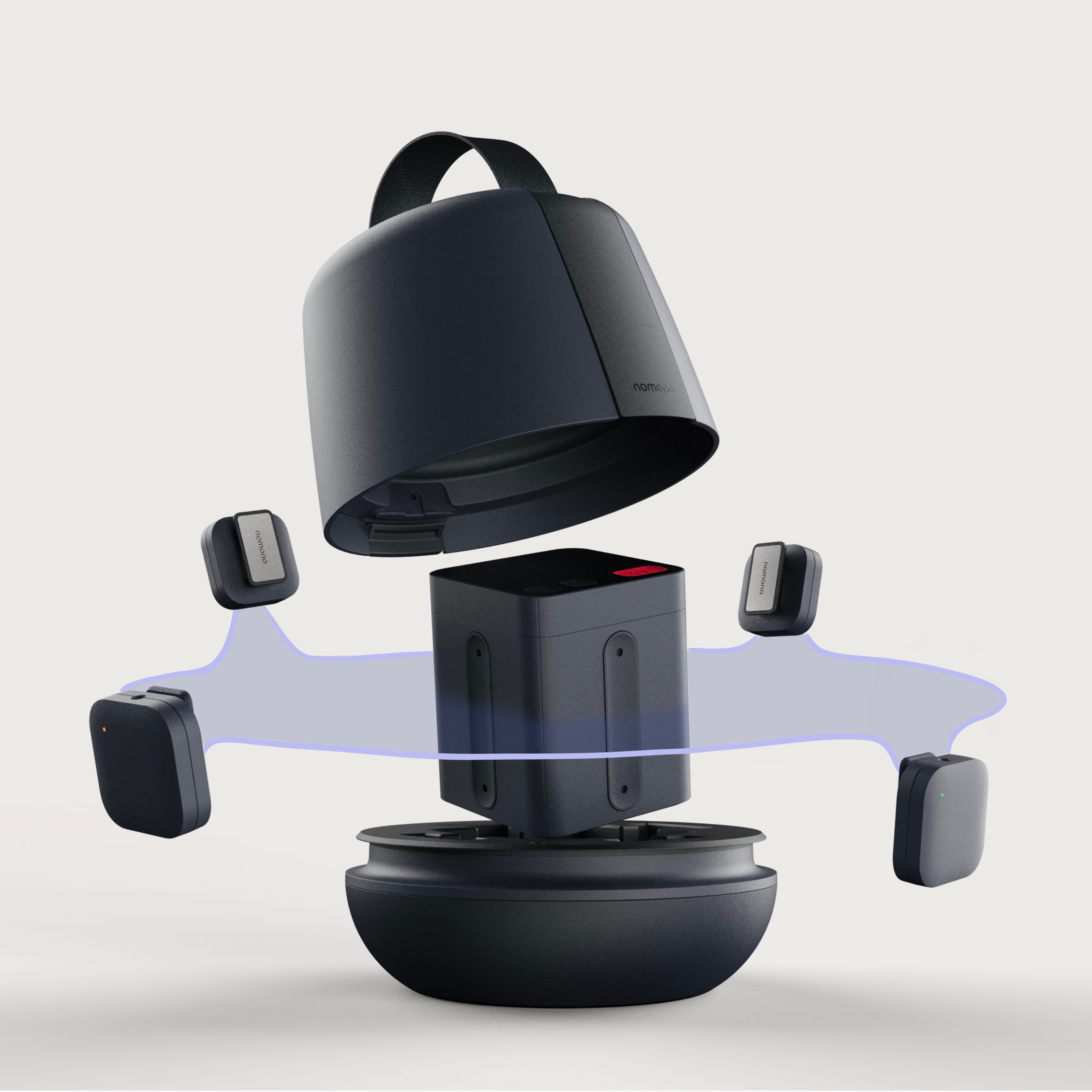
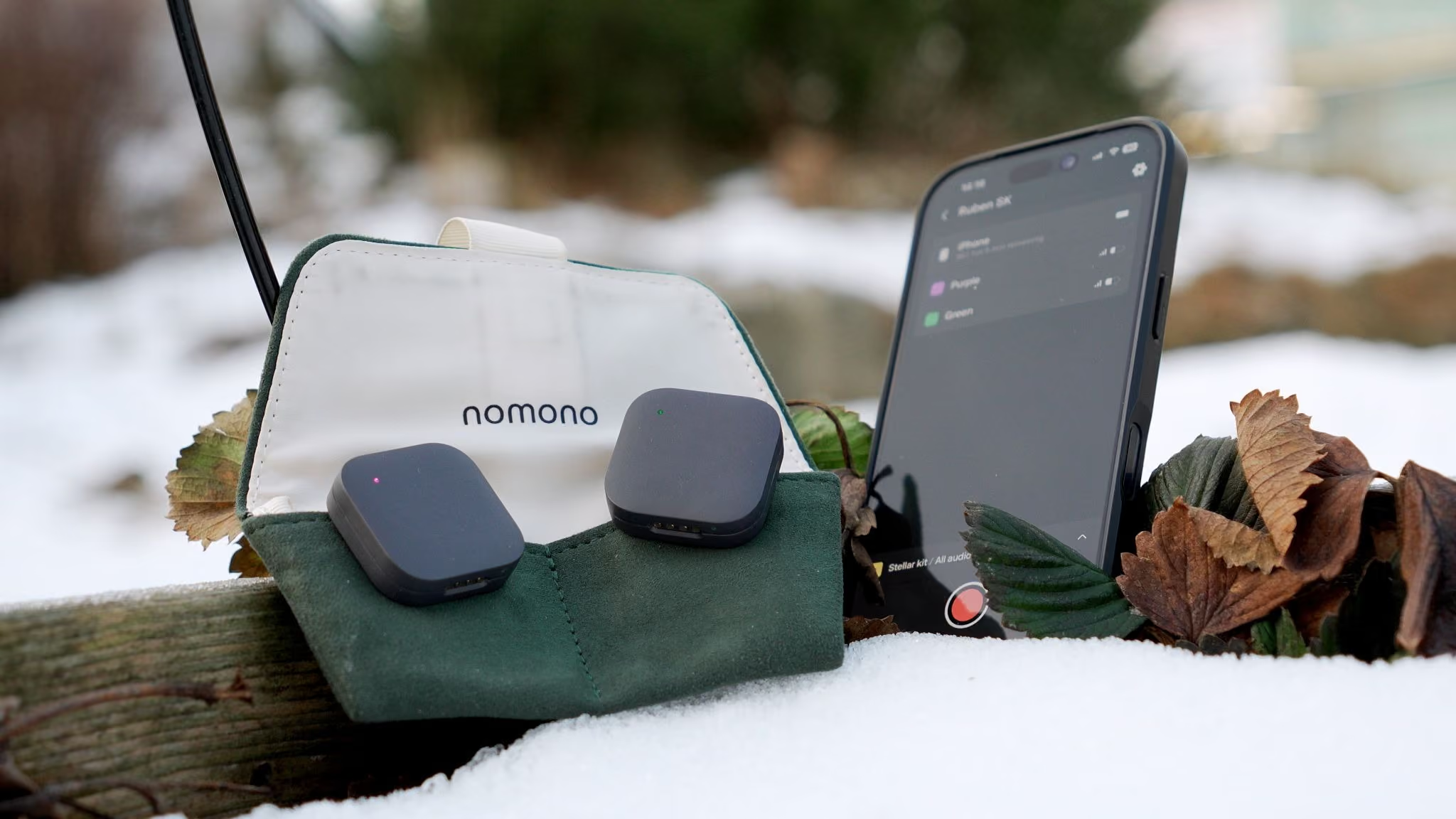
The F3 has two inputs. A four-person conversation needs two F3 units, four microphones, four cables and four stands, and someone to line up the two recorders' files afterward. The Sound Capsule handles that session from one 2.9 lb case with a Space Recorder and four Stellar wireless mics, auto-levelling on every mic and no cables in the room. Each Stellar Mic also keeps a 40-minute lossless audio buffer. It records without a phone or laptop and uploads to Nomono Studio over Wi-Fi automatically.
Setup time follows from that. The Sound Capsule is ready to record in under 10 seconds, and clipping a mic to four people and pressing record is a different job from placing stands, running cables and setting levels on two devices. Teams recording in offices and hotel rooms rarely get as much time in the room as they want. Our guide to recording a podcast outside the studio covers placement for wireless mics.
The Space Recorder's 8-mic ambisonic array also records the room as a spatial track alongside the voices, which makes the Sound Capsule Dolby Atmos-ready. The F3 has no spatial capture. See spatial audio for podcasts for when that is worth it.
Both recorders protect you against clipping, in different ways. The F3 uses 32-bit float with dual A/D converters, so a shouted laugh won't clip and a quiet answer can be raised in post. The Sound Capsule uses auto-levelling on every Stellar Mic, so every voice lands at a usable level from the first word. Voice tracks are 16-bit/48 kHz, which gives 96 dB of dynamic range – more than a voice uses from a whisper to a shout. Read why Nomono records voice at 16-bit. The spatial track is 24-bit/48 kHz.
With auto-levelling on every mic, nobody watches meters or rides gain, and AI noise removal and audio enhancement in Nomono Studio then polishes every track. 32-bit float is built for levels nobody can plan for; auto-levelling keeps conversation consistent without an operator. For other 32-bit float recorders with four inputs, see Sound Capsule vs Zoom H6essential and Sound Capsule vs Tascam Portacapture X8.
A four-person F3 setup costs more than one recorder. One F3 at $299.99 list covers two people with mics you already own. Four people need a second unit, which puts the recorders alone at $599.98 before any microphones, cables, stands or cards.
| Line item | Nomono Sound Capsule | Zoom F3, four people |
|---|---|---|
| Recorders | 1 Space Recorder, included | 2 units, $599.98 list |
| Microphones | 4 Stellar Mics, included | 4 needed, bought separately |
| Cables and stands | None | 4 XLR cables, 4 stands |
| Storage | Up to 12 h on board | 2 microSD cards |
| Editing and transcription | 12 months of Nomono Studio Premium included | Bought separately |
| Price | $1,188 | $599.98 plus mics, accessories, software |
The price includes 12 months of Nomono Studio Premium, a plan that costs $948 billed yearly on its own, with 10 hours (600 minutes) per month of AI enhancement, 600 GB of storage, two editors, unlimited reviewers, unlimited transcriptions, spatial export and ambisonics download. Plan details are on the Nomono Studio plans page. After the first 12 months, Premium continues at $99/month, or $79/month billed yearly. You can also switch to Nomono Studio Professional at $39/month, or $29/month billed yearly, or move to the Free plan. A paid plan keeps the lifetime hardware warranty active, and the hardware keeps working on every plan.
F3 files come off a microSD card and go wherever you take them, usually a DAW, a transcription service and a manual sync step. Engineers who already run that pipeline lose nothing. Teams without one are buying a recorder and inheriting a project.
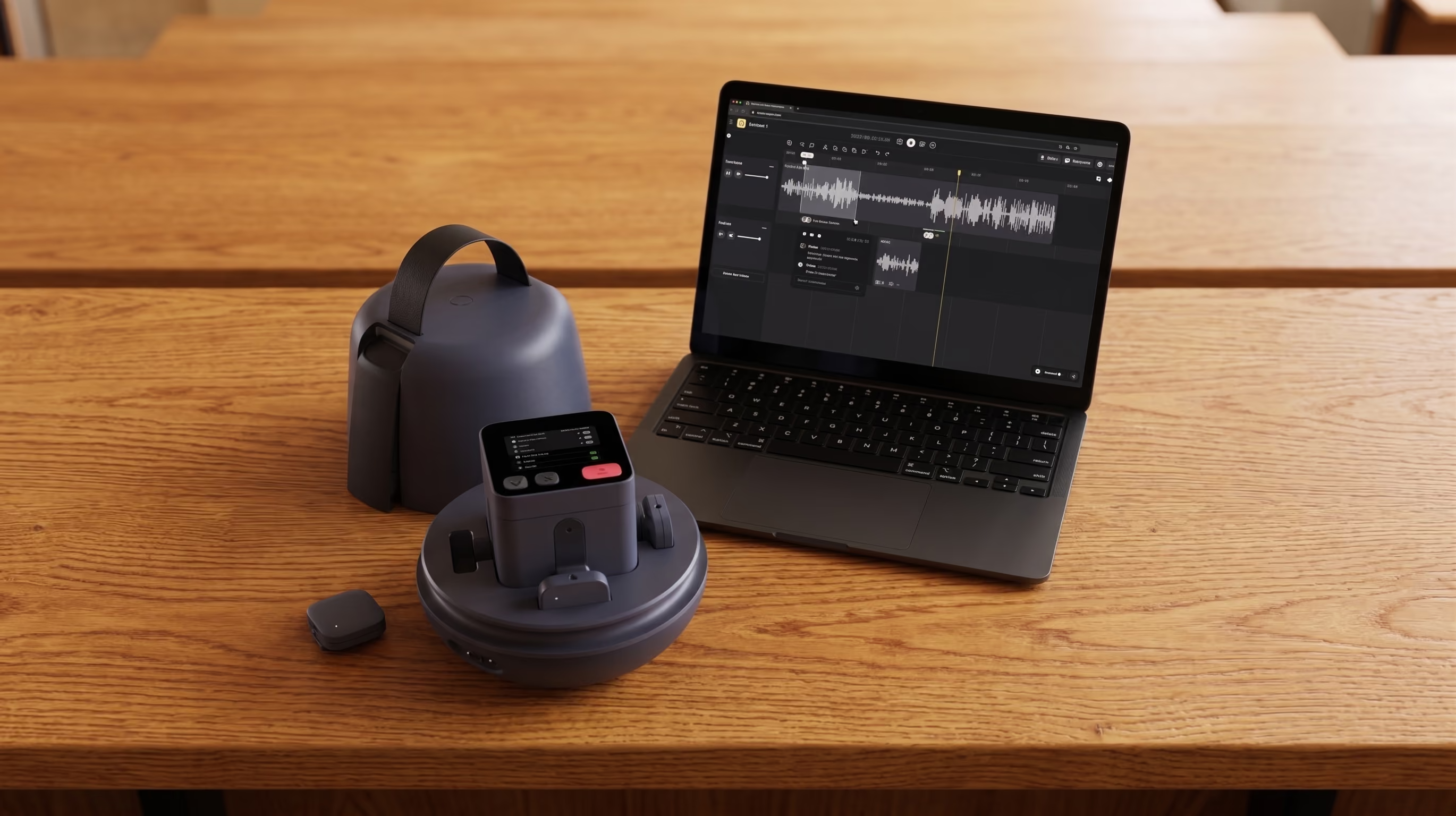
Sound Capsule sessions upload over Wi-Fi to Nomono Studio for AI noise removal and audio enhancement, cloud editing, transcription and collaboration. One-click audio-video sync is included on every plan and uses audio fingerprinting to lock your recording to camera footage, frame-accurate, with no timecode generator. Productions already built around timecode can add the F3's optional TCA-1 adapter. You can also export over USB and edit in your own DAW.

| Your situation | Buy | Why |
|---|---|---|
| You own mics you want to keep using | Zoom F3 | Two XLR inputs take any mic |
| Unpredictable, loud sources | Zoom F3 | 32-bit float headroom |
| Two to four guests on location | Sound Capsule | Up to four wireless mics, one case |
| Existing timecode workflow | Zoom F3 + TCA-1 | Timecode within 0.5 frames per 24 h |
| No one on the team runs a DAW | Sound Capsule | 12 months of Nomono Studio Premium included |
| Dolby Atmos delivery | Sound Capsule | Ambisonic array built in |
| One or two voices, Nomono workflow | Stellar Kit | Two mics, 12 months of Nomono Studio Professional |
| Very long days, no offload | Zoom F3 | Up to 1 TB removable storage |
If you record one or two people, the Stellar Kit is $348 with 12 months of Nomono Studio Professional included, a plan that costs $348 billed yearly on its own. That is about $48 more than one F3 at list, and it includes two wireless Stellar Mics with 15 hours of recording on a charge and a 40-minute lossless buffer, plus editing, transcription and AI enhancement.
Recording two to four people on location?
Sound Capsule records up to four wireless mics and a spatial track from one case, with 12 months of Nomono Studio Premium included.
For two people, yes. Two XLR inputs cover a host and a guest with mics of your choice, and 32-bit float removes most level worries. For four people you need a second F3 plus four mics, stands and cables.
The Sound Capsule protects against clipping with auto-levelling on every Stellar Mic rather than 32-bit float. Voice tracks are 16-bit/48 kHz, which gives 96 dB of dynamic range, more than a voice uses from a whisper to a shout, and the spatial track is 24-bit/48 kHz. AI noise removal and audio enhancement in Nomono Studio then polish every track. See 16-bit audio explained.
Two, one per XLR input. A four-person panel needs two F3 units and four mics. The Sound Capsule records up to four people on separate tracks from one recorder.
$299.99 list, for the recorder alone. Microphones, cables, stands, batteries, a microSD card and the optional TCA-1 timecode adapter are extra.
No. It has two inputs and no ambisonic capture. The Sound Capsule's 8-mic ambisonic array records a spatial track that is Dolby Atmos-ready.
Both work well. Nomono Studio's one-click audio-video sync locks Sound Capsule audio to your camera footage, frame-accurate, with no timecode hardware, on every plan. If your production already runs on timecode, the F3 with the optional TCA-1 adapter fits that workflow.
No. 12 months of Nomono Studio Premium is included, with cloud editing, unlimited transcriptions and 10 hours per month of AI enhancement, and sessions upload over Wi-Fi automatically. If you prefer a DAW, you can also export your files over USB.
Written by Ruben Åeng, Lead Audio Engineer at Nomono
Audio engineer and Product Manager for spatial audio products at Nomono, with 15 years of experience in film and television sound. Before joining in 2021 he worked as a production sound mixer, dialogue editor and sound designer, with credits including the Oscar-nominated short “Night Ride”.
Enjoy free express shipping to the listed locations within 2–5 business days.
 Austria
 Belgium
 Bulgaria
 Croatia
 Cyprus
 Czech Republic
 Denmark
 Estonia
 Finland
 France
 Germany
 Greece
 Hungary
 Ireland
 Italy
 Latvia
 Lithuania
 Luxembourg
 Malta
 Netherlands
 Norway
 Poland
 Portugal
 Romania
 Slovakia
 Slovenia
 Spain
 Sweden
 United Kingdom
 United States