Comparisons
November 3, 2026


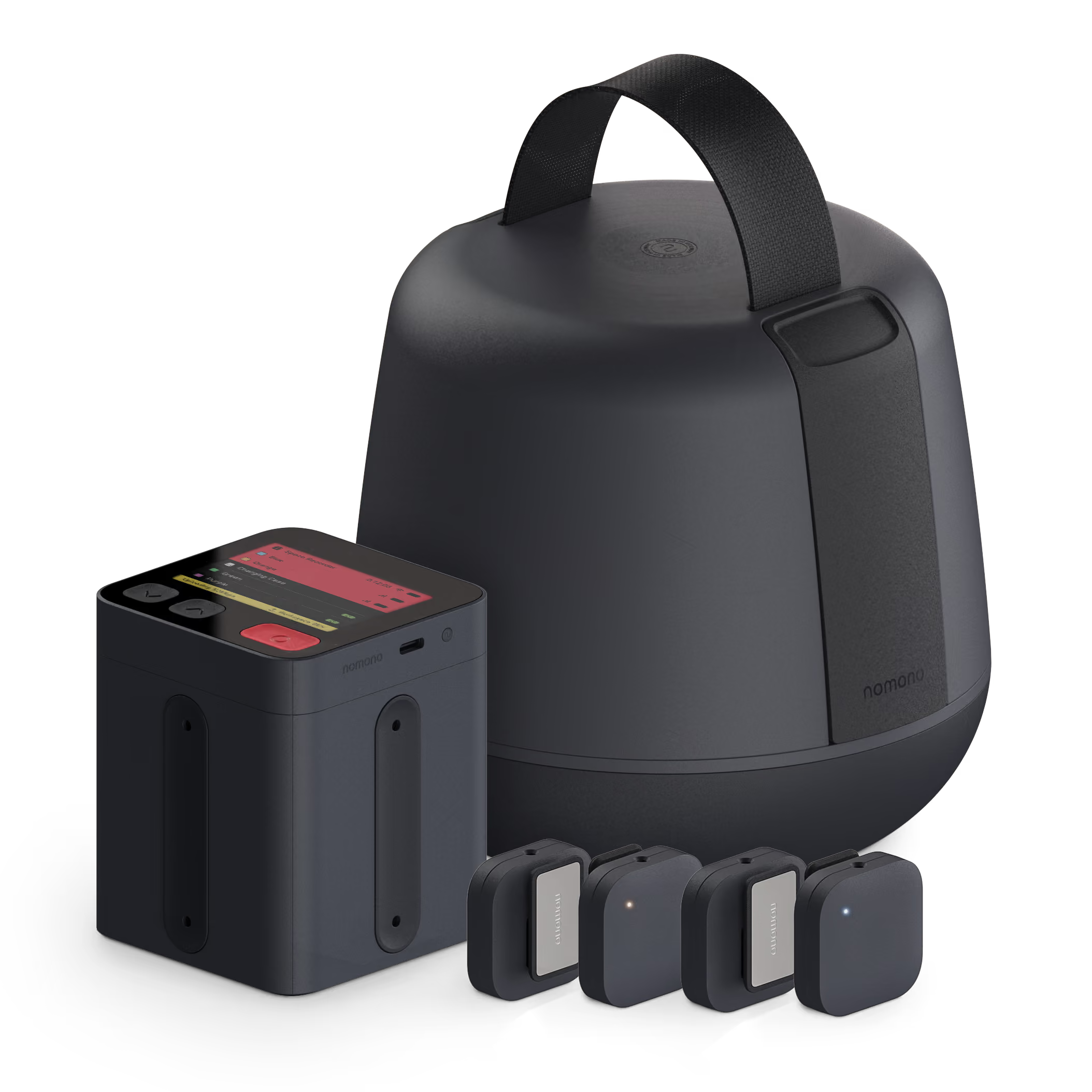
The Nomono Sound Capsule and the Tascam Portacapture X8 solve different halves of field recording. The Sound Capsule gives you four wireless mics, ambisonic room capture and Studio Cloud for $1,188. The Portacapture X8 is a 32-bit float handheld recorder with six input channels, $499 at launch and $399 at Sweetwater, with external microphones not included.
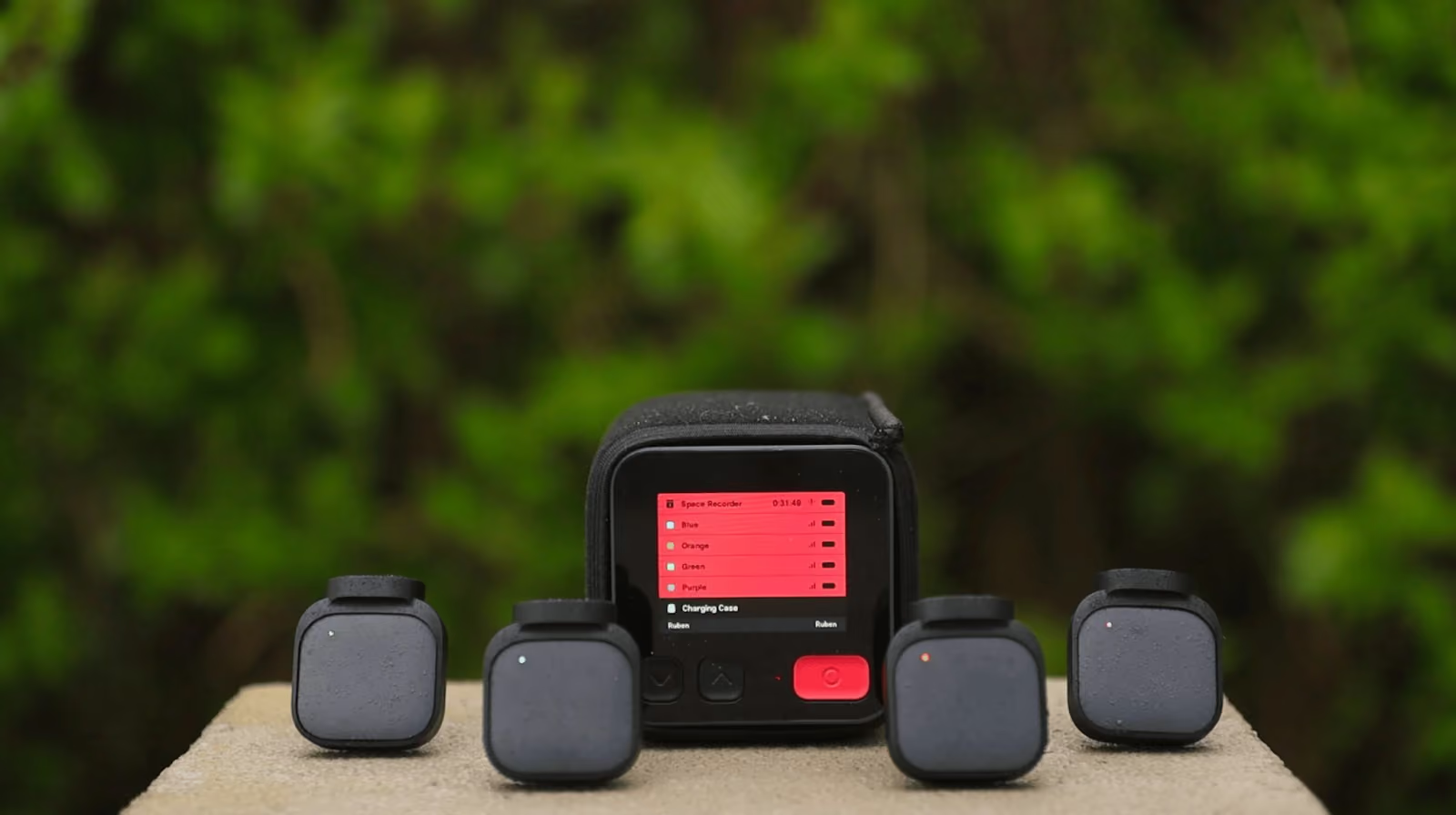
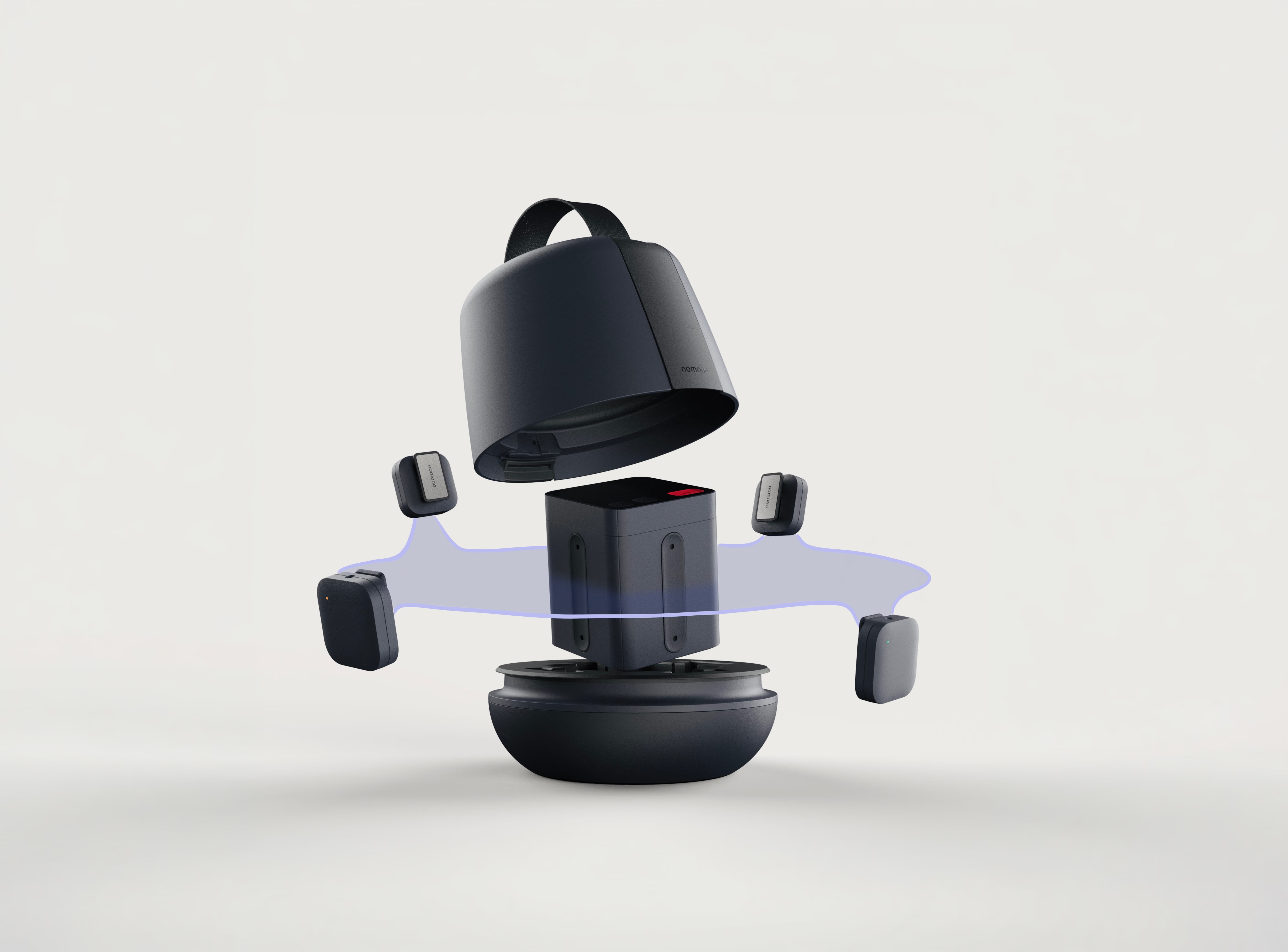
The Sound Capsule is a closed system: a Space Recorder with an 8-mic ambisonic array, four Stellar wireless mics and a charging case. The Portacapture X8 is an open one: a touchscreen recorder with a pair of 14.6 mm condenser mics that can be set to A-B or X-Y, four XLR/TRS combo inputs and two 3.5 mm inputs for the microphones you already own.
| Spec | Nomono Sound Capsule | Tascam Portacapture X8 |
|---|---|---|
| Price | $1,188 | $499 launch, $399 Sweetwater |
| Mics included | 4 Stellar wireless mics + 8-mic array | Built-in stereo condenser pair |
| Inputs | Its own 4 wireless mics | 4 XLR/TRS combo + 2 mini jacks |
| Channels | 4 voice tracks + spatial track | Up to 6 inputs, 8 tracks with mix |
| Format | Voice 16-bit/48 kHz, spatial 24-bit/48 kHz | Up to 32-bit float, 192 kHz |
| 32-bit float | No | Yes |
| Storage | Up to 12 h internal (64 GB) | microSD up to 512 GB |
| Battery | 10 h, 25 h with case | ~11 h alkaline, ~18 h lithium (no phantom) |
| Spatial audio | Ambisonic capture, Atmos-ready | A-B or X-Y stereo |
| Cloud workflow | First year of Studio Cloud included | None |
Tascam specs are from its product page (checked Oct 2026). Battery figures drop to about 5.5 hours on alkaline and 10 on lithium with phantom power on.

Comparing $1,188 with $399 is misleading until you finish the shopping list. The X8 on its own records the room through its built-in mics. Putting four people on separate tracks means four microphones, four cables and stands or booms, plus a microSD card and editing software. Using fact-sheet street prices, four RØDE PodMics at $86 each add $344, which puts the core kit near $743 before cables and stands.
Nomono's number is a single line item. The Sound Capsule is $1,188, and the price includes the first year of Studio Cloud Premium: 600 minutes a month of AI enhancement, 600 GB of storage, unlimited transcription and two editors with unlimited reviewers. After the first year you can stay on the Free plan or continue Studio Cloud from $29/month (Professional) or $99/month (Premium); the hardware keeps working either way. Solo hosts and two-person interviews should look at the Stellar Kit at $348 instead. Full plan details are on Studio Cloud pricing.
| Line item | Nomono Sound Capsule | Tascam Portacapture X8 |
|---|---|---|
| Recorder | Included | $399 at Sweetwater |
| Four microphones | Included, wireless | Bought separately, wired |
| Cables and stands | Not needed | Bought separately |
| Memory card | Not needed | microSD, bought separately |
| Editing and cleanup | First year of Studio Cloud included | Your own software |
Wireless capture removes the step that costs the most time on location. With the Sound Capsule you clip a Stellar mic on each guest and start recording; auto-levelling sets each mic without anyone riding a knob, and the Sound Capsule is ready to record in under 10 seconds. No cable runs, and no stand pulled over when a guest stands up mid-take. Tascam's answer to setup friction is software: seven preset apps (Manual, Voice, Podcast, Music, Field, Pocketstudio and ASMR) guide signal settings on the touchscreen. Presets shorten the thinking, not the cabling. Our guide to multi-guest panel recording covers the room prep that applies to either rig.
Tascam wins this on paper. The X8 records 32-bit float, so an unexpected shout does not clip and can be turned down in editing. The Sound Capsule has no 32-bit float mode; its voice tracks are 16-bit/48 kHz.
Nomono uses a different mechanism for the same problem. Every Stellar mic auto-levels, so four voices at four volumes arrive on four sensibly levelled tracks without an operator, and AI audio enhancement in Studio Cloud handles noise removal and audio enhancement afterward. Judge by what goes wrong: 32-bit float rescues a level set badly, while auto-levelling avoids the setup decision. For unpredictable loud sources such as live music, buy the 32-bit float recorder. For four people talking, the gap narrows.
From TASCAM: how 32-bit float and timecode work on the Portacapture X8.
Ambisonic capture is the one feature with no Tascam equivalent. The Space Recorder's 8-mic array records a spatial track of the room at 24-bit/48 kHz alongside the voice tracks, and Studio Cloud Premium includes spatial export and ambisonics download. A Dolby Atmos or binaural mix needs that soundfield captured on the day. The X8's built-in pair gives a good A-B or X-Y stereo image, which is not the same thing. Our explainer on spatial audio for podcasts covers when it pays off.

The X8 leaves WAV files on a microSD card that you copy, back up, import, sync and clean in whatever software you use. It also works as an 8-in/2-out USB audio interface, and the optional AK-BT1 Bluetooth adapter enables remote control from the Portacapture Control app. Tascam also lists wireless timecode sync with compatible Atomos devices, which matters on a multi-camera shoot. Nomono uploads the session to Studio Cloud for cloud editing, transcription and audio/video sync, so a producer in another city can open it without a file transfer. If you plan to edit by transcript, see our Nomono Studio Cloud vs Descript comparison.
| Your situation | Buy | Why |
|---|---|---|
| Four-person interviews, new venue each week | Sound Capsule | 4 wireless mics, 25 h with case |
| Solo or two voices, tight budget | Portacapture X8 | Built-in stereo pair, $399 |
| Nature, live music, unpredictable peaks | Portacapture X8 | 32-bit float up to 192 kHz |
| Video shoot synced to Atomos timecode | Portacapture X8 | Wireless timecode with Atomos |
| Dolby Atmos or binaural delivery | Sound Capsule | Ambisonic spatial track |
| Distributed team editing together | Sound Capsule | Automatic upload to Studio Cloud |
| You own four good XLR mics | Portacapture X8 | 4 combo inputs |
Weighing another 32-bit float handheld? Our Sound Capsule vs Zoom H6essential comparison covers the $329.99 Zoom, and our roundup of portable podcast recording kits covers the wider field.
Skip the cables on location
The Sound Capsule records four wireless mics and the room, then uploads everything to Studio Cloud.
For a four-person podcast recorded away from a studio, the Sound Capsule fits better: four wireless mics, room capture and Studio Cloud in one kit. For a solo or two-person show on a tight budget, the X8 at $399 at Sweetwater does the job for less.
No. Voice tracks are 16-bit/48 kHz and the spatial track is 24-bit/48 kHz. Nomono relies on auto-levelling on every mic. If you need 32-bit float for unpredictable sources, the Portacapture X8 records it.
It has up to six input channels: four XLR/TRS combo inputs and two 3.5 mm inputs, with the built-in mics as an option. Four guests on separate tracks need four external microphones, cables and stands, none of which ship with the recorder.
It launched at $499 and sells for $399 at Sweetwater. Microphones, a microSD card and the optional AK-BT1 adapter are extra.
Tascam does not list ambisonic capture. Its built-in 14.6 mm condenser pair records stereo in A-B or X-Y. The Sound Capsule's 8-mic array records an ambisonic spatial track and the system is Dolby Atmos-ready.
The Sound Capsule runs up to 10 hours, or 25 with the charging case, and stores up to 12 hours internally. Tascam quotes about 11 hours on alkaline and 18 on lithium without phantom power, and about 5.5 and 10 hours with it.
If you record one or two people, yes. The Stellar Kit has two wireless mics with 15 hours of battery and Studio Cloud Professional for $348. Step up to the Sound Capsule for four guests or spatial capture.
Written by Ruben Åeng, Lead Audio Engineer at Nomono
Audio engineer and Product Manager for spatial audio products at Nomono, with 15 years of experience in film and television sound. Before joining in 2021 he worked as a production sound mixer, dialogue editor and sound designer, with credits including the Oscar-nominated short “Night Ride”.
Enjoy free express shipping to the listed locations within 2–5 business days.
 Austria
 Belgium
 Bulgaria
 Croatia
 Cyprus
 Czech Republic
 Denmark
 Estonia
 Finland
 France
 Germany
 Greece
 Hungary
 Ireland
 Italy
 Latvia
 Lithuania
 Luxembourg
 Malta
 Netherlands
 Norway
 Poland
 Portugal
 Romania
 Slovakia
 Slovenia
 Spain
 Sweden
 United Kingdom
 United States