Comparisons
November 19, 2026


The RØDE Wireless PRO wins for video work that needs timecode and long onboard recording: 32 GB per transmitter, 40+ hours, $299 list. The DJI Mic 2 is cheaper at $199 at B&H, but DJI has replaced it with the DJI Mic 3, which adds timecode and links up to four transmitters to one receiver. For two-person audio, either works, and so does the Nomono Stellar Kit: $348, $49 more than the Wireless PRO's list price, with 12 months of Nomono Studio Professional included, a plan that costs $348 billed yearly on its own.
Specs below come from RØDE's and DJI's product, spec and FAQ pages, checked November 2026. Prices are from our September 2026 retailer check.
| Spec | DJI Mic 2 | DJI Mic 3 | RØDE Wireless PRO |
|---|---|---|---|
| Price | $199 at B&H | $329 list, $259 at B&H | $299 list, $260 at B&H |
| Status | Superseded by Mic 3 | Current | Current |
| Transmitters in kit | 2 | 2 | 2 |
| Max transmitters per receiver | 2 | 4 | 2 |
| 32-bit float onboard | Yes | Yes | Yes |
| Onboard storage per transmitter | 8 GB (about 11 h in 32-bit float) | 32 GB | 32 GB, 40+ hours |
| Transmitter battery | About 6 hours | About 8 hours | Not listed on product page |
| Timecode | Not listed | Yes (LTC) | Yes |
| Level help | Noise canceling | Noise canceling | GainAssist |
| Range (open space) | Up to 250 m (FCC) | Up to 400 m | Up to 260 m |
Battery and range figures are each maker's best-case numbers. Real-world range and runtime drop with interference, bodies between transmitter and receiver, and processing features switched on.
Independent review: Curtis Judd compares the DJI Mic 2 with the RØDE Wireless PRO.
Onboard recording is the backup that saves a take when the wireless link drops, so storage matters. RØDE quotes 32 GB per Wireless PRO transmitter, enough for over 40 hours, which means a week of interviews can sit on the transmitters without offloading. DJI gives the Mic 3 the same 32 GB and quotes roughly 43 hours in 32-bit float single-file mode.
The DJI Mic 2 has 8 GB per transmitter, about 11 hours in 32-bit float according to DJI's FAQ, and its transmitters are rated at about 6 hours with both connected, with the charging case adding roughly two more full cycles. The Mic 3 is rated at about 8 hours per transmitter, with the case adding about 2.4 charges. If you record all day without a break to charge, the newer kits are the safer bet.
Timecode stamps a clock reference into each audio file so an editor can line it up with video from separate cameras automatically. Multi-camera interviews, shoots with a second operator and anything cut from several angles benefit directly. The Wireless PRO and the Mic 3 both offer it; DJI's Mic 2 spec page does not list it.
Audio-only podcasters can skip timecode entirely. So can a single-camera shooter feeding the receiver straight into the camera, because sound and picture already land in one file. If you record audio and video separately without timecode, one-click audio-video sync in Nomono Studio lines them up after the fact, and it is included on every Nomono Studio plan, Free included.

Level safety is close to a tie. All three kits record 32-bit float in the transmitter, so a guest who suddenly laughs or a lav clipped too far down a jacket can be recovered in editing. RØDE adds GainAssist to manage output level during the take. DJI adds noise canceling on the device, which cleans the signal going to your camera or phone.
Processing the live output is convenient, but it is baked into that feed. Keeping a clean internal recording as well gives you something to fall back on if the processing struggles in an echoey room. Good placement still matters more than any feature; our guide to lavalier mic placement covers where to clip each mic.
Out of the box, each kit records two people. For a host plus three guests with the Wireless PRO, you need two kits: two receivers to monitor, four transmitters to charge and four files to line up afterward, though timecode makes that faster. The DJI Mic 3 can pair four transmitters to one receiver, which is a real advantage for panels. You still buy extra transmitters, and you still get four lavalier tracks with no room sound.
The Nomono Sound Capsule is built for two-, three- and four-person shows. One 2.9 lb case holds a Space Recorder with an 8-mic ambisonic array, four wireless Stellar Mics and the charger. It records with no phone or laptop, runs 10 hours on battery and 25 with the case, and auto-levels every mic. Each Stellar Mic keeps a 40-minute lossless buffer, so a wireless dropout does not cost you the take. Recordings upload over Wi-Fi to Nomono Studio for noise removal, enhancement, transcription and editing, with one-click audio-video sync. It costs $1,188 with 12 months of Nomono Studio Premium included, a plan that costs $948 billed yearly on its own, and a paid plan keeps the lifetime hardware warranty active.
Both approaches protect against clipping: RØDE and DJI with 32-bit float, Nomono with auto-levelling on every mic. Nomono records voice at 16-bit/48 kHz, which gives 96 dB of dynamic range, more than a voice uses from whisper to shout (why Nomono records voice in 16-bit). For multi-camera shoots that need timecode, the wireless kits are built for it. For a table of two to four voices, the Sound Capsule covers the mics, the room track and the editing in one purchase. Our head-to-heads of the Sound Capsule vs RØDE Wireless PRO and Sound Capsule vs DJI Mic 2 go through the numbers.
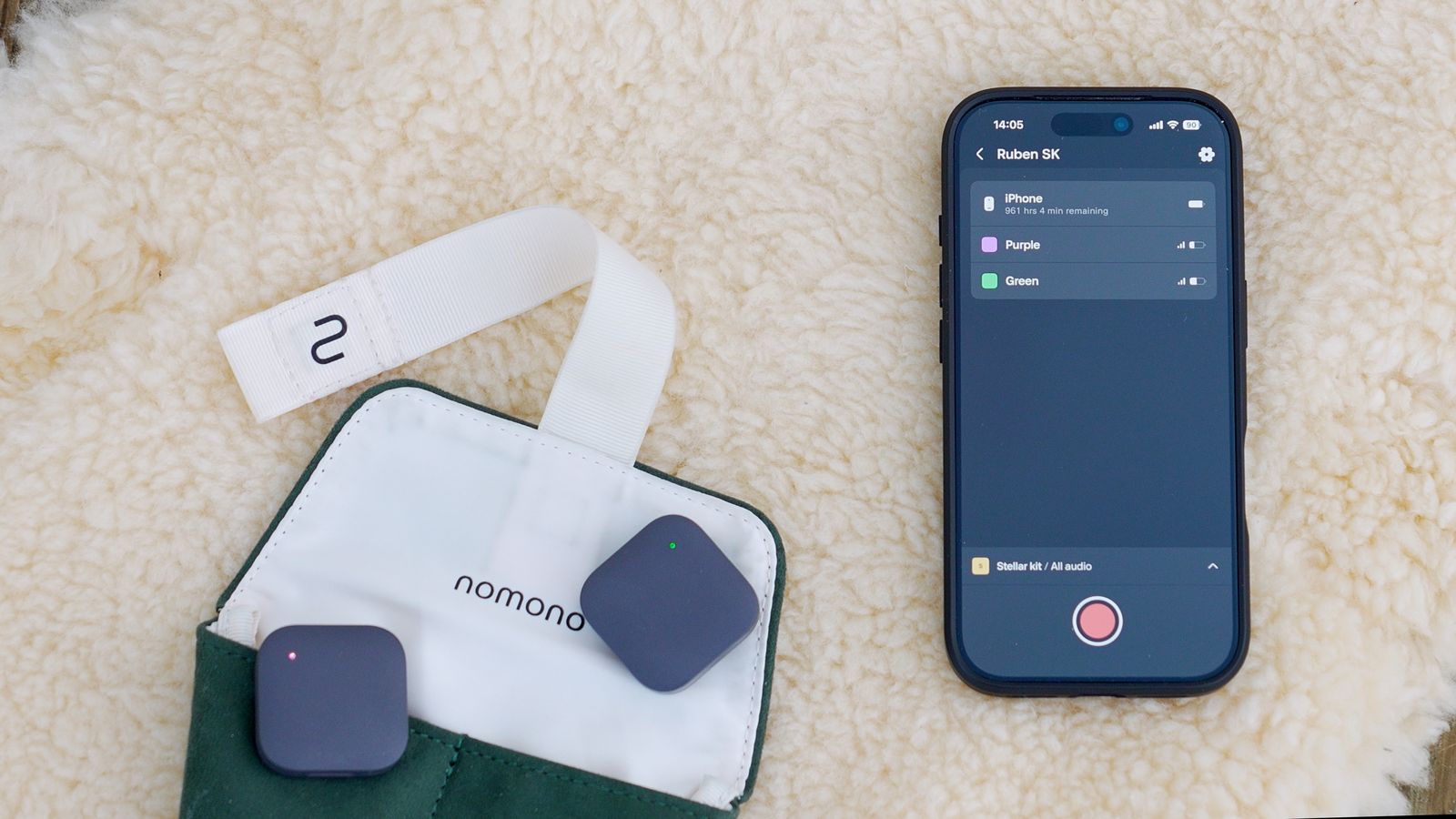
If your show is a host and one guest and you care more about the finished episode than about timecode, the Stellar Kit is worth a look. It includes two Stellar Mics, a charging dock, a travel sleeve and magnets for clip, cold shoe or magnetic mounting, with 15 hours of battery, for $348. 12 months of Nomono Studio Professional are included, a plan that costs $348 billed yearly on its own: 6 hours a month of noise removal and enhancement, unlimited transcriptions, 400 GB of storage and audio-video sync.
The Stellar Kit records with no phone or laptop, auto-levels each mic and keeps a 40-minute lossless buffer in each Stellar Mic, then uploads to Nomono Studio for cleanup and editing. At $348 it sits $49 above the Wireless PRO's $299 list price, with a year of editing and enhancement already included. If your shoot needs timecode for multi-camera sync, RØDE and DJI are built for it.
| What you record | Buy | Why |
|---|---|---|
| Two-person interview, multi-camera video | RØDE Wireless PRO | Timecode and 40+ h onboard per mic |
| Solo vlogging, lowest price | DJI Mic 2 (while sold) | $199 at B&H with 32-bit float |
| Video interviews, may grow to 4 mics | DJI Mic 3 | Timecode, up to 4 transmitters per receiver |
| Two-person audio podcast, editing included | Nomono Stellar Kit | 12 months of Nomono Studio Professional included |
| Four people around a table on location | Nomono Sound Capsule | 4 wireless mics plus spatial track |
| Spatial or Dolby Atmos mixes | Nomono Sound Capsule | 8-mic ambisonic array |
Still choosing the recorder side of your setup? Our comparison of the RØDECaster Pro II vs Zoom PodTrak P4 covers wired four-person options.
Recording two to four people?
The Sound Capsule records up to four wireless mics plus a spatial room track and uploads to Nomono Studio automatically.
For interviews cut against video from several cameras, the RØDE Wireless PRO is better because of timecode and 40+ hours of onboard recording per transmitter. For a single-camera interview on a budget, the DJI Mic 2 at $199 does the job. Both record 32-bit float internally.
DJI has replaced it with the DJI Mic 3, which lists at $329 with the charging case. The Mic 3 adds timecode, 32 GB per transmitter and support for up to four transmitters on one receiver. The Mic 2 was still available at $199 at B&H in our September 2026 check.
Not with one kit. Both are two-transmitter systems, so four people means two kits and two receivers. The DJI Mic 3 can link four transmitters to one receiver, and the Nomono Sound Capsule records four wireless mics plus a room track from one recorder.
Yes. The DJI Mic 2, DJI Mic 3 and RØDE Wireless PRO all record 32-bit float inside the transmitters, so clipped or quiet takes can usually be recovered. The Nomono Sound Capsule protects levels with auto-levelling on every mic, and its 16-bit/48 kHz voice tracks give 96 dB of dynamic range, more than a voice uses from whisper to shout.
DJI does not list timecode for the Mic 2. The Mic 3 and the RØDE Wireless PRO both support it. Without timecode, you can still sync audio and video in editing, for example with one-click audio-video sync in Nomono Studio, included on every plan.
The DJI Mic 2 is cheapest at $199 at B&H. The RØDE Wireless PRO is $260 at B&H and Sweetwater against $299 list, and the DJI Mic 3 is $259 at B&H against $329 list. None needs a subscription.
Neither kit records an ambisonic or spatial track; they record individual lavalier channels. Spatial capture comes from a dedicated array such as the Sound Capsule's 8-mic Space Recorder. Our explainer on spatial audio for podcasts covers what it adds.
Written by Ruben Åeng, Lead Audio Engineer at Nomono
Audio engineer and Product Manager for spatial audio products at Nomono, with 15 years of experience in film and television sound. Before joining in 2021 he worked as a production sound mixer, dialogue editor and sound designer, with credits including the Oscar-nominated short “Night Ride”.
Enjoy free express shipping to the listed locations within 2–5 business days.
 Austria
 Belgium
 Bulgaria
 Croatia
 Cyprus
 Czech Republic
 Denmark
 Estonia
 Finland
 France
 Germany
 Greece
 Hungary
 Ireland
 Italy
 Latvia
 Lithuania
 Luxembourg
 Malta
 Netherlands
 Norway
 Poland
 Portugal
 Romania
 Slovakia
 Slovenia
 Spain
 Sweden
 United Kingdom
 United States