Comparisons
November 18, 2026



The RØDECaster Pro II is a desk console for live-mixed shows: four XLR inputs, faders, 64 SMART pads and APHEX processing for $699 list. The Zoom PodTrak P4 is a battery-powered four-XLR recorder, and Zoom has replaced it with the PodTrak P4next at $179.99 list. Pick the RØDECaster for a fixed studio, the PodTrak for travel and tight budgets.
Prices are for the console or recorder only. Specs come from each maker and the retailer listings noted below the table.
| Spec | RØDECaster Pro II | Zoom PodTrak P4next |
|---|---|---|
| Price | $699 list, $595 at Sweetwater (Sep 2026) | $179.99 list, $149.99 at Sweetwater sale (Sep 2026) |
| Type | Desktop production console | Portable four-track recorder |
| XLR mic inputs | 4 combo inputs | 4 XLR |
| Preamp gain | 76 dB | 70 dB |
| Headphone outputs | 4 | 4, one per guest |
| Sound pads | 64 SMART pads | 4 pads |
| Onboard processing | APHEX voice processing | AI noise reduction |
| Mix-minus | Yes | Yes |
| Phone guests | Bluetooth built in | TRRS smartphone input; Bluetooth with Zoom's optional BTA-2 adapter |
| Recording format | 24-bit/48 kHz | 24-bit/48 kHz |
| 32-bit float | No | No |
| Records to | microSD, USB drive or computer | microSD |
| Power | No battery; USB-C power bank (30 W+) works | 2 AA batteries or USB |
| Computer interface | 2 USB-C interfaces | USB audio interface |
Since the original PodTrak P4 is no longer the current model, if you find one used, expect the same four-XLR, four-headphone layout without the P4next's AI noise reduction.
Neither box includes a microphone, a stand or a cable, so the headline price is never the price of a working four-person show. Here is what a complete four-person setup costs with each, using retailer prices from September 2026.
| Four-person setup | What's in it | Price |
|---|---|---|
| PodTrak P4next + 4 Zoom ZDM-1 packs | Recorder, 4 dynamic mics, 4 headphones, 4 tabletop stands, 4 cables | About $580 at list ($179.99 + 4 × $99.99) |
| RØDECaster Pro II 4-person kit | Console, 4 RØDE PodMic, 4 NTH-100 headphones, 4 PSA1+ arms, 4 XLR cables | $2,229.65 at B&H |
| Nomono Sound Capsule | Space Recorder, 4 wireless Stellar Mics, charging case, 12 months of Nomono Studio Premium included (a plan that costs $948 billed yearly on its own) | $1,188 |
The gap between the two wired rigs is bigger than the console prices suggest, because RØDE's kit uses boom arms and studio headphones while Zoom's ZDM-1 packs use tabletop stands. For a fuller shopping list by group size, see our podcast equipment cost guide and our roundup of the best 4-person podcast setups.
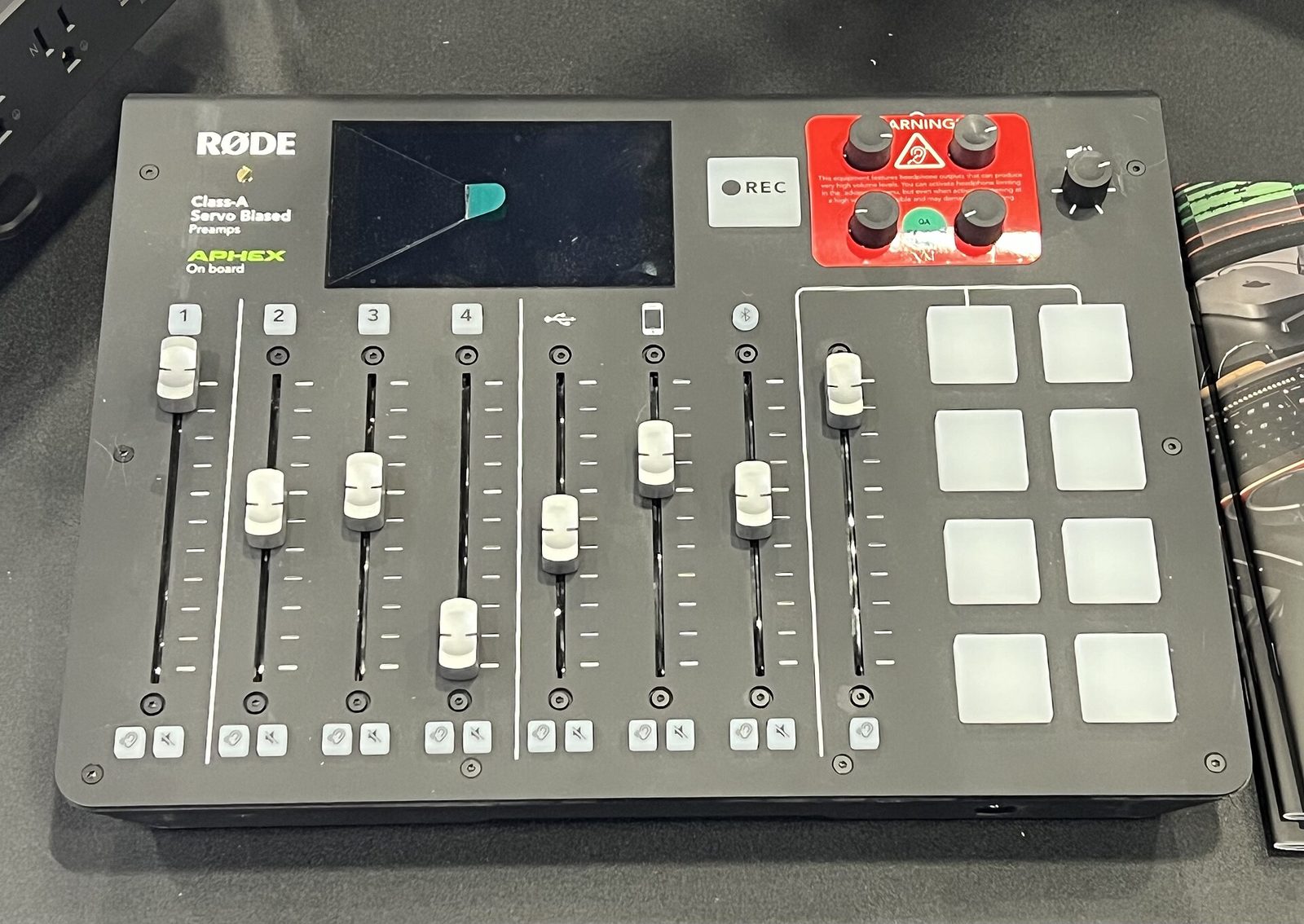
Live production is the RØDECaster Pro II's job. Physical faders, 64 SMART pads for stings and music beds, APHEX processing on every voice and mix-minus mean the show can be mixed and finished while it is being recorded. Built-in Bluetooth puts a remote guest on a phone into the mix without feedback. The PodTrak needs a wired TRRS connection or Zoom's optional BTA-2 Bluetooth adapter for the same job.
Two USB-C interfaces also make it easy to run the console into a computer and a second device at once, for example a streaming laptop and a recording laptop. For a weekly show in the same room with the same hosts, the console removes editing work every episode, and that is what the price buys.
It is not built to travel. There is no internal battery, so on location you need an outlet or a 30 W+ USB-C power bank, plus four mics, four stands and four cables.
Independent review: Tom Buck shares his long-term take on the RØDECaster Pro II.
Portability and price are the PodTrak's whole argument, and the argument holds. Two AA batteries or USB power run it anywhere, four XLR inputs and four headphone jacks cover a full panel, and 70 dB of gain drives most podcast dynamics. At $179.99 list it costs less than many single broadcast microphones, which leaves budget for the mics themselves.
Zoom's battery figures range widely: about 3.5 hours on alkaline AAs and 8.5 hours on lithium AAs with dynamic mics, but as little as 20 minutes on alkalines with phantom-powered condenser mics. Carry spares or a USB power source if you run power-hungry mics. Field technique for this kind of setup is covered in our guide to recording a podcast outside the studio.
For some teams these shared limits matter more than the differences.
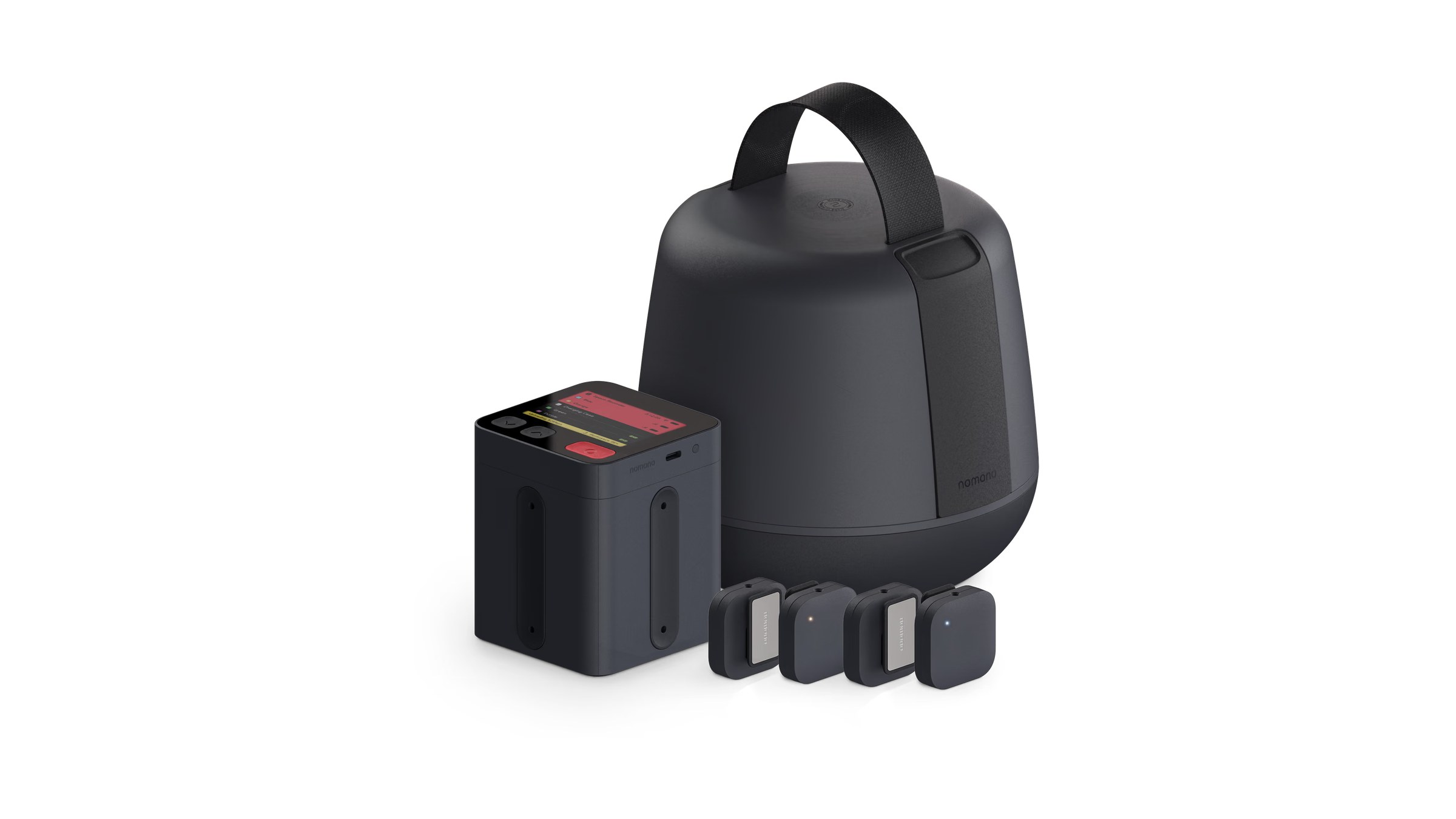
Cables are the main reason teams leave this category. On location, in a client's office or around a conference table, the setup time for four wired mics is the bottleneck, not the recorder. The Nomono Sound Capsule handles two to four people differently: a Space Recorder with an 8-mic ambisonic array, four wireless Stellar Mics and a charging case, 2.9 lb in total. It records up to 10 hours, 25 with the case, with auto-levelling on every mic, and it records without a phone or laptop. Each Stellar Mic also keeps a 40-minute lossless buffer, and the kit is ready to record in under 10 seconds.
Recordings upload automatically over Wi-Fi to Nomono Studio for noise removal and audio enhancement, transcription, editing and one-click audio-video sync. The Sound Capsule is $1,188 and includes 12 months of Nomono Studio Premium, a plan that costs $948 billed yearly on its own, and a paid plan keeps the lifetime hardware warranty active. See Nomono Studio plans for details, and our head-to-heads of the Sound Capsule vs RØDECaster Pro II and Sound Capsule vs Zoom PodTrak P4 for the detail.
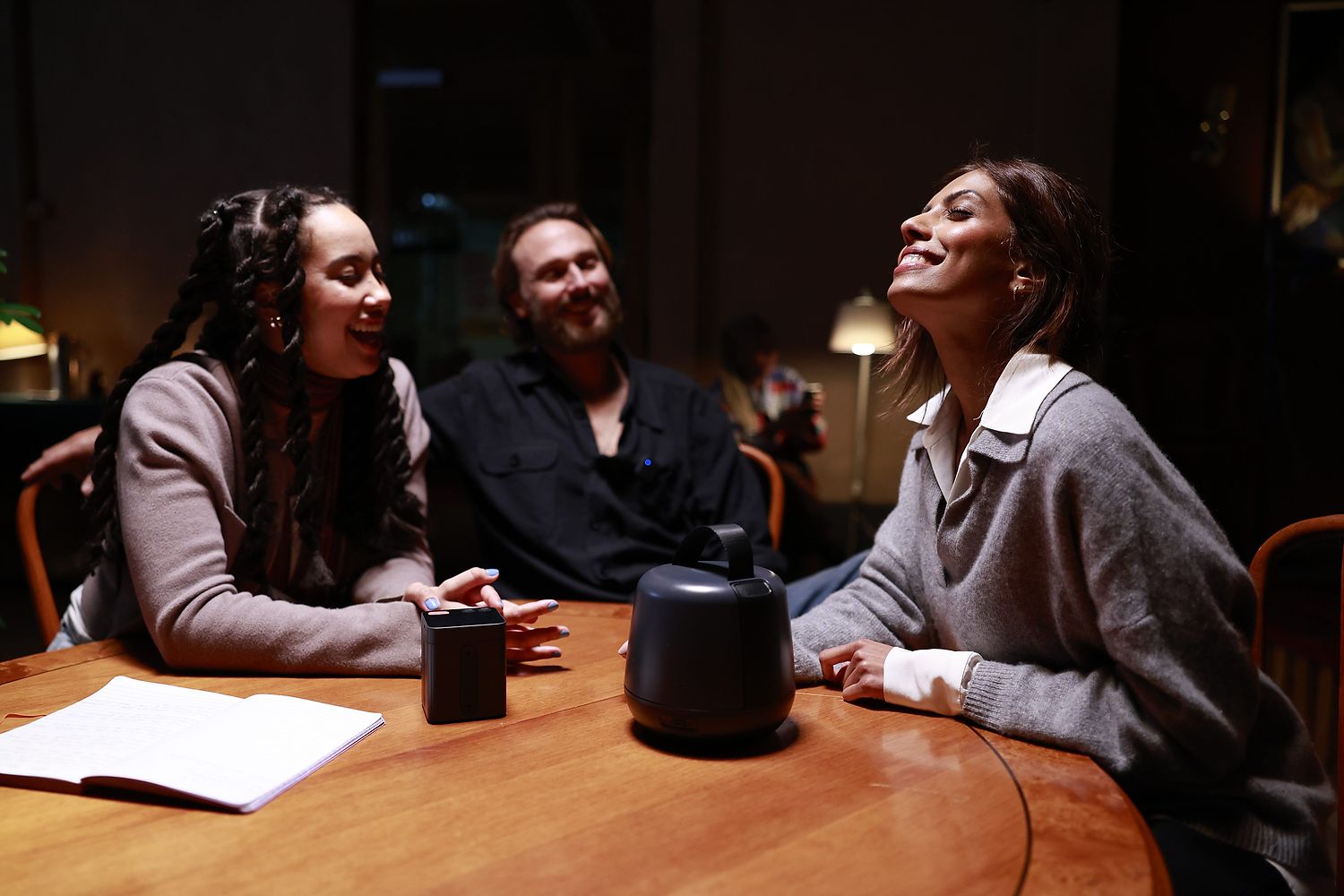
Both PodTrak and RØDECaster rely on someone setting gain before guests arrive. The Sound Capsule handles levels with auto-levelling on every Stellar Mic. Voice is recorded in 16-bit, which gives 96 dB of dynamic range, more than a voice uses from a whisper to a shout (see why Nomono records voice in 16-bit), and the spatial track is 24-bit/48 kHz. The Sound Capsule is built for wireless capture rather than live mixing: it has no XLR inputs, faders, sound pads or Bluetooth call-ins, so a live-mixed talk show with phone-in guests is the RØDECaster Pro II's job. For one or two voices, the two-mic Stellar Kit is $348 with 15 hours of recording per charge and 12 months of Nomono Studio Professional included, a plan that costs $348 billed yearly on its own.
| Scenario | Best fit | Why |
|---|---|---|
| Weekly 4-person show at one desk, mixed live | RØDECaster Pro II | Faders, 64 pads and APHEX processing |
| Frequent phone call-ins | RØDECaster Pro II | Bluetooth with mix-minus |
| First podcast, four hosts, tight budget | PodTrak P4next | About $580 with four ZDM-1 packs |
| Interviews where power is unreliable | PodTrak P4next, Nomono Sound Capsule or Stellar Kit | P4next runs on 2 AA batteries; Sound Capsule records 10 hours, 25 with its case; Stellar Mics run 15 hours per charge |
| Four guests on location, fast setup | Nomono Sound Capsule | Four wireless mics, no cables |
| Spatial or Dolby Atmos mixes | Nomono Sound Capsule | 8-mic ambisonic array, Dolby Atmos-ready |
| Unpredictable levels, wired mics | 32-bit float recorder | Neither console records 32-bit float |
Recording two to four people away from a desk?
The Sound Capsule records up to four wireless mics plus a spatial track, then uploads over Wi-Fi to Nomono Studio for noise removal, enhancement and editing.
Zoom has replaced the PodTrak P4 with the PodTrak P4next, which lists at $179.99. It keeps four XLR inputs, four headphone outputs, mix-minus and AA or USB power, and adds AI noise reduction. If you are buying new, compare the RØDECaster Pro II against the P4next.
Yes, if the show is mixed live at a fixed desk. Faders, 64 SMART pads, APHEX processing and Bluetooth call-ins save editing time every episode. If the recorder travels or you only need four clean tracks, the extra money buys features you will not use.
Yes. It has four XLR inputs and four headphone outputs and records each mic to its own track on a microSD card. Microphones, cables and stands are extra; four Zoom ZDM-1 packs bring a complete setup to about $580 at list prices.
No. Both record 24-bit/48 kHz, so gain must be set correctly before you record. For clip-proof wired recording, look at a 32-bit float recorder such as the Zoom H6essential or Tascam Portacapture X8.
It has no internal battery. It can run from a USB-C power bank rated 30 W or more, which helps on location, but you still carry four wired mics, stands and cables.
No. Both record standalone to microSD, and the RØDECaster can also record to a USB drive. Both work as USB audio interfaces when connected to a computer, and editing happens afterward in separate software.
No. Both record mono mic tracks and a stereo mix. Spatial capture needs a dedicated array, such as the 8-mic ambisonic array in the Sound Capsule's Space Recorder, which is Dolby Atmos-ready.
Usually not, since a solo host pays for three inputs they will not use. A single good microphone covers one voice. For a host plus one guest, the Stellar Kit ($348) is two wireless mics with 12 months of Nomono Studio Professional included and no cables, less than a P4next with two ZDM-1 packs (about $380 at list).
Written by Ruben Åeng, Lead Audio Engineer at Nomono
Audio engineer and Product Manager for spatial audio products at Nomono, with 15 years of experience in film and television sound. Before joining in 2021 he worked as a production sound mixer, dialogue editor and sound designer, with credits including the Oscar-nominated short “Night Ride”.
Enjoy free express shipping to the listed locations within 2–5 business days.
 Austria
 Belgium
 Bulgaria
 Croatia
 Cyprus
 Czech Republic
 Denmark
 Estonia
 Finland
 France
 Germany
 Greece
 Hungary
 Ireland
 Italy
 Latvia
 Lithuania
 Luxembourg
 Malta
 Netherlands
 Norway
 Poland
 Portugal
 Romania
 Slovakia
 Slovenia
 Spain
 Sweden
 United Kingdom
 United States