Comparisons
November 16, 2026


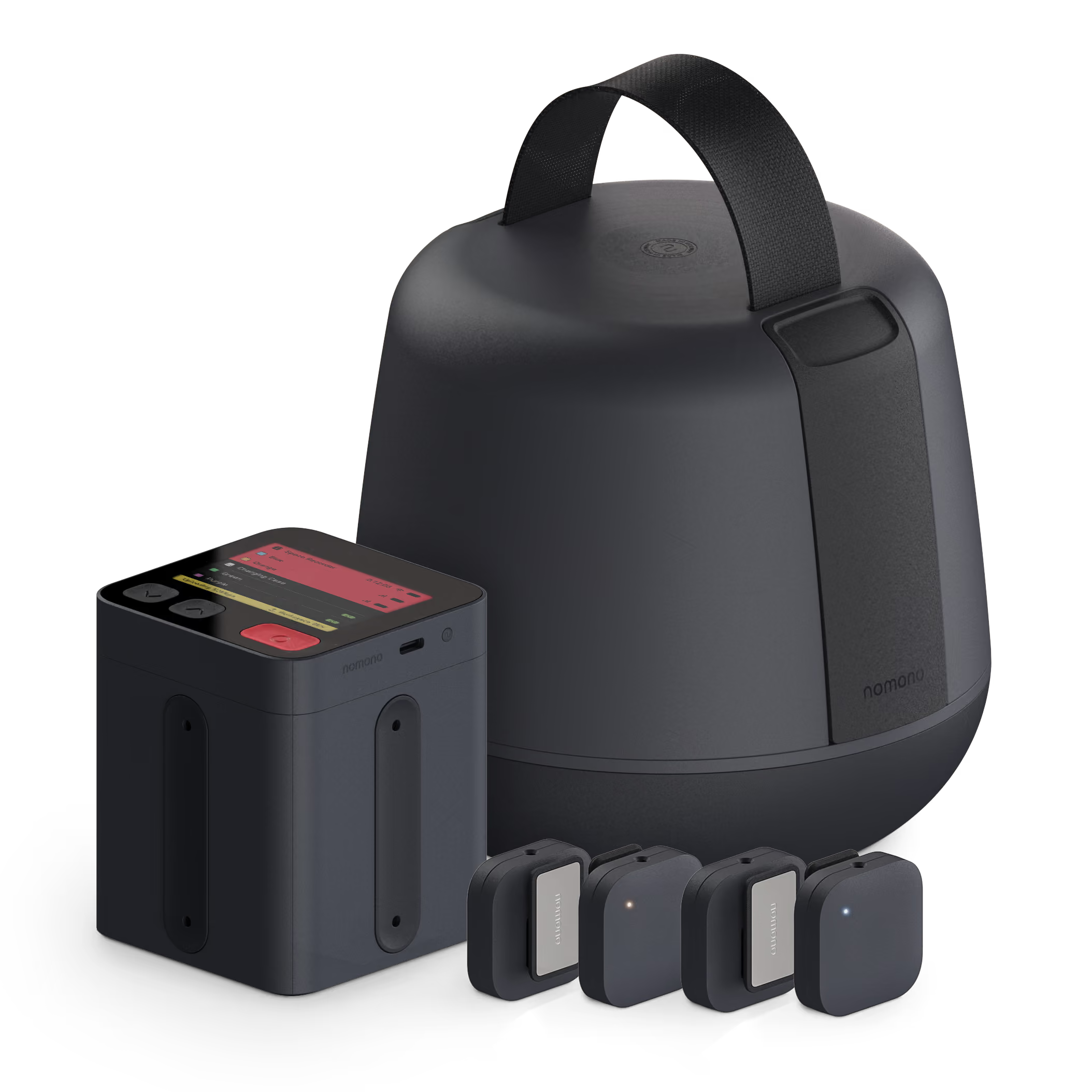
A DIY portable podcast kit for four people costs roughly $690 to $1,200 in year one once you add a recorder, four mics, headphones and an editing subscription, before cables and stands. The Nomono Sound Capsule is $1,188 for one 2.9 lb kit that records two, three or four people with no phone or laptop, uploads to Nomono Studio over Wi-Fi and includes 12 months of Nomono Studio Premium. A budget wired DIY build costs less up front; the Sound Capsule wins on setup, workflow and spatial audio.
Four people talking on location need four isolated voice tracks, something to record them, power, storage, and a way to turn raw files into a finished episode. A DIY kit assembles that from parts: a multitrack recorder or wireless systems that record on board, four microphones, cables or clips, memory cards, headphones, a bag, and a software subscription for cleanup and transcription.
Most build guides stop at the hardware. The recording is not finished until it has been leveled, cleaned, transcribed and cut, which is why our podcasting equipment buyer's guide treats capture and post-production as one purchase. The Sound Capsule is priced the same way: the $1,188 price includes 12 months of Nomono Studio Premium (AI noise removal and audio enhancement, editing, transcription, one-click audio-video sync, 600 GB of storage).
All prices are US street prices from Sweetwater or B&H checked in September 2026, and software is billed annually. Cables, stands, cards and a bag are not priced because they vary too much by build.
| Line item | A: wired budget | B: wireless, on-board | C: wireless + recorder |
|---|---|---|---|
| Recorder | Zoom PodTrak P4next, $149.99 | None (transmitters record) | Zoom H6essential, $329.99 |
| Four mics | 4x RØDE PodMic, $344 | 2x RØDE Wireless GO (Gen 3), $339.98 | 2x RØDE Wireless PRO, $520 |
| Headphones | ATH-M20x, $59 | ATH-M20x, $59 | ATH-M20x, $59 |
| Editing, year one | Descript Creator, $288 | Descript Creator, $288 | Descript Creator, $288 |
| Year-one total | $840.99 + stands, cables | $686.98 | $1,196.98 + adapters |
| 32-bit float | No (24-bit) | Yes, in transmitter | Yes |
| Wireless | No, four XLR runs | Yes | Yes |
| Timecode | No | No | Yes |
| Spatial track | No | No | No |
Prices: PodTrak P4next $179.99 list, $149.99 at Sweetwater on sale; PodMic $99 list, $86 street; Wireless GO (Gen 3) $199 list, $169.99 at B&H and Sweetwater; Wireless PRO $299 list, $260 street; H6essential $329.99; ATH-M20x $59 at Sweetwater; Descript Creator $24 a month billed annually. The original Zoom PodTrak P4 has been replaced by the P4next.
Build B is the cheapest wireless route, but each transmitter records its own file, so you line up four files in post. Build C is the closest like-for-like wireless rig, and at about $1,197 plus adapter cables it costs slightly more than the Sound Capsule ($1,188). For a deeper look at the Nomono price itself, see our Sound Capsule price breakdown.

Software is where DIY turns into a subscription anyway. Descript Creator is $35 a month, or $24 billed annually. Riverside Pro is $29, or $24 billed annually. Alitu is $38 a month, with its annual plan on sale at $20.58 a month in November 2026. Whichever you pick, year two of a DIY kit still carries a software bill of roughly $250 to $290 billed annually.
Nomono's year two is your choice, and the Sound Capsule keeps recording on every plan. Nomono Studio Free costs $0 and keeps editing, 2 hours a month of AI enhancement, 75 GB of storage and audio-video sync. Nomono Studio Professional is $39 a month, or $29 a month billed yearly ($348). Nomono Studio Premium is $99 a month, or $79 a month billed yearly ($948), with 600 minutes a month of AI enhancement, 600 GB, two editors, unlimited reviewers, unlimited transcriptions and spatial export. A paid plan also keeps the lifetime hardware warranty active.
| Cost over time | Build A | Build C | Sound Capsule |
|---|---|---|---|
| Year one | $840.99+ | $1,196.98+ | $1,188 |
| Year two, software | $288 | $288 | $0 Free to $948 Premium billed yearly |
| Two-year total | $1,128.99+ | $1,484.98+ | $1,188 to $2,136 |
Wireless kits ship with two transmitters, so four guests means two complete systems. With RØDE Wireless PRO that is two receivers feeding a recorder with enough inputs. With the RØDE Wireless GO (Gen 3) you can skip the recorder and use the 40+ hours of on-board recording in each transmitter, at the cost of a live mix and of syncing four files afterward.
Memory cards, spare batteries, windshields, clips, spare cables and a bag that holds it all are real money and real weight. The Sound Capsule's charging case is the charger and the carry case, and the Space Recorder has 64 GB of internal storage (up to 12 hours), so there is no card to lose.
A wired build means four stands or table mounts, four XLR runs taped down, four gain settings on the recorder and a headphone check per input. A two-system wireless build removes the cables but adds pairing per receiver, routing two receivers into one recorder, and four level checks anyway.
With the Sound Capsule you open the case, clip on the Stellar Mics and press record; the Sound Capsule is ready to record in under 10 seconds. Auto-levelling runs on every mic, so there is no gain to set, and each Stellar Mic keeps a 40-minute lossless buffer. The Space Recorder records without a phone or laptop, runs up to 10 hours (25 with the case) and uploads to Nomono Studio over Wi-Fi automatically, ready for one-click enhancement and editing. Our guide to recording a podcast outside the studio walks through the steps.
Clipping protection works differently. The RØDE Wireless GO (Gen 3), RØDE Wireless PRO, DJI Mic 3 and Zoom H6essential record 32-bit float. The Sound Capsule protects every take with auto-levelling on every mic and a 40-minute lossless buffer in each Stellar Mic, then AI audio enhancement in Nomono Studio. Its 16-bit voice tracks have 96 dB of dynamic range, more than a voice uses from whisper to shout. Timecode is a real DIY strength: the Wireless PRO and DJI Mic 3 carry it for existing timecode workflows. Nomono Studio's one-click audio-video sync lines up audio and camera footage frame-accurately without timecode, on every plan including Free.
Flexibility is another. A DIY rig lets you swap a mic, add an input or keep the dynamic mic you already trust. And on a tight budget, a PodTrak P4next with four PodMics is the cheapest credible route to four isolated tracks. Our Sound Capsule vs PodTrak P4 comparison covers that matchup in detail, and best portable podcast recording kits rounds up more options.
| Situation | Buy this | Reason |
|---|---|---|
| Four guests, new location each week | Sound Capsule, $1,188 | One kit, no cables, auto-levelling |
| Solo host or two-person interview | Stellar Kit, $348 | Two wireless mics plus 12 months of Nomono Studio Professional ($348 billed yearly on its own) |
| Existing timecode workflow | DIY with RØDE Wireless PRO | Timecode and 32-bit float |
| Tight budget, one table | DIY with PodTrak P4next | Lowest cost, four XLR inputs |
| Spatial or Dolby Atmos audio | Sound Capsule | Spatial track from 8-mic array |
| You love your current mics | DIY recorder + Nomono Studio Free | Keep the mics you own; Free edits and enhances files from any recorder at $0 |
One kit for four voices
The Sound Capsule records four wireless Stellar Mics and a spatial track, with 12 months of Nomono Studio Premium included.
A budget one is. A wired PodTrak P4next build with four PodMics, headphones and a Descript Creator seat is about $841 in year one before stands and cables. A wireless build with two RØDE Wireless PRO kits and a Zoom H6essential is about $1,197, slightly above the Sound Capsule's $1,188.
Four mics, a recorder with four inputs (or transmitters that record on board), power, storage, cables or clips, headphones, a case and editing software. Wireless systems ship with two transmitters, so four guests means two systems. Budget twelve months of software, not one.
The Stellar Mics record 16-bit voice tracks and the Space Recorder records a 24-bit/48 kHz spatial track. Both approaches protect against clipping: the RØDE Wireless GO (Gen 3) and RØDE Wireless PRO with 32-bit float in the transmitter, the Sound Capsule with auto-levelling on every mic and a 40-minute lossless buffer in each Stellar Mic. 16-bit gives 96 dB of dynamic range, more than a voice uses from whisper to shout.
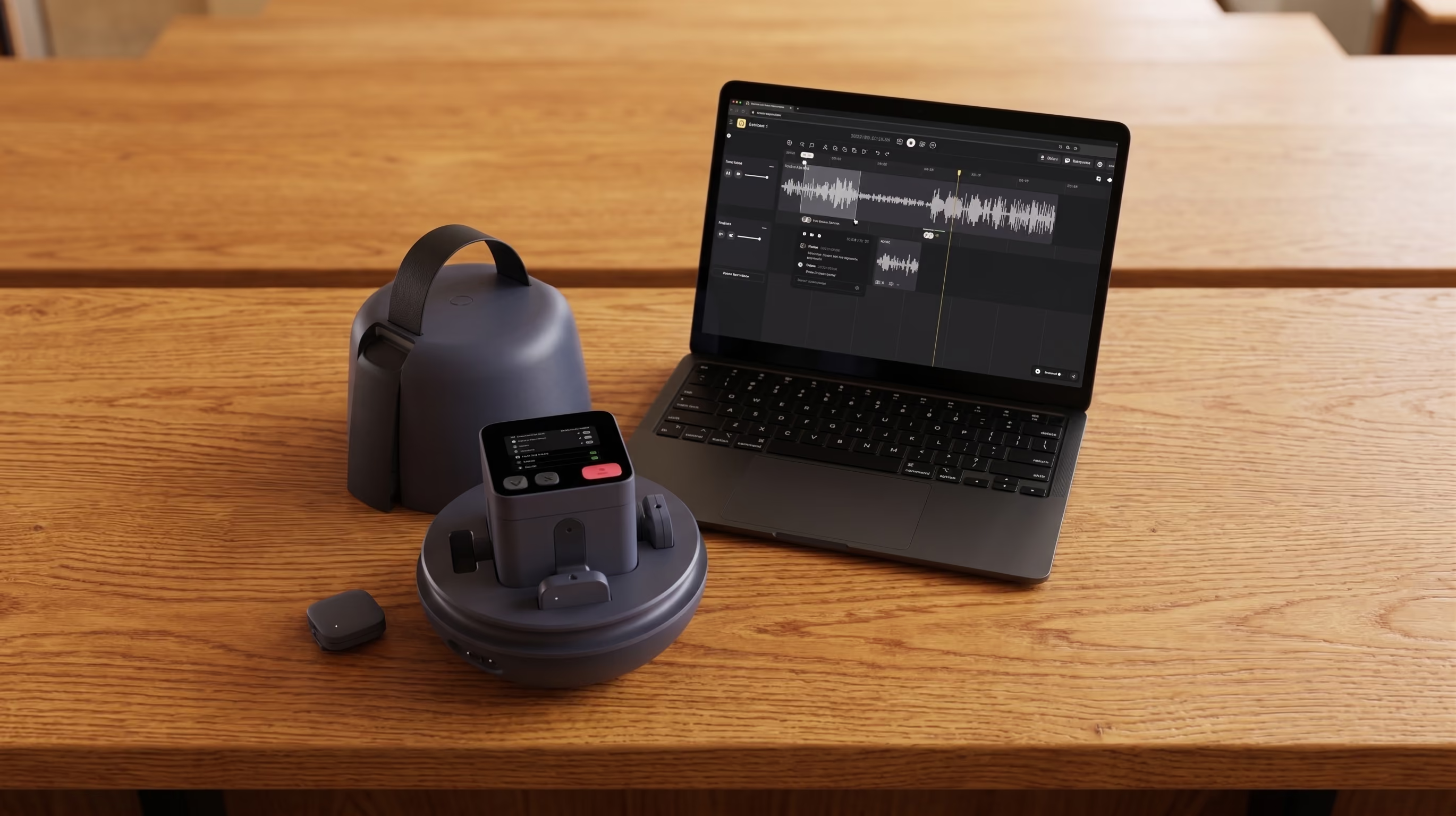
The Sound Capsule (Space Recorder with an 8-mic ambisonic array, four wireless Stellar Mics and the charging case) plus 12 months of Nomono Studio Premium, a plan that costs $948 billed yearly on its own: 600 minutes a month of AI enhancement, 600 GB, two editors, unlimited reviewers, unlimited transcriptions, one-click audio-video sync and spatial export.
You can move to Nomono Studio Free at $0 or keep a paid Nomono Studio plan: Premium is $99 a month, or $79 a month billed yearly. The year-two costs are compared above. The hardware works without a subscription, and the warranty is one year, extended for life while you stay on a paid plan.
None of the builds priced here captures a spatial track. You would need a separate ambisonic microphone and a recorder with enough channels. The Sound Capsule records a spatial track alongside the four voice tracks and is Dolby Atmos-ready; see our spatial audio guide.
No. 12 months of Nomono Studio Premium are included, with cloud editing, AI enhancement, transcription and one-click audio-video sync. If you already use Descript, Riverside or Alitu you can keep it, but you would be paying twice for cleanup.
Written by Ruben Åeng, Lead Audio Engineer at Nomono
Audio engineer and Product Manager for spatial audio products at Nomono, with 15 years of experience in film and television sound. Before joining in 2021 he worked as a production sound mixer, dialogue editor and sound designer, with credits including the Oscar-nominated short “Night Ride”.
Enjoy free express shipping to the listed locations within 2–5 business days.
 Austria
 Belgium
 Bulgaria
 Croatia
 Cyprus
 Czech Republic
 Denmark
 Estonia
 Finland
 France
 Germany
 Greece
 Hungary
 Ireland
 Italy
 Latvia
 Lithuania
 Luxembourg
 Malta
 Netherlands
 Norway
 Poland
 Portugal
 Romania
 Slovakia
 Slovenia
 Spain
 Sweden
 United Kingdom
 United States