Comparisons
November 20, 2026



For most solo podcasters the Shure MV7+ is the better buy: $299 list, USB-C and XLR, with a real-time denoiser and auto level built in, so it works straight into a laptop. The Shure SM7B ($439 list) is XLR only and needs a high-gain interface, but gives an engineer an untouched signal. Both record one voice; a multi-guest show needs one mic per person.
The SM7B is a cardioid dynamic microphone with an XLR output and nothing else. It has switchable bass rolloff and presence boost, shielding against electromagnetic hum from monitors, an air-suspension shock mount and a close-talk windscreen in the box. There is no processing inside, so the file you record is the mic, the room and your preamp.
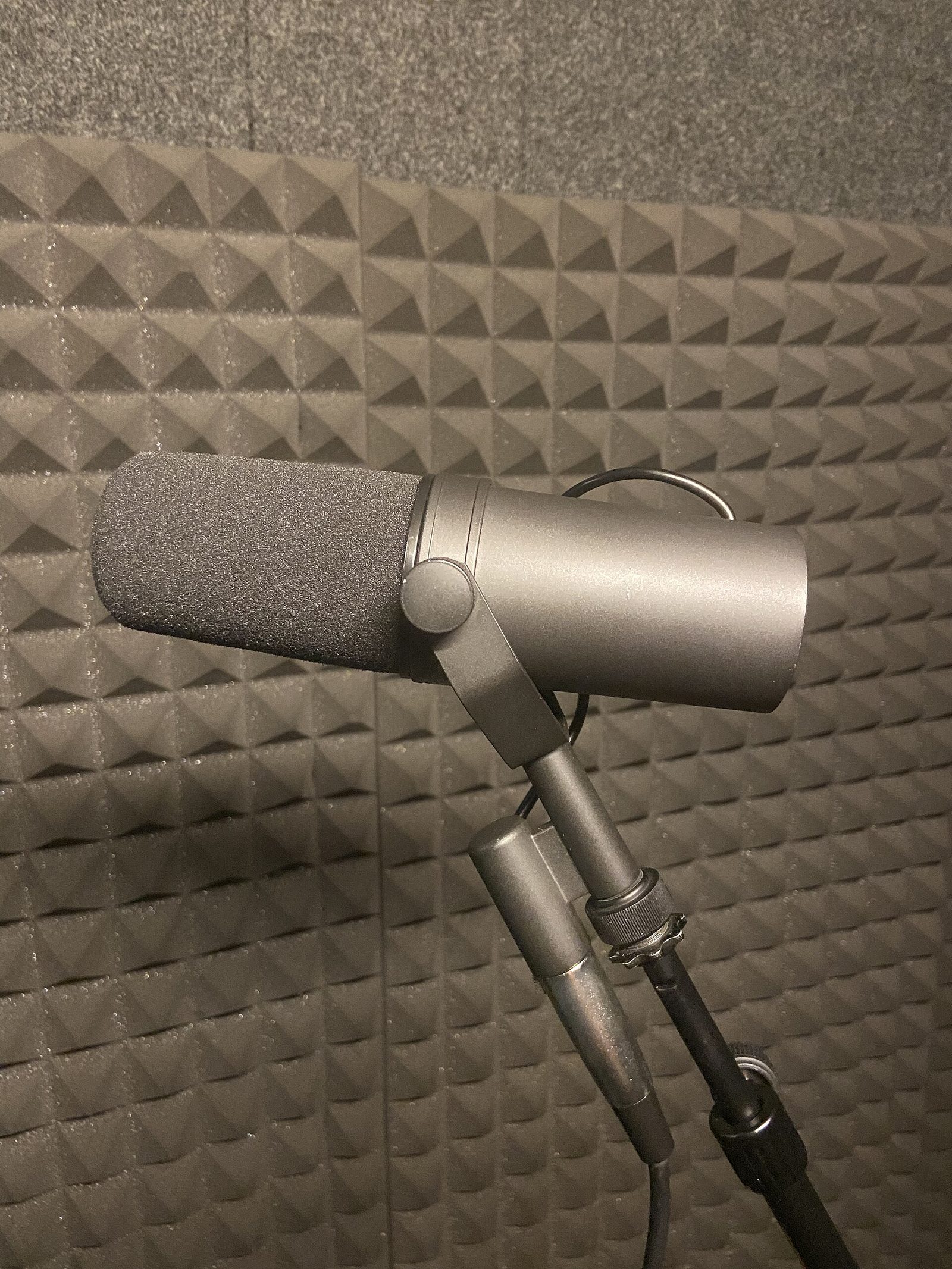
The catch is output level. The SM7B is a low-output passive dynamic and needs a lot of clean gain, so most home setups pair it with a high-gain interface or an inline booster. That second purchase belongs in the budget.
The MV7+ takes the broadcast look and moves the processing inside. It connects over USB-C or XLR, and its onboard DSP includes a real-time denoiser, an improved Auto Level Mode that adjusts gain as you move closer or further away, a digital pop filter, compressor, limiter and Plate, Hall and Studio reverbs. A 3.5 mm headphone output on the mic gives zero-fuss monitoring, and the MOTIV Mix desktop app controls the settings.
Because XLR is there too, the MV7+ can move into an interface or recorder later without being replaced.
| Spec | Shure MV7+ | Shure SM7B |
|---|---|---|
| List price | $299 ($319 with stand) | $439 |
| Type | Dynamic, USB-C + XLR | Passive dynamic, XLR only |
| Polar pattern | Cardioid | Cardioid |
| Onboard processing | Denoiser, auto level, compressor, limiter, reverb | None (bass rolloff and presence switches) |
| Needs an interface | No (USB-C); yes for XLR | Yes, with high clean gain |
| Headphone jack on mic | Yes, 3.5 mm | No |
| Software | MOTIV Mix | None needed |
| People per mic | 1 | 1 |
| Records on its own | No, needs a computer, phone or recorder | No, needs an interface or recorder |
Prices are Shure list prices from our September 2026 check. The SM7dB sits between them at $549 list if you want the SM7B sound without a separate booster.
Independent review: Podcastage compares the Shure MV7+ with the SM7B.
The MV7+ needs a USB-C cable and a stand; the $319 version includes the stand. That is a complete setup for one host on a laptop. The SM7B needs an XLR cable, a boom arm or stand, and an interface or recorder with enough gain. Many owners add an inline booster as well, or choose the SM7dB to build the boost in.
| Option | Gain or format | Price |
|---|---|---|
| Zoom PodTrak P4next | 4 XLR, 70 dB gain, 24-bit | $179.99 list |
| RØDECaster Pro II | 4 XLR, 76 dB gain, 24-bit | $699 list |
| Zoom F3 | 2 XLR, 32-bit float | $299.99 list |
| Zoom H6essential | 4 XLR/TRS, 32-bit float | $329.99 list |
A 32-bit float recorder such as the Zoom F3 or H6essential means you cannot clip the SM7B by setting gain too high. For a full starter shopping list, see our podcast starter kit guide.
Control is the SM7B's argument. No algorithm decides how loud a laugh should be, no denoiser is trimming consonants, and the recording is exactly what the mic heard. Engineers who prefer to apply their own compression and EQ in editing want that, and Nomono Studio Free is a ready place to do it: it edits and enhances audio from any mic, with 2 hours of AI enhancement a month, 75 GB of storage and audio-video sync, at no cost. The SM7B also has no firmware, drivers or software requirements, so it works with any interface or recorder with an XLR input and enough gain.
If you already own a good interface, a boom arm and a reasonably quiet room, the MV7+'s built-in processing duplicates what you have.
Speed and forgiveness. Auto Level Mode holds a usable level when you lean back mid-sentence, the denoiser works in real time, and the digital pop filter handles plosives without a retake. Hosts recording alone with nobody watching meters benefit most, and one USB-C cable travels easily to a hotel room or office. The trade is that the processing makes choices for you, so heavy settings are hard to undo later.
One microphone covers one voice in one seat. A second host means a second mic, a second input and a second stand. Four people means a four-input recorder, four mics, four stands and four cables, which ties the show to one room. Our guides to a podcast kit for 2 people and the best 4-person podcast setups cover both cases.
Nomono's answer is wireless capture plus cleanup in one purchase. The Stellar Kit gives two wireless Stellar Mics with 15 hours of battery for $348, with 12 months of Nomono Studio Professional included – a plan that costs $348 billed yearly on its own. The Sound Capsule records two, three or four people on wireless Stellar Mics plus an 8-mic ambisonic room track, with no phone or laptop needed. It weighs 2.9 lb, records for 10 hours with 15 more from the charging case, uploads to Nomono Studio automatically over Wi-Fi and costs $1,188 with 12 months of Nomono Studio Premium included – a plan that costs $948 billed yearly on its own. Both plans include AI noise removal and audio enhancement, unlimited transcriptions and one-click audio-video sync, and a paid plan keeps the lifetime hardware warranty active. Nomono Studio pricing lists what each plan covers.

Every Stellar Mic records the voice at 16-bit/48 kHz with auto-levelling, so levels stay under control when someone laughs or leans in. 16-bit gives 96 dB of dynamic range, more than a voice uses from whisper to shout (why 16-bit is enough for voice), and each Stellar Mic keeps a 40-minute lossless audio buffer. For one host at a fixed desk, the MV7+ and SM7B are strong close-up voice mics. Once a show has two to four voices or records away from the desk, the Sound Capsule gives every voice its own wireless mic and track, and it is ready to record in under 10 seconds. Our Sound Capsule vs Shure MV7+ comparison covers that trade in detail.
| Your situation | Pick | Why |
|---|---|---|
| Solo host, bare desk, recording this week | Shure MV7+ | USB-C, no interface needed |
| Solo host, good interface already owned | Shure SM7B | Untouched signal, you control processing |
| Interface with limited gain | Shure SM7dB | Built-in +18/+28 dB preamp |
| Host who records in hotels and offices | Shure MV7+ | One cable, real-time denoiser |
| Two people away from a desk | Nomono Stellar Kit | Two wireless mics plus 12 months of Nomono Studio Professional |
| Two to four people on location | Nomono Sound Capsule | Up to four wireless mics plus spatial track, no laptop needed |
| Any mic, cleanup after recording | Nomono Studio Free | Edits and enhances audio from any source, 2 hours of AI enhancement a month |
Outgrowing a single mic?
Record two to four people wirelessly and let Nomono Studio handle noise removal, enhancement and transcripts.
Connection and processing. The MV7+ connects over USB-C or XLR and has a denoiser, auto level, compressor and other DSP built in. The SM7B is a passive XLR-only mic with no electronics, so it needs an interface with plenty of clean gain.
For most solo podcasters recording speech, yes, and it costs less once you count the interface. If you want to make all processing decisions yourself in editing, the SM7B's untouched signal is the better fit.
Yes. It has an XLR output only and needs an interface or recorder with enough clean gain. Many home setups add an inline booster, or buy the SM7dB, which has a built-in preamp powered by phantom power.
Not over USB-C, since the mic handles gain itself. Over XLR it behaves like a regular dynamic mic, so check your interface has enough gain.
Both are cardioid dynamics, so both reject room sound well. The MV7+ adds a real-time denoiser, so a hard-walled spare room needs less fixing afterward. Neither removes a loud air conditioner on its own, but Nomono Studio, including the Free plan, removes background noise after recording.
Not with good results. Cardioid mics are built for the person directly in front of them, and sharing one puts both voices on a single, roomy track. Two people need two mics and two tracks.
The MV7+ records over USB, and 32-bit float is not part of its spec. The SM7B is analog, so bit depth depends on the recorder; a 32-bit float recorder like the Zoom F3 ($299.99 list) gives an SM7B setup clip-proof headroom.
Written by Ruben Åeng, Lead Audio Engineer at Nomono
Audio engineer and Product Manager for spatial audio products at Nomono, with 15 years of experience in film and television sound. Before joining in 2021 he worked as a production sound mixer, dialogue editor and sound designer, with credits including the Oscar-nominated short “Night Ride”.
Enjoy free express shipping to the listed locations within 2–5 business days.
 Austria
 Belgium
 Bulgaria
 Croatia
 Cyprus
 Czech Republic
 Denmark
 Estonia
 Finland
 France
 Germany
 Greece
 Hungary
 Ireland
 Italy
 Latvia
 Lithuania
 Luxembourg
 Malta
 Netherlands
 Norway
 Poland
 Portugal
 Romania
 Slovakia
 Slovenia
 Spain
 Sweden
 United Kingdom
 United States