Comparisons
November 23, 2026


The best RØDECaster Pro II alternatives for teams that record in different places are the Nomono Sound Capsule, RØDECaster Duo, Zoom PodTrak P4next, Zoom H6essential, Tascam Portacapture X8, RØDE Wireless PRO and DJI Mic 3. Pick wireless for fast setup on location, a 32-bit float recorder for clip-proof wired takes, and keep the console for a fixed studio.
The RØDECaster Pro II is built for a permanent desk. Four combo XLR inputs with 76 dB of gain, APHEX processing, eight SMART pads with eight banks (64 actions), mix-minus and Bluetooth call-ins are all strengths, but they assume four wired mics on stands and a table you will not move. There is no internal battery, so on location it needs an outlet or a USB-C power bank rated 30 W or more.
Teams that record at client offices, events or a different room each week spend more time on cables and stands than on the conversation. That is where the alternatives below come in. For a direct comparison with the closest budget option, see our RØDECaster Pro II vs Zoom PodTrak P4 guide.
We looked at how many people each option records on separate tracks, whether it runs away from mains power, whether it records 32-bit float, what happens to the audio after the session, and the real price. Prices come from maker list prices and US retailer checks in September 2026; specs are from each maker's product pages.
| Product | Price (US) | People on own tracks | Wireless | Battery | 32-bit float / clip protection | Editing included |
|---|---|---|---|---|---|---|
| RØDECaster Pro II (incumbent) | $699 list, $595 Sweetwater | 4 wired | No | No | No | No |
| Nomono Sound Capsule | $1,188 | 2 to 4 | Yes | 10 h, 25 h with case | Auto-levelling on every mic, 40-min lossless buffer per mic | 12 months of Nomono Studio Premium included |
| RØDECaster Duo | $499 list, $416 B&H | 2 wired | No | Not listed | No | No |
| Zoom PodTrak P4next | $179.99 list | 4 wired | No | 2 AA or USB | No | No |
| Zoom H6essential | $329.99 list | 4 wired + capsule | No | 4 AA or USB | Yes | No |
| Tascam Portacapture X8 | $499 launch, $399 Sweetwater | 4 wired + built-in mics | No | 4 AA or USB | Yes | No |
| RØDE Wireless PRO | $299 list, $260 B&H | 2 | Yes | Rechargeable | Yes | No |
| DJI Mic 3 | $329 list, $259 B&H | 2 in kit, up to 4 | Yes | About 8 h per mic | Yes | No |
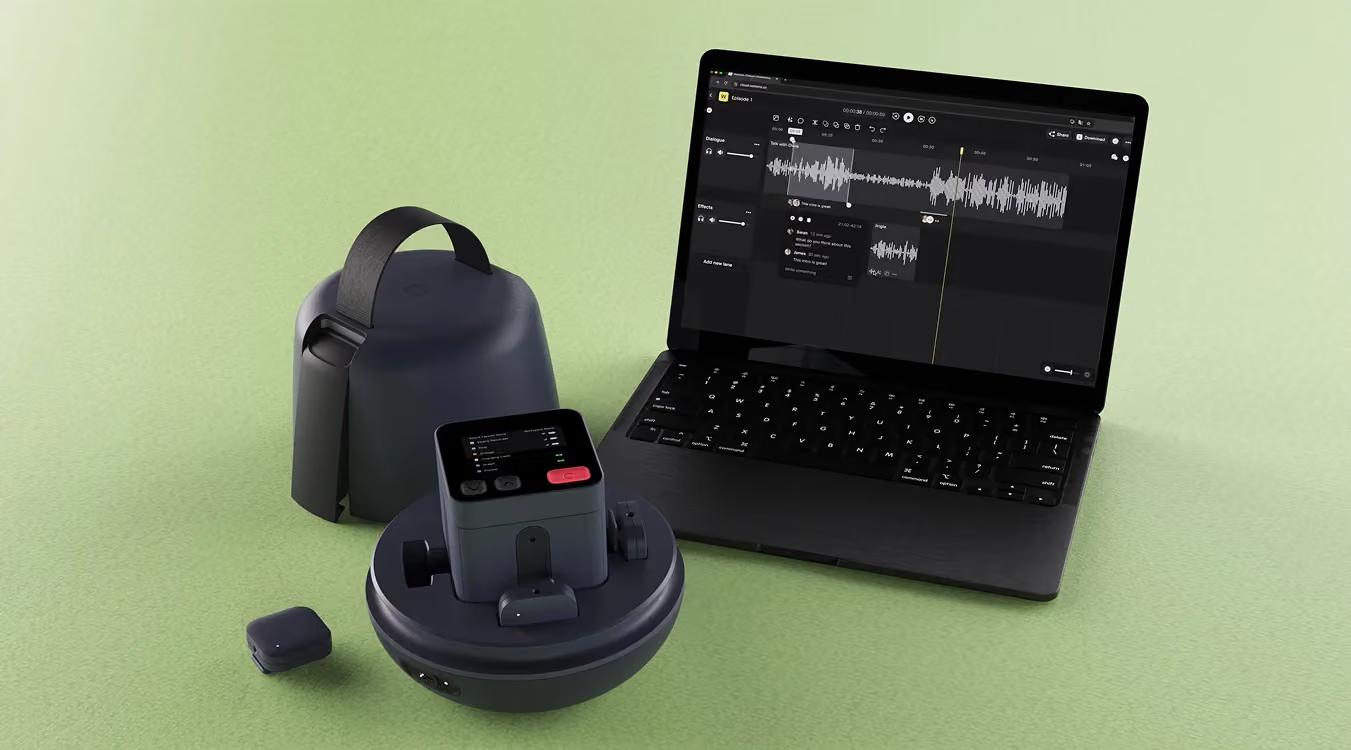
The Sound Capsule replaces the console, stands and cables with a 2.9 lb case. Inside are a Space Recorder with an 8-mic ambisonic array, four wireless Stellar Mics and a charging case. It records up to 10 hours, 25 with the case, stores up to 12 hours internally and has auto-levelling on every mic, so nobody rides faders. It is ready to record in under 10 seconds, records without a phone or laptop and uploads over Wi-Fi to Nomono Studio automatically for noise removal and audio enhancement, transcription, editing and one-click audio-video sync. Each Stellar Mic also keeps a 40-minute lossless buffer, and the same kit works for two-, three- and four-person shows.
Every take is protected: voice tracks are 16-bit/48 kHz with auto-levelling on every mic, and 16-bit gives 96 dB of dynamic range, more than a voice uses from whisper to shout (see why Nomono records voice in 16-bit). The spatial track is 24-bit/48 kHz. Live faders, sound pads and Bluetooth call-ins stay the RØDECaster's job, and the Sound Capsule uses its own wireless mics rather than XLR inputs. The Sound Capsule is $1,188 and includes 12 months of Nomono Studio Premium, a plan that costs $948 billed yearly on its own. After that it is $99/month, or $79/month billed yearly, and a paid plan keeps the lifetime hardware warranty active. The hardware keeps recording without a subscription. Our Sound Capsule vs RØDECaster Pro II comparison goes deeper.
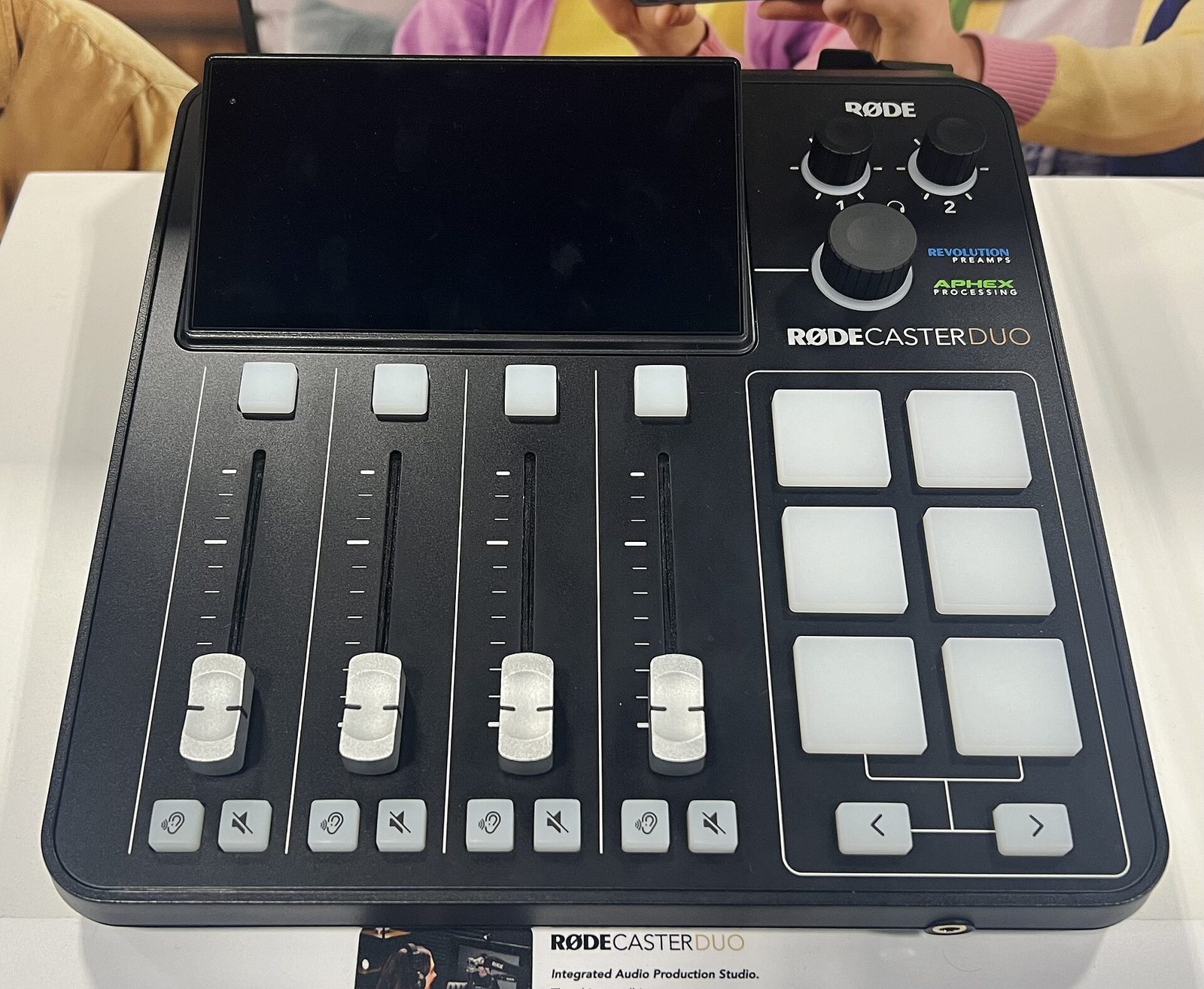
If you like the RØDECaster workflow but only ever record two people, the RØDECaster Duo keeps the same approach in a smaller unit with two combo inputs, at $499 list or $416 at B&H. RØDE's 2-person kit with mics, headphones, arms and cables is $1,164.24 at B&H. It is still a desk console, though, and it does not solve recording on location.
Independent comparison: Radio.co explains which RØDECaster model fits which setup.
The PodTrak P4next (it replaced the PodTrak P4) is the cheapest way to keep four wired mics and go portable, at $179.99 list or $149.99 on sale at Sweetwater in September 2026. It has four XLR inputs with 70 dB of gain, four headphone outputs, mix-minus and four sound pads, and runs on two AA batteries or USB. You lose the faders, APHEX processing and SMART pads, and it records 24-bit/48 kHz, so gain still has to be set carefully. Four Zoom ZDM-1 mic packs ($99.99 each) make a complete four-person kit.
The Zoom H6essential ($329.99 list) has four XLR/TRS combo inputs plus an X/Y mic capsule and records six tracks in 32-bit float, so there is no gain to set and a loud laugh cannot clip. It runs on four AA batteries or USB-C power. Zoom quotes about 18 hours on alkalines for two tracks but only about 3.5 hours for six tracks, so bring lithium cells or USB power for a full panel. Timecode needs an optional adapter, and there is no editing workflow included.
The Tascam Portacapture X8 ($499 at launch, $399 at Sweetwater in September 2026) has four XLR/TRS combo inputs, a pair of built-in condenser mics in A-B or X-Y, and records up to eight tracks with 32-bit float. Its touchscreen preset apps, including a podcast mode, help a producer who is not an audio engineer get a clean multitrack take. Tascam quotes about 11 hours on alkaline AAs with the built-in mics, no phantom power and power save on (stereo 24-bit recording).
For two-person video shoots, the RØDE Wireless PRO ($299 list, $260 at B&H and Sweetwater) records 32-bit float and timecode in each transmitter, with 32 GB onboard for over 40 hours. GainAssist manages levels. It is a dual-channel system, so a four-person roundtable needs two kits, and nothing in the box handles editing or cleanup.
The DJI Mic 3 ($329 list with case, $259 at B&H) replaced the DJI Mic 2. It records 32-bit float with timecode, has 32 GB per transmitter and about 8 hours of battery per mic. The kit includes two transmitters, but one receiver can link up to four, which makes it a flexible wireless kit for panels if you buy extra transmitters. DJI notes that four-channel output only works with certain Sony cameras or via USB to certain software, so plan to sync the internal recordings in the edit otherwise. Our DJI Mic 2 vs RØDE Wireless PRO comparison covers both kits in detail.
| Your situation | Pick | Why |
|---|---|---|
| Two to four guests, new location each week | Nomono Sound Capsule | Wireless mics with auto-levelling, 12 months of Nomono Studio Premium included |
| Only two people at a desk | RØDECaster Duo | Same workflow, smaller and cheaper |
| Four wired mics, tight budget | Zoom PodTrak P4next | $179.99 list, AA power |
| Four wired mics, no clipped takes | Zoom H6essential | 32-bit float, four XLR/TRS |
| Producer is not an audio engineer | Tascam Portacapture X8 | Preset apps, 32-bit float |
| Two people, multi-camera video | RØDE Wireless PRO | Timecode, 40+ h per mic |
| Solo host or one guest, editing included | Nomono Stellar Kit | Two mics, 15 h battery, 12 months of Nomono Studio Professional included, $348 |
| Fixed desk, live callers, sound pads | Keep the RØDECaster Pro II | Nothing portable matches it |
Recording two to four people away from the studio?
The Sound Capsule is ready to record in under 10 seconds, records up to four wireless mics plus a spatial track and uploads to Nomono Studio over Wi-Fi.
For two to four people, the Nomono Sound Capsule, because it records wireless mics from one 2.9 lb case with up to 10 hours of battery, auto-levelling on every mic and 12 months of Nomono Studio Premium for cleanup and editing. If you want to keep wired XLR mics, the Zoom H6essential adds 32-bit float.
No. The RØDECaster Pro II has no internal battery, though it can run from a USB-C power bank rated 30 W or more. Battery-powered four-input alternatives include the Zoom PodTrak P4next, Zoom H6essential and Tascam Portacapture X8.
RØDE's 4-person kit with the console, four PodMics, four NTH-100 headphones, four PSA1+ arms and four XLR cables is $2,229.65 at B&H (Sep 2026). Buying the same parts separately at Sweetwater street prices ($595 console, $86 PodMic, $129 NTH-100, $129 PSA1+) comes to about $1,970 before cables.
The Zoom H6essential, Tascam Portacapture X8, RØDE Wireless PRO and DJI Mic 3 all do. The RØDECaster Pro II and PodTrak P4next record 24-bit/48 kHz, and the Nomono Sound Capsule protects every take with auto-levelling on every mic, recording 16-bit/48 kHz voice tracks with 96 dB of dynamic range.
Yes. The Nomono Sound Capsule records four wireless mics plus a spatial room track with no mixer. The DJI Mic 3 can also link four transmitters to one receiver, though the kit ships with two.
Nomono is the one here that includes it. The Sound Capsule comes with 12 months of Nomono Studio Premium: 600 minutes a month of AI enhancement, 600 GB of storage, two editors, unlimited transcriptions and export in spatial formats. The others ship with setup or control apps only, but Nomono Studio Free edits and enhances audio from any of these recorders, with 2 hours a month of AI enhancement, 75 GB of storage and audio-video sync.
A solo host does not need a four-input console. A single USB or XLR mic covers one voice, and the Nomono Stellar Kit covers a host and one guest with two wireless mics for $348, with 12 months of Nomono Studio Professional included, a plan that costs $348 billed yearly on its own.
No. It records mic tracks and a stereo mix. The Sound Capsule's 8-mic ambisonic array records a spatial track and is Dolby Atmos-ready. Our explainer on spatial audio for podcasts covers what that adds.
Written by Ruben Åeng, Lead Audio Engineer at Nomono
Audio engineer and Product Manager for spatial audio products at Nomono, with 15 years of experience in film and television sound. Before joining in 2021 he worked as a production sound mixer, dialogue editor and sound designer, with credits including the Oscar-nominated short “Night Ride”.
Enjoy free express shipping to the listed locations within 2–5 business days.
 Austria
 Belgium
 Bulgaria
 Croatia
 Cyprus
 Czech Republic
 Denmark
 Estonia
 Finland
 France
 Germany
 Greece
 Hungary
 Ireland
 Italy
 Latvia
 Lithuania
 Luxembourg
 Malta
 Netherlands
 Norway
 Poland
 Portugal
 Romania
 Slovakia
 Slovenia
 Spain
 Sweden
 United Kingdom
 United States