Comparisons
November 2, 2026


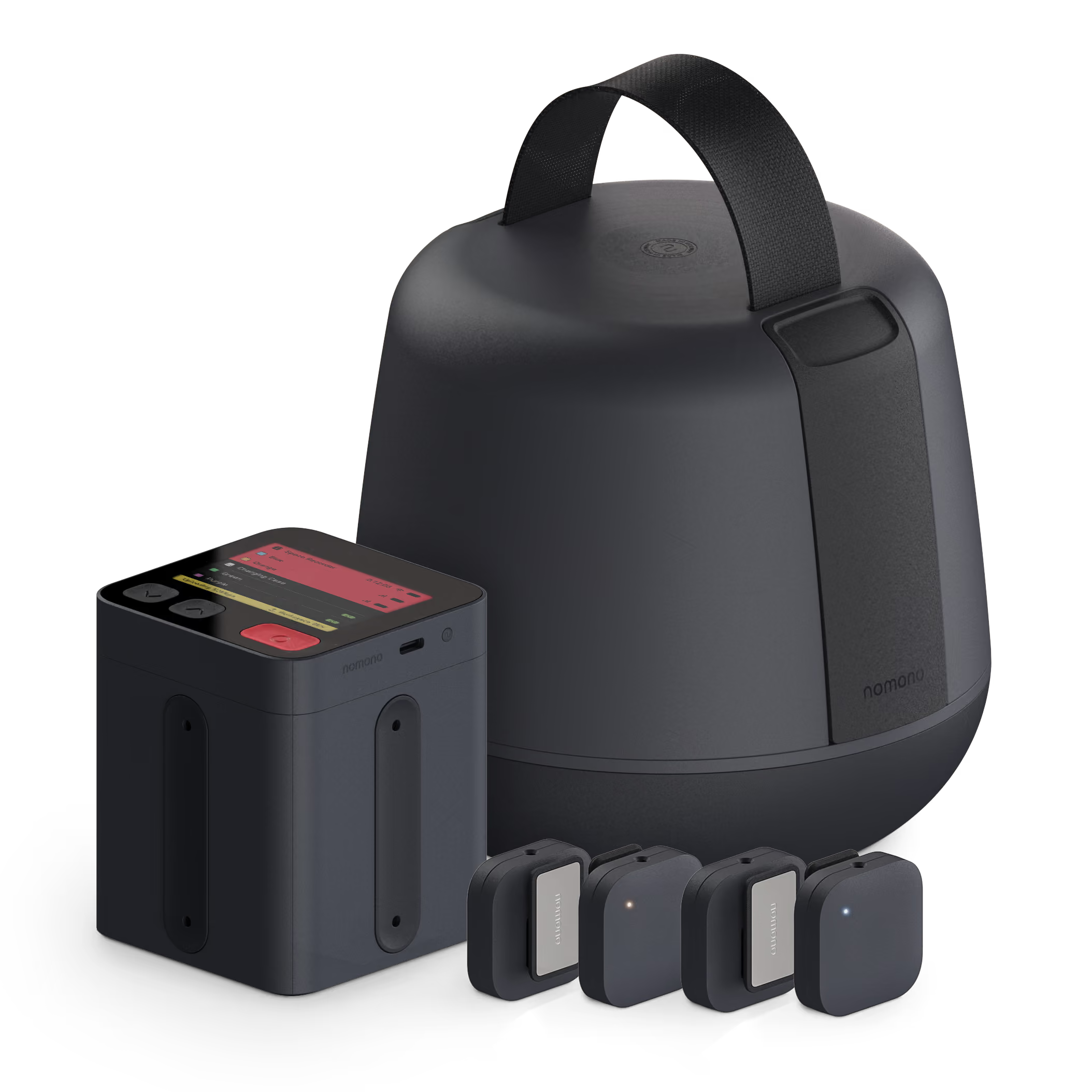
The Nomono Sound Capsule and the Zoom H6essential solve a four-person interview in two different ways. Zoom's $329.99 handheld records up to six tracks in 32-bit float through four XLR/TRS inputs you cable yourself. Nomono's Sound Capsule ($1,188) records four wireless mics plus ambisonic room sound and uploads it to Studio Cloud automatically.
| Spec | Nomono Sound Capsule | Zoom H6essential |
|---|---|---|
| Category | 4-person wireless system + cloud | 6-track handheld recorder |
| Price | $1,188 | $329.99 list |
| Mics included | 4 Stellar wireless mics + 8-mic array | XYH-6e X/Y stereo capsule |
| Inputs | Its own 4 wireless mics | 4 XLR/TRS combo jacks |
| Format | Voice 16-bit/48 kHz, spatial 24-bit/48 kHz | 32-bit float, 44.1/48/96 kHz |
| Level setting | Auto-levelling per mic | None needed (dual A/D) |
| Storage | Up to 12 h internal (64 GB) | microSD up to 1 TB |
| Battery | 10 h, 25 h with case | ~3.5 h alkaline, ~9 h lithium (6 tracks) |
| Spatial audio | Ambisonic capture, Atmos-ready | X/Y stereo |
| Timecode | Audio/Video Sync in Studio Cloud | TCA-1, UltraSync BLUE via BTA-1 |
| Cloud workflow | First year of Studio Cloud included | None |
Zoom specs are from the H6essential product page (checked Oct 2026). Nomono plan details are on Studio Cloud pricing.
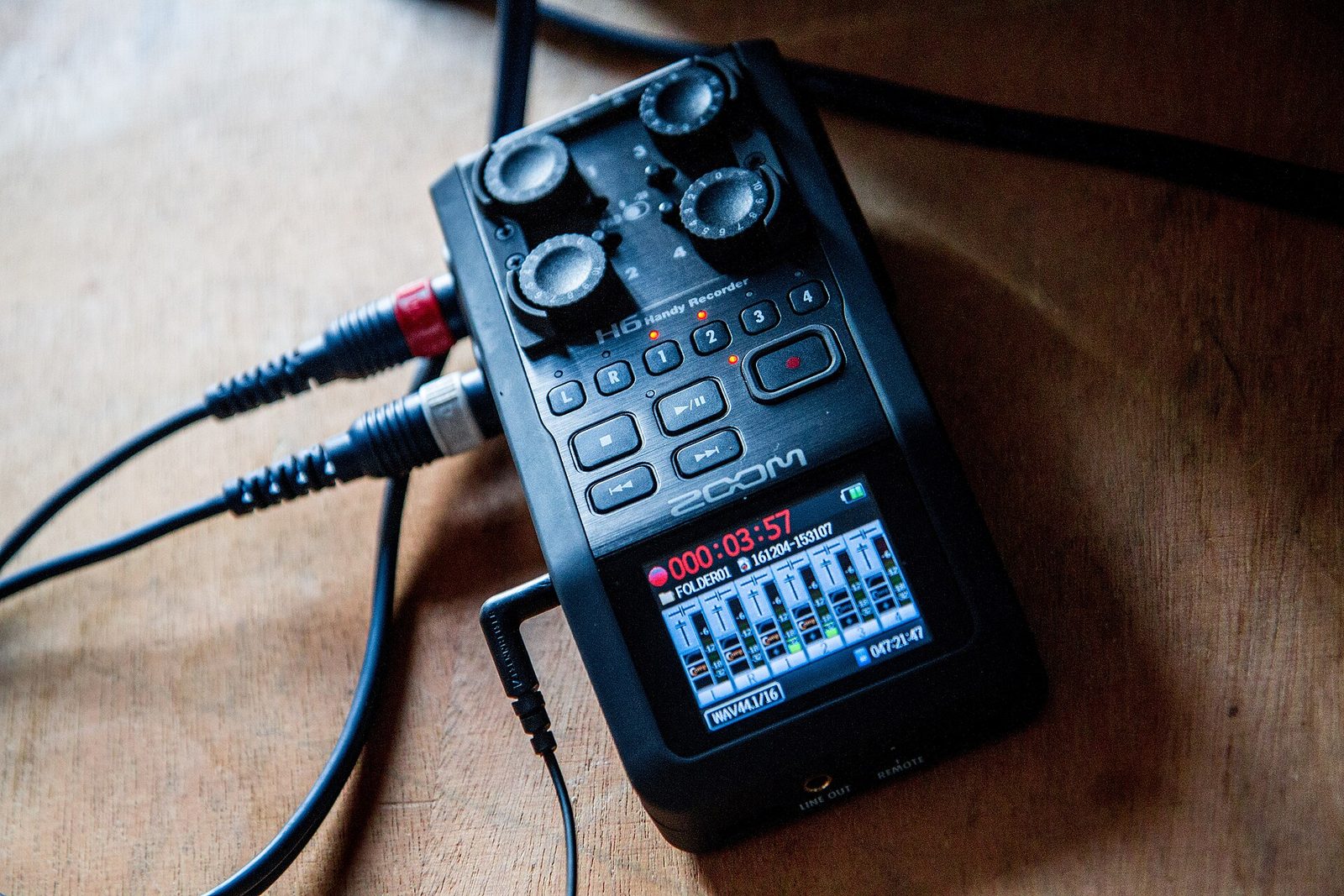
The H6essential arrives as a recorder. The body has four XLR/TRS combo inputs with locking connectors and a detachable XYH-6e X/Y stereo capsule rated to 135 dB SPL, and it writes up to six tracks of 32-bit float WAV at up to 96 kHz through dual A/D converters, so you do not set input gain before the take. Zoom also sells an SSH-6e stereo shotgun capsule and an EXH-6e dual-input capsule. It can work as a USB-C audio interface and record to card at the same time.
Four guests around a table still means four microphones, four XLR cables and four stands, and every guest stays tethered to the recorder for the session. Using fact-sheet street prices, four RØDE PodMics at $86 each add $344, bringing the core kit to about $674 before cables, stands, headphones and a memory card.
Independent review: Free Podcast Tools tests the Zoom H6essential.
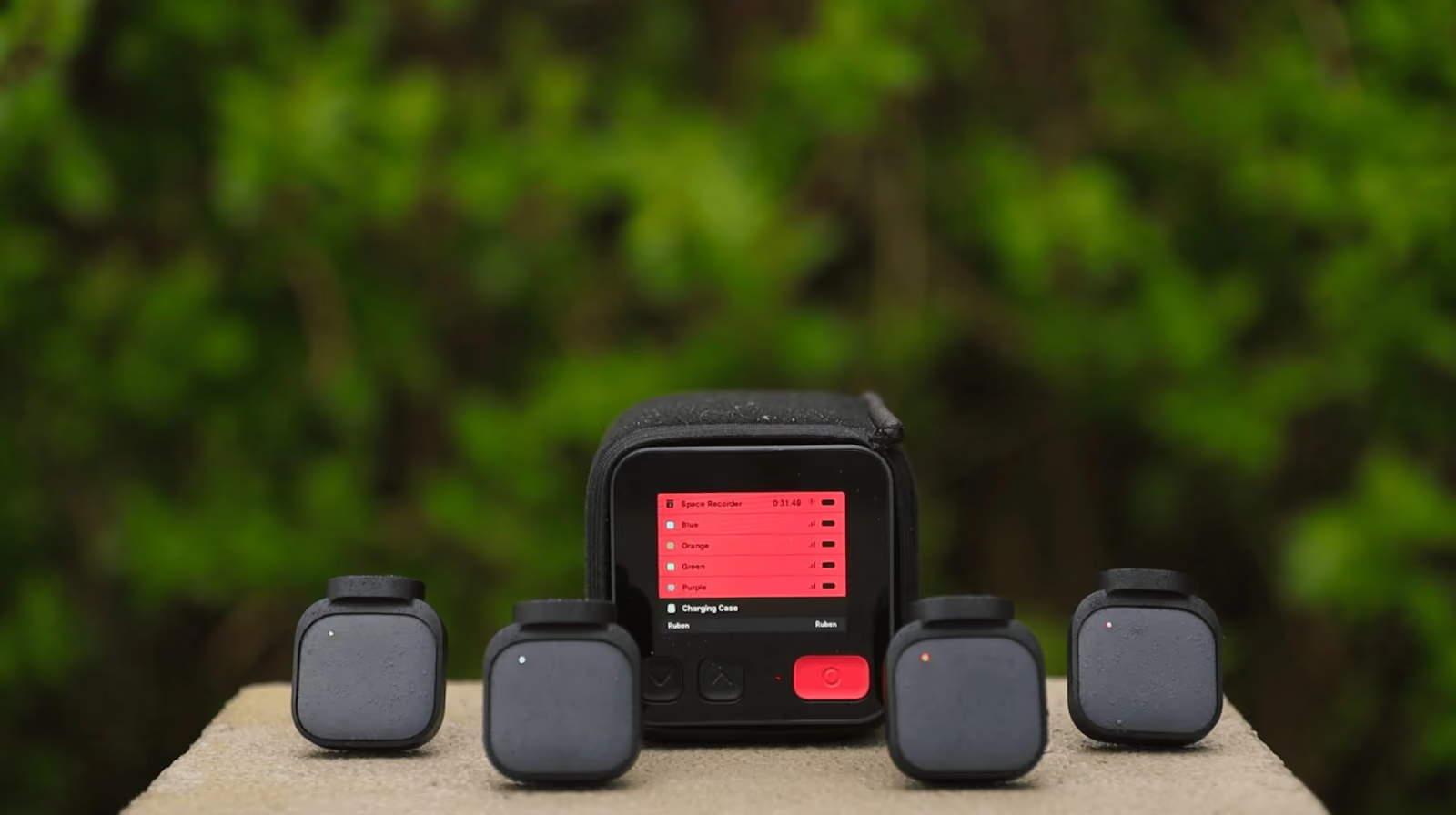
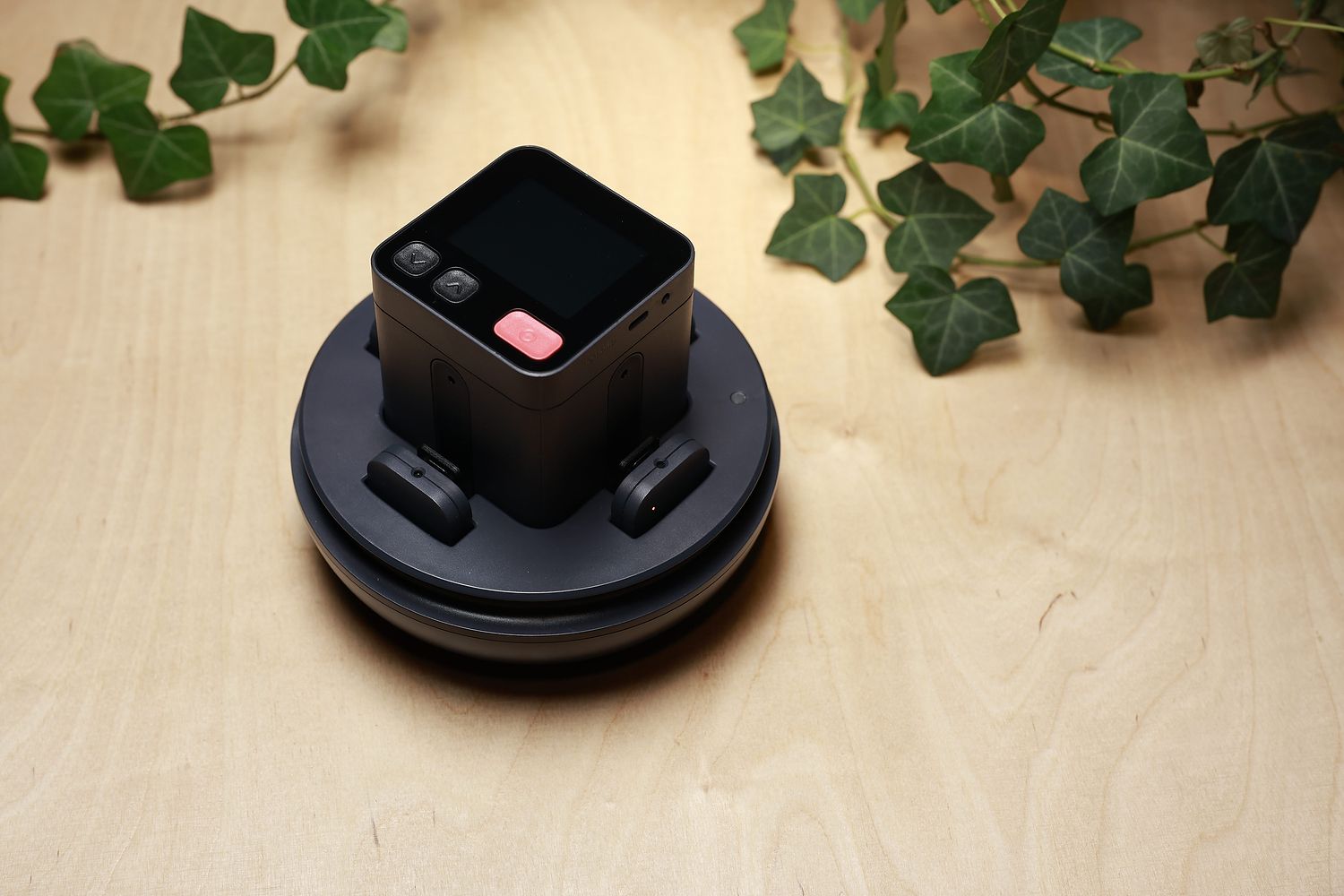
Nomono sells the whole recording chain in one case. Inside are the Space Recorder with its 8-mic ambisonic array, four Stellar wireless mics and the charging case, 2.9 lb in total. Each mic gets its own voice track with auto-levelling, and the array records a spatial track of the room alongside them. Up to 12 hours of internal storage covers a full shoot day with no card to manage, and recordings upload to Studio Cloud automatically, with USB export as a backup route. The price includes the first year of Studio Cloud Premium: 600 minutes a month of AI enhancement, 600 GB, unlimited transcription, two editors and unlimited reviewers, and audio and video sync.
Customer story: We Are Makers take one Sound Capsule on the road for 35 days.
Setup is where the two diverge most outside a studio. A wired four-input build means placing four stands, running four cables without crossing a walkway, checking each input, and keeping guests within reach of their cable. A wireless build means clipping on four mics and starting the recorder, and the Sound Capsule is ready to record in under 10 seconds. In a borrowed room with a fixed time slot, that difference matters, and a wired table often wants a second pair of hands. Our guide on how to record a 4-person podcast covers mic placement for both approaches.
Zoom records 32-bit float and Nomono does not. If a guest laughs into a hot channel, the H6essential's dual converters leave room to pull the peak back down in editing. Nomono's answer is auto-levelling on every Stellar mic at capture, plus noise removal and audio enhancement in Studio Cloud. That is a different safety net, and for a sudden loud spike it is a weaker one.
Four combo inputs mean you choose the microphones: dynamics you already own, a shotgun on a boom, or the Shure MV7+ on its XLR output. The Sound Capsule is built around its own Stellar mics and array. If you already own four good XLR mics, the Zoom is the cheaper upgrade by a wide margin.
The H6essential accepts the TCA-1 timecode adapter and wireless timecode from an Atomos UltraSync BLUE through the BTA-1, which matters on a multi-camera shoot handed to an outside post house. Nomono aligns audio and video in software with Audio/Video Sync, free on every Studio Cloud plan. Both work; only timecode survives a handover that expects it. For more on desk mics, see our Sound Capsule vs Shure MV7+ comparison.
Wireless capture, spatial audio and battery life. Guests on wireless mics can stand, turn or walk to a whiteboard, which a table of cabled mics rules out. The ambisonic array records the room as a spatial track at 24-bit/48 kHz, and the Sound Capsule is Dolby Atmos-ready; the H6essential's included capsule is X/Y stereo. Six-track battery life is the Zoom's quiet weak spot at about 3.5 hours on alkaline cells, against 10 hours for the Sound Capsule and 25 with the case. And files land in Studio Cloud with transcription and enhancement included, so nothing is copied off a card and emailed. If you often record outside, read how to record audio outdoors.
| Scenario | Better fit | Why |
|---|---|---|
| Four-person interview, borrowed room, one operator | Sound Capsule | 4 wireless mics, no cable runs |
| Tight budget, mics bought over time | Zoom H6essential | $329.99 for the recorder |
| You own four good XLR mics | Zoom H6essential | 4 combo inputs |
| Multi-camera shoot with timecode | Zoom H6essential | TCA-1 and UltraSync BLUE support |
| Immersive or Dolby Atmos delivery | Sound Capsule | Ambisonic array, Atmos-ready |
| Solo host or one-to-one interview | Stellar Kit | 2 wireless mics, $348 |
| A take you cannot repeat, loud peaks | Zoom H6essential | 32-bit float |
Solo hosts should look at the Stellar Kit instead: two wireless mics with 15 hours of battery, plus Studio Cloud Professional, for $348. For a budget four-input alternative, see our Sound Capsule vs Zoom PodTrak P4 comparison, which covers the PodTrak P4next that replaced it.
Four voices, zero cables
The Sound Capsule records four wireless mics and the room, then uploads everything to Studio Cloud.
Neither wins outright. The Sound Capsule records four wireless mics plus room sound and includes a year of Studio Cloud Premium for $1,188. The H6essential costs $329.99 and records 32-bit float, but arrives without mics, cables or stands for a four-person table.
Yes. It records 32-bit float WAV at 44.1, 48 or 96 kHz using dual A/D converters, so you do not set input gain before a take. The Sound Capsule records voice tracks at 16-bit/48 kHz with auto-levelling instead.
Four, through the XLR/TRS combo inputs, with the X/Y capsule bringing the total to six tracks. The four microphones, cables and stands are separate purchases.
Zoom quotes about 18 hours on alkaline and 30 on lithium for two-track X/Y recording, dropping to about 3.5 hours alkaline and 9 hours lithium at six tracks. The Sound Capsule runs up to 10 hours, or 25 with its charging case.
Its included XYH-6e capsule records X/Y stereo, and Zoom does not list ambisonic capture. The Sound Capsule's 8-mic array records an ambisonic spatial track, and the system is Dolby Atmos-ready.
The Sound Capsule is designed around its four Stellar wireless mics and its built-in array. If you want to keep using XLR mics you own, a recorder with combo inputs such as the H6essential is the better fit.
After the first year you can stay on the Free plan or continue Studio Cloud from $29/month (Professional) or $99/month (Premium), billed monthly or yearly; the hardware keeps working either way. Premium keeps 600 minutes a month of AI enhancement, 600 GB, unlimited transcription, spatial capture and export, ambisonics download, two editors and unlimited reviewers.
Written by Ruben Åeng, Lead Audio Engineer at Nomono
Audio engineer and Product Manager for spatial audio products at Nomono, with 15 years of experience in film and television sound. Before joining in 2021 he worked as a production sound mixer, dialogue editor and sound designer, with credits including the Oscar-nominated short “Night Ride”.
Enjoy free express shipping to the listed locations within 2–5 business days.
 Austria
 Belgium
 Bulgaria
 Croatia
 Cyprus
 Czech Republic
 Denmark
 Estonia
 Finland
 France
 Germany
 Greece
 Hungary
 Ireland
 Italy
 Latvia
 Lithuania
 Luxembourg
 Malta
 Netherlands
 Norway
 Poland
 Portugal
 Romania
 Slovakia
 Slovenia
 Spain
 Sweden
 United Kingdom
 United States