Comparisons
November 17, 2026



Nomono and Descript both take a podcast from raw recording to finished episode, but they start in different places. Nomono pairs wireless mics with Studio Cloud: recordings upload on their own, one click of AI enhancement removes noise and levels every voice, and you edit, transcribe and sync to video in the browser. Descript is an editing app where you cut audio and video by editing the transcript. If you record people in the same room, Nomono gets you to clean, finished audio with fewer tools. If your guests are remote or your output is video-first, Descript fits better.
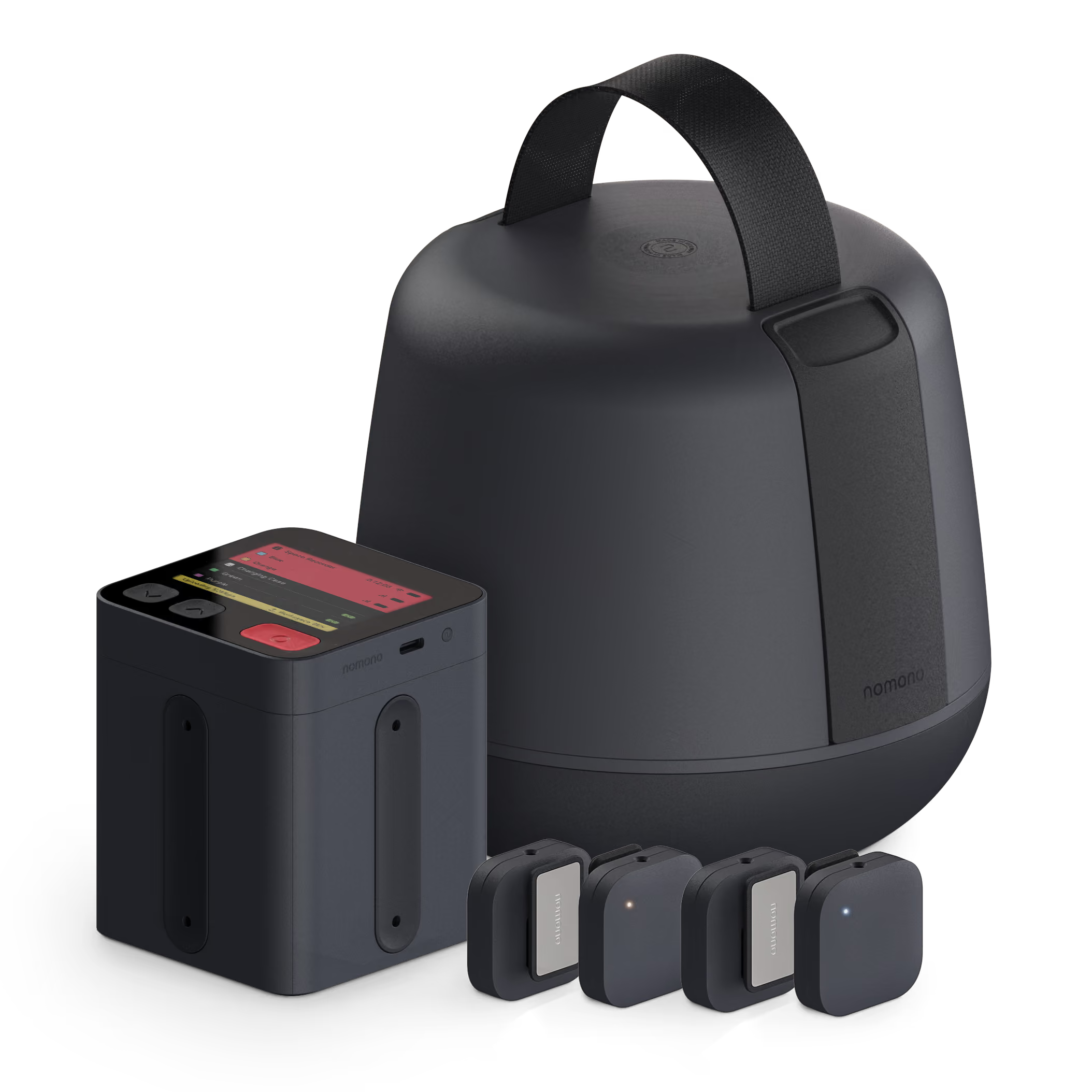
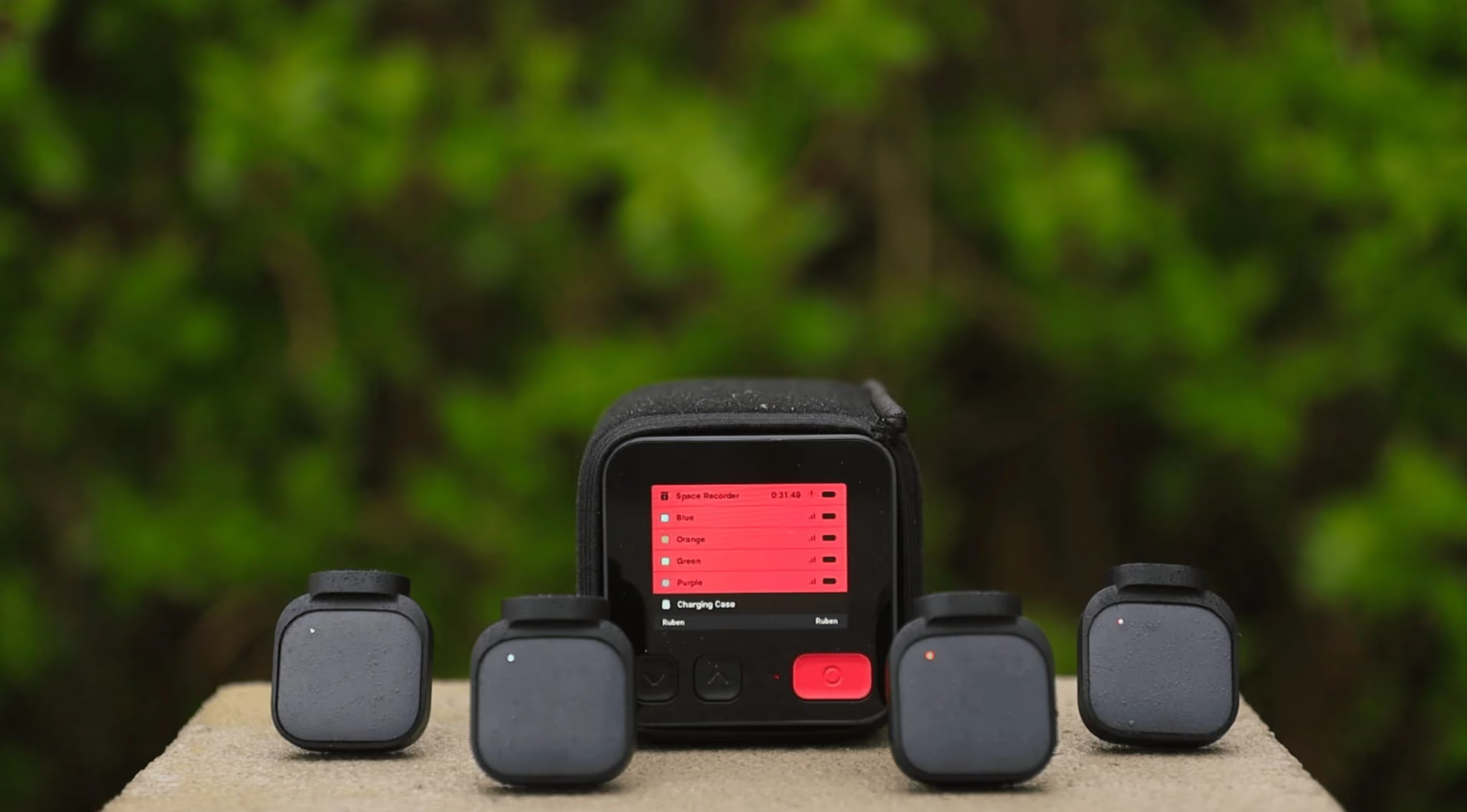
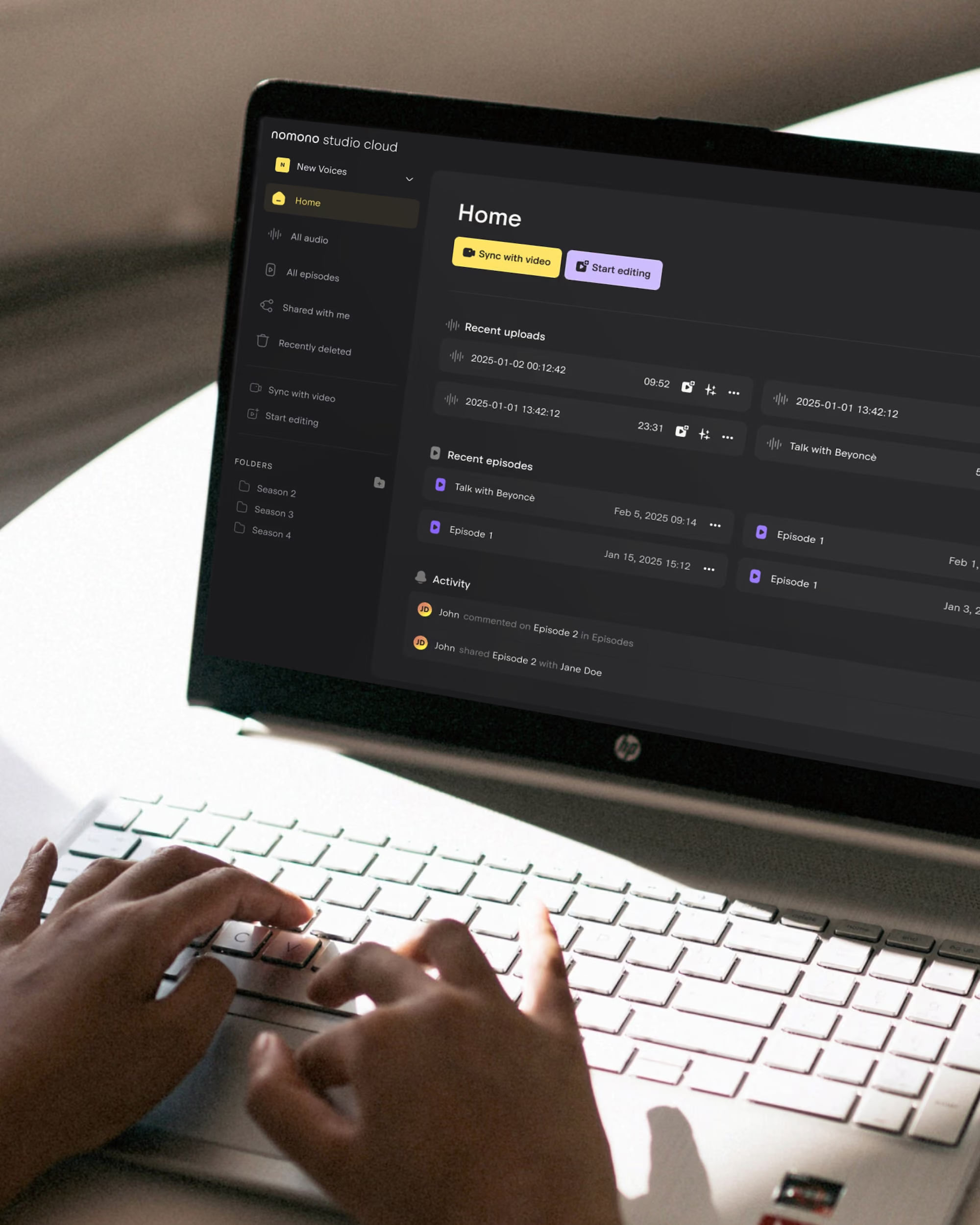
Nomono starts at the microphone and carries through to the finished file. The Sound Capsule pairs a Space Recorder, which has an 8-mic ambisonic array, with four Stellar wireless mics and a charging case, 2.9 lb in total. It records without a phone or laptop, holds up to 12 hours internally and runs up to 10 hours, or 25 with the case. When you stop recording, the session uploads to Studio Cloud automatically. There, AI enhancement removes background noise and room echo, levels every voice and reduces bleed between the speaker mics in one click, with Full, Medium and Light presets and the original always preserved. Cloud editing, transcription and audio and video sync sit in the same browser tab.
Descript turns a recording into a text document, so cutting a sentence from the transcript cuts it from the media. Its pricing page lists Studio Sound for background noise, filler-word removal, clip creation, screen recording, automatic multicam, captions, eye contact correction and AI voices, plus remote recording with an hours allowance on each plan (Descript pricing, checked Oct 2026). For unscripted interviews, text-based editing is faster than dragging regions on a waveform.
| Capability | Nomono (hardware + Studio Cloud) | Descript |
|---|---|---|
| Category | Wireless recording kit plus browser studio | Software-only editor |
| Getting audio into the editor | Uploads to Studio Cloud automatically after recording | Record in the app or import files |
| AI noise removal and enhancement | One click, 3 presets, tuned for Nomono mics incl. crosstalk reduction; original kept | Studio Sound |
| In-room microphones | 2 (Stellar Kit) or 4 (Sound Capsule) wireless | None, uses your devices |
| Remote guests | Not covered | Yes, remote recording |
| Editing model | Cloud multitrack editing | Text-based editing |
| Transcription | Unlimited on paid plans | Included, metered by media hours |
| Spatial audio | Ambisonic capture, Dolby Atmos-ready | No |
| Video tools | Audio/Video Sync (free on every plan) | Screen recording, multicam, captions |
| Seats | 1 editor (Professional), 2 editors + unlimited reviewers (Premium) | 1 (Hobbyist), up to 3 (Creator), up to 5 (Business) |
A price comparison only works if you name what the money buys. A Descript subscription buys software. A Nomono purchase buys microphones, a recorder or charging dock, and the first year of Studio Cloud in one payment, which is why it looks high next to a monthly app fee.
| Plan | Price | What it covers |
|---|---|---|
| Descript Hobbyist | $24/mo or $16/mo yearly | 10 media hours, 400 AI credits, 1080p |
| Descript Creator | $35/mo or $24/mo yearly | 30 media hours, 800 AI credits, 4K |
| Descript Business | $65/mo or $50/mo yearly | 40 media hours, 1,500 AI credits |
| Nomono Free | $0 | Unlimited editing, 2 h/mo AI enhancement, 75 GB, no hardware needed |
| Stellar Kit | $348 | Studio Cloud Professional included, 360 AI min/mo, 400 GB |
| Sound Capsule | $1,188 | Studio Cloud Premium included, 600 AI min/mo, 600 GB |
Descript limits are from its pricing page (Oct 2026). Media hours and AI credits are metered separately, and a weekly show with long raw sessions tends to hit the media-hours ceiling first. After the first year you can stay on the Free plan or continue Studio Cloud from $29/month (Professional) or $99/month (Premium), billed monthly or yearly; the hardware keeps working either way. Full plan details are on Studio Cloud pricing.
Nomono wins on everything between the microphone and a clean track. Four people at a table get four separate wireless tracks plus a spatial track of the room, recorded on the Space Recorder with no laptop present. Every mic has auto-levelling, so nobody rides a fader mid-interview. The session lands in Studio Cloud without a file transfer, and enhancement built for those exact mics handles noise, echo, level differences and crosstalk in one pass. With Descript, a multi-person recording in one room needs its own mics, an interface and file handling before editing can start.
Nomono also covers spatial work end to end: the spatial track records at 24-bit/48 kHz, Premium includes spatial export and ambisonics download, and the Sound Capsule is Dolby Atmos-ready. Our explainer on spatial audio for podcasts covers when that is worth it. Curious about bit depth? Our support article on how Nomono captures 16-bit audio explains why the mics record raw audio designed for that cloud enhancement step.

Descript leads on text-based and video editing. Cutting by transcript removes the slowest part of a rough cut, and filler-word removal saves time on unscripted talk. Screen recording, automatic multicam, captions, eye contact correction and clip creation have no equivalent in Studio Cloud. Remote guests are covered by built-in remote recording, while Nomono hardware records people who are physically present. For a solo host at a desk with a USB mic who posts weekly video clips, Descript covers the whole job. If background noise is your main issue, our guide on removing background noise from a recording covers the fixes in either tool, and the Studio Cloud Free plan includes 2 hours of AI enhancement a month for recordings from any mic.
Tutorial: Vince Opra shows how text-based editing works in Descript.
You can also run both. Nomono records the room, Studio Cloud enhances each speaker track, and you download the cleaned tracks; Descript then turns those files into a transcript you can cut. Raw files can also be exported from the recorder over USB if you prefer to process them elsewhere. Video teams can keep microphones, enhancement and audio and video sync on Nomono and use Descript for multicam edits and vertical clips. Check how imported multitrack sessions count against your Descript media hours before committing to an annual plan. For the wider capture side, see the best audio setups for video podcasts.
| Your situation | Better fit | Why |
|---|---|---|
| Solo host at a desk, weekly video clips | Descript | Editing speed is the bottleneck |
| Two-person interviews on location | Stellar Kit + Professional | 2 wireless mics, auto-upload and enhancement, $348 |
| Four-person panel in rooms you do not control | Sound Capsule + Premium | 4 wireless tracks plus room capture, enhancement tuned for the mics |
| Interviews in noisy or untreated rooms | Nomono | One-click noise, echo and crosstalk reduction |
| Guests in other cities | Descript | Built-in remote recording |
| Immersive or Dolby Atmos delivery | Sound Capsule | Ambisonic capture, Atmos-ready |
| Field recording, heavy video edit after | Both | Capture and enhance on Nomono, cut in Descript |
Weighing hardware for two-person interviews instead? Our Sound Capsule vs RØDE Wireless PRO comparison covers that choice, and the podcasting equipment buyer’s guide covers the rest of the kit.
People searching for Descript alternatives rarely want the same feature, so the right substitute depends on which part of the job is failing. Riverside records remote guests on their own devices, from $29/mo or $24/mo billed annually. Auphonic processes finished audio for loudness and noise, from $13/mo. Alitu bundles recording and automated cleanup at $38/mo or $32/mo billed annually. Nomono sits outside that group because one plan covers capture, enhancement and editing, microphones included. Compare on where your quality problem lives before comparing on price.
Record, enhance and edit in one place
Wireless mics that upload straight to Studio Cloud, with AI enhancement one click away. Compare Professional and Premium.
Partly. Both offer cloud editing, transcription and noise cleanup. Nomono connects that software to its own wireless mics, so recordings arrive in Studio Cloud automatically and enhancement is tuned to the hardware. Descript is a software-only editor with stronger video and text-based tools. Buyers comparing them are usually choosing between an in-room recording workflow and a transcript-first editor.
Descript records through the audio devices your computer sees, so several guests in one room need their own microphones and an interface or recorder to arrive as separate tracks. The Sound Capsule handles that stage itself, recording four wireless mics on separate tracks plus a spatial track of the room.
Hobbyist is $24/mo, or $16/mo billed annually, with 10 media hours and 400 AI credits. Creator is $35/mo, or $24/mo yearly, with 30 media hours and 800 AI credits. Business is $65/mo, or $50/mo yearly, with 40 media hours.
Yes. Download the enhanced speaker tracks from Studio Cloud, or export the raw files from the Sound Capsule over USB, then import them into Descript like any other audio. Check how multitrack imports count against your monthly media hours.
Descript does not list spatial or ambisonic audio features. Immersive delivery needs capture that records a soundfield, which is what the Space Recorder's 8-mic ambisonic array does. The Sound Capsule is Dolby Atmos-ready, and Studio Cloud Premium includes spatial export and ambisonics download.
Yes. The Free plan needs no hardware and includes unlimited editing, 2 hours of AI enhancement a month and 75 GB of storage. The paid plans come with the Stellar Kit and Sound Capsule, which add automatic uploads from the mics.
Nomono, because the Sound Capsule supplies four wireless mics, records without a laptop, runs up to 25 hours with its charging case and hands the session straight to Studio Cloud for enhancement and editing. Descript can still edit the result if you prefer cutting by transcript.
Written by Ruben Åeng, Lead Audio Engineer at Nomono
Audio engineer and Product Manager for spatial audio products at Nomono, with 15 years of experience in film and television sound. Before joining in 2021 he worked as a production sound mixer, dialogue editor and sound designer, with credits including the Oscar-nominated short “Night Ride”.
Enjoy free express shipping to the listed locations within 2–5 business days.
 Austria
 Belgium
 Bulgaria
 Croatia
 Cyprus
 Czech Republic
 Denmark
 Estonia
 Finland
 France
 Germany
 Greece
 Hungary
 Ireland
 Italy
 Latvia
 Lithuania
 Luxembourg
 Malta
 Netherlands
 Norway
 Poland
 Portugal
 Romania
 Slovakia
 Slovenia
 Spain
 Sweden
 United Kingdom
 United States