Podcasting guides
October 22, 2026


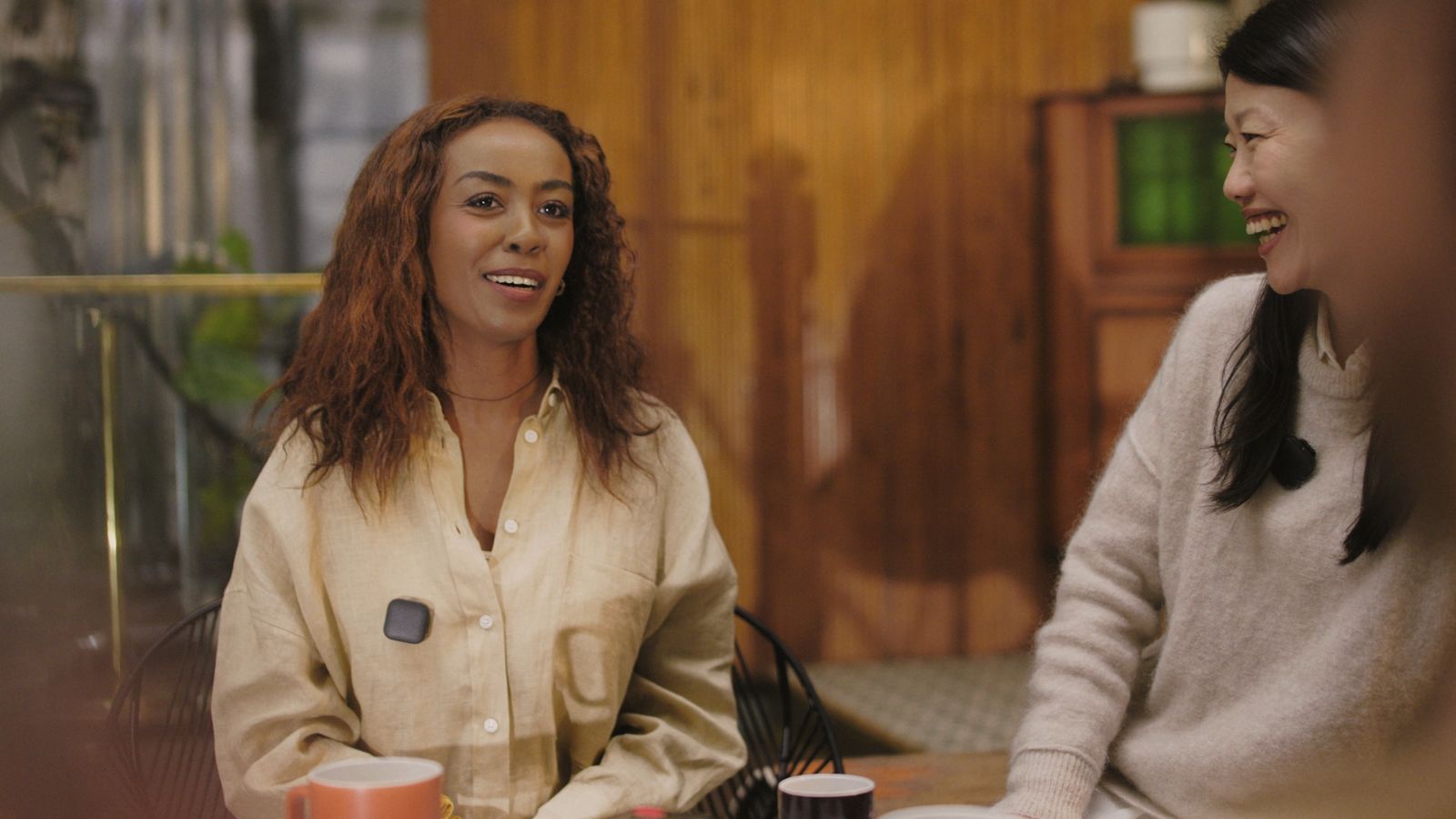
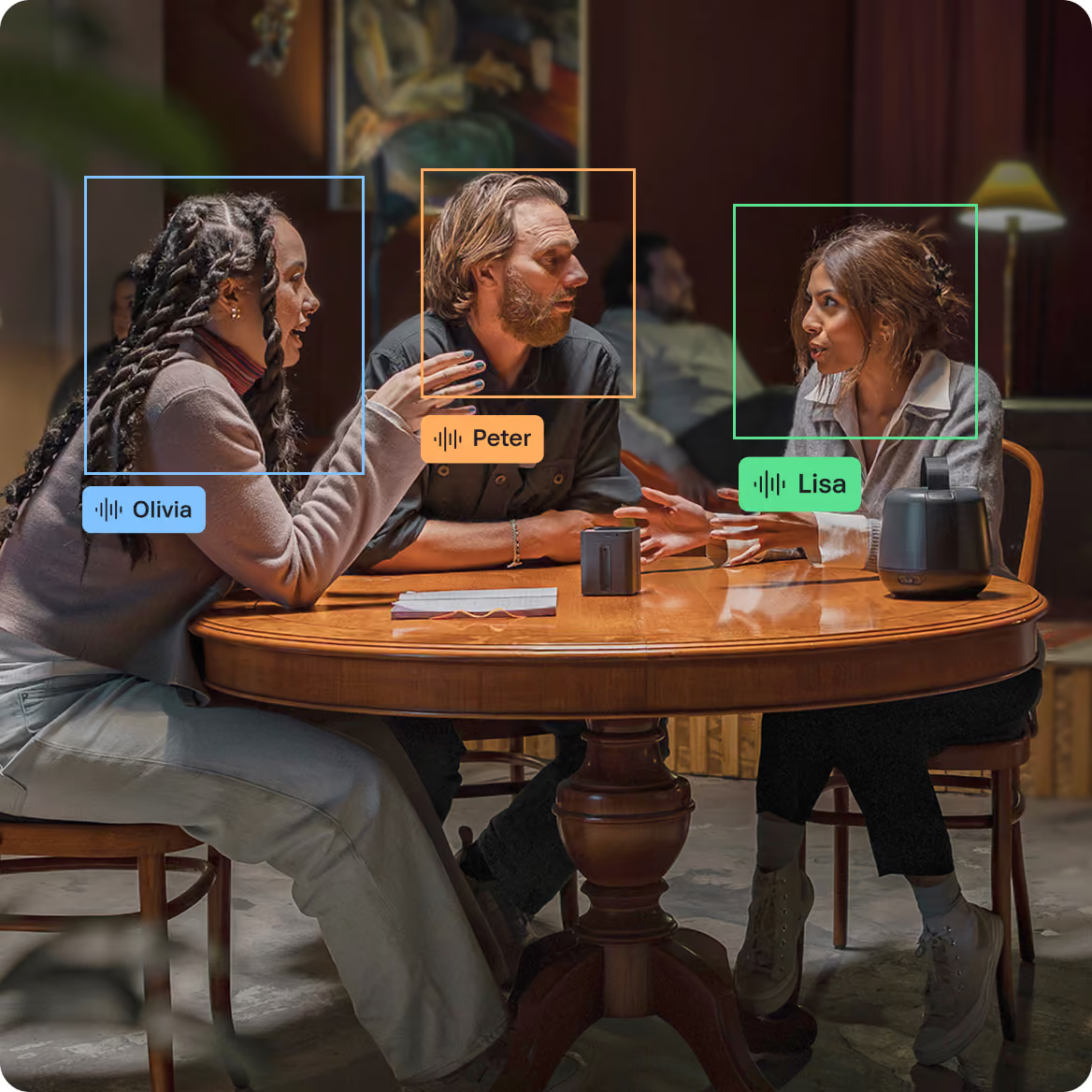
The best audio setup for a video podcast depends on where you shoot and how many people you record. For four people on location, the Nomono Sound Capsule records four wireless mics with no cables in frame and syncs to video in Studio Cloud. A fixed studio desk suits the RØDECaster Pro II. Camera-first duos are best served by the RØDE Wireless PRO or DJI Mic 3, which carry timecode.
First, the microphone becomes part of the picture. A boom arm swinging into frame or a large dynamic mic in front of a guest's face changes the shot, which is why many video podcasts use clip-on mics or hide the mic below frame. If you go the clip-on route, placement matters more than the brand: our guide to lavalier mic placement covers where to clip for clean speech and minimal clothing noise.
Second, the audio has to marry a separate video file. A camera's built-in mic is useful as a sync reference, not as the final audio. Every multi-mic video podcast ends up doing one of three things: carrying timecode, feeding audio into the camera, or aligning the files in software afterward. That choice usually decides the rest of the kit.
Setup time also matters more than spec sheets suggest. In a borrowed room you may have twenty minutes before guests arrive. Wired setups spend it on cable runs and gain checks. Wireless setups spend it clipping mics to collars.
Prices are US list prices from the maker plus street prices where noted, checked in late September 2026.
| Setup | Price | People | 32-bit float | Sync route | Wins when |
|---|---|---|---|---|---|
| Nomono Sound Capsule | $1,188 | 4 wireless | No (16-bit voice) | Audio/video sync in Studio Cloud | Four people on location |
| Nomono Stellar Kit | $348 | 2 wireless | No | Audio/video sync in Studio Cloud | Solo or duo on the move |
| RØDE Wireless PRO | $299 list, $260 street | 2 wireless | Yes | Timecode | Multi-camera duo shoots |
| DJI Mic 3 | $329 list with case, $259 at B&H | 2 wireless | Yes | Timecode or camera feed | Run-and-gun on camera |
| RØDECaster Pro II | $699 list, $595 at Sweetwater | 4 wired XLR | No (24-bit) | Align in the edit | Permanent studio desk |
| Zoom PodTrak P4next | $179.99 list, $149.99 Sweetwater sale | 4 wired XLR | No (24-bit) | Align in the edit | Lowest-cost four tracks |
| Zoom H6essential | $329.99 list | 4 wired XLR/TRS | Yes | Align in the edit | Four wired mics, no gain setting |
| Shure MV7+ | $299 ($319 with stand) | 1 wired | No | USB-C to the recording computer | Solo host on camera at a desk |
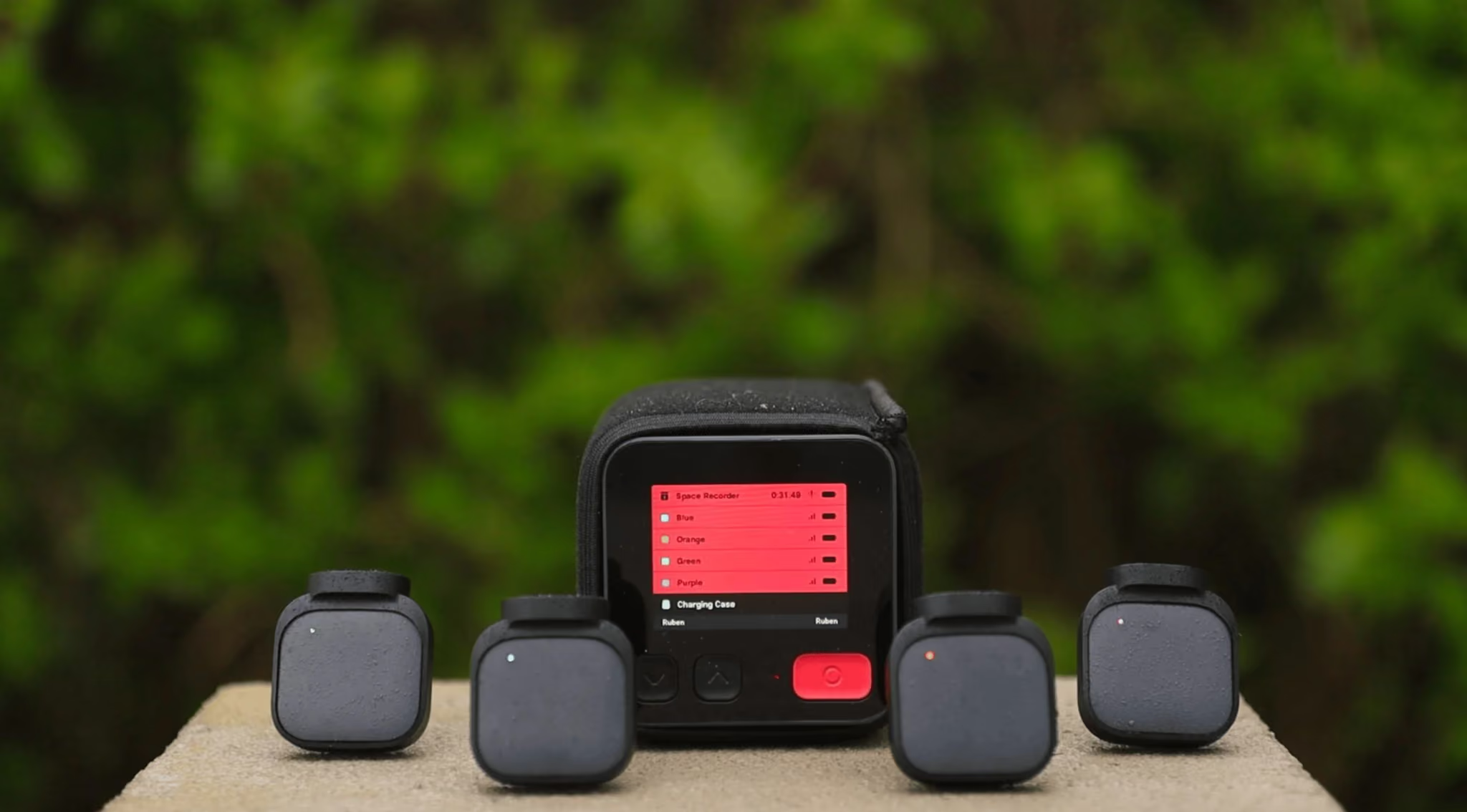
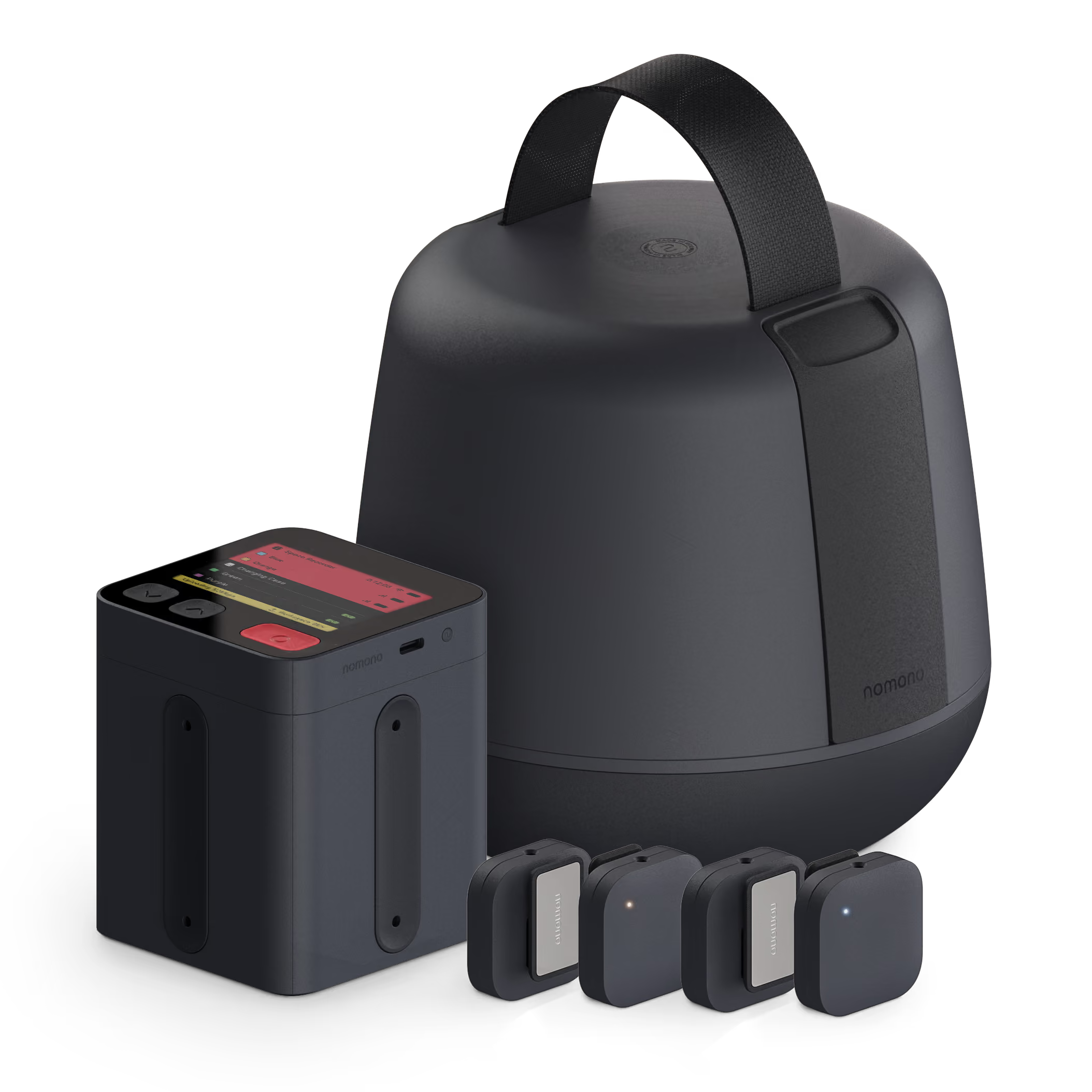
The Nomono Sound Capsule is built for the shoot where the room is not yours. One case holds the Space Recorder with its 8-mic ambisonic array, four Stellar wireless mics and the charging case, at 2.9 lb (1.3 kg) for the whole kit. It records for up to 10 hours, plus 15 more from the case, and stores up to 12 hours internally. Each voice gets its own 16-bit/48 kHz track, and the array records a 24-bit/48 kHz spatial track of the room.
The Sound Capsule is ready to record in under 10 seconds, and on shoot day, setup is clipping four mics to four collars. There are no cables across the floor, no boom arms in the wide shot and no gain knobs, because every mic is levelled automatically. The recorder runs without a phone or laptop and uploads to Studio Cloud automatically, where audio/video sync lines the audio up with your camera files. Sync is free on every plan. Studio Cloud also handles AI noise removal and audio enhancement, transcription and editing.
The Sound Capsule is $1,188, and the price includes the first year of Studio Cloud Premium, with 600 minutes of AI enhancement a month, 600 GB of storage and two editors. Plan details are on the Studio Cloud pricing page.
It does not record 32-bit float. A guest who shouts into a mic set for quiet speech is more recoverable on a RØDE or DJI transmitter. Auto-levelling on every mic handles normal swings in volume, but it is not the same safety net. The Sound Capsule also has no XLR inputs and no camera output or timecode, so if your editor wants a scratch feed into the camera body or a timecode-locked workflow, plan around that.
Customer story: We Are Makers film artisans with a camera and a Sound Capsule.
A host who never leaves the desk is well served by the Shure MV7+ ($299, or $319 with stand). It connects over USB-C straight to the computer, so there is no interface, and its real-time denoiser cleans up room noise. On camera the MV7+ is visible, which some shows want as part of the look and others do not.
A host who travels, or who interviews people in their own offices, is better off with the Nomono Stellar Kit. Two small wireless mics clip on and stay out of the way, with 15 hours of battery and magnetic, clip or cold shoe mounting. The kit works with the Studio app on your phone and uploads to Studio Cloud, where audio/video sync and transcription work the same way as on the Sound Capsule. It is $348, with the first year of Studio Cloud Professional included.
When the podcast is really a video shoot with two people, these two kits lead. The RØDE Wireless PRO ($299 list, $260 street) records 32-bit float to 32 GB on each transmitter, which RØDE rates at more than 40 hours, and adds timecode and GainAssist automatic levelling. Timecode means the audio drops onto a multi-camera timeline without manual alignment.
The DJI Mic 3 ($329 list with case, $259 at B&H) also records 32-bit float on each transmitter and supports timecode, and its receiver has a 3.5 mm output to feed a camera directly. It replaces the DJI Mic 2, which is still sold at $199 at B&H. Neither the RØDE nor the DJI kit includes a cloud editor, and both are two-transmitter systems, so a four-person show needs more than one kit.
For a show that records in the same room every week, the RØDECaster Pro II ($699 list, $595 at Sweetwater) gives live control that no wireless kit offers: 4 combo XLR inputs, 76 dB of gain, APHEX processing, 64 SMART pads, mix-minus and Bluetooth for phone guests. Two USB-C interfaces connect it to computers, and it records 24-bit/48 kHz to microSD, USB or a computer.
Budget honestly. The console is only the start: a 4-person kit with four RØDE PodMics, NTH-100 headphones, PSA1+ arms and cables is $2,229.65 at B&H. Those arms are in the shot. The console has no battery, though it can run from a 30 W or larger USB-C power bank. Our Sound Capsule vs RØDECaster Pro II comparison covers the trade-off in detail.
The Zoom PodTrak P4 has been replaced by the PodTrak P4next ($179.99 list, $149.99 on sale at Sweetwater). It has four XLR inputs, four headphone outputs, mix-minus, 70 dB of gain and four sound pads, and runs on two AA batteries or USB. It records 24-bit/48 kHz to microSD, so levels need setting before you roll. The Zoom H6essential ($329.99) adds 32-bit float across four XLR/TRS inputs, so a clipped guest is recoverable. Both leave you with raw multitrack files and no editing service, so budget for post-production software.
| Route | How it works | Used by |
|---|---|---|
| Timecode | Audio and camera share a clock | RØDE Wireless PRO, DJI Mic 3 |
| Camera feed | Receiver plugs into the camera | DJI Mic 3 |
| Software sync | Files aligned after upload or in the edit | Studio Cloud, any desktop editor |
Timecode is the professional route for multi-camera sets. Feeding the camera is simplest for one-camera shoots, at the cost of recording into the camera's audio format. Software sync is what most four-mic shows end up using. Our walkthrough on syncing Nomono audio with your camera shows how it works in Studio Cloud. For the room side of recording on location, read how to record a podcast outside the studio.
Shoot four people without cables in frame
Sound Capsule records four wireless mics and the room, then lines the audio up with your camera files in Studio Cloud.
It depends on the shoot. For four people on location, the Nomono Sound Capsule records four wireless mics and syncs to video in Studio Cloud. For a fixed desk, the RØDECaster Pro II gives live control. For camera-first duos, the RØDE Wireless PRO and DJI Mic 3 carry timecode and record 32-bit float.
Not always, but they help when you want the mic out of the shot. Clip-on mics free the table of boom arms, which is why wireless kits are common on video podcasts. Shows that want a visible broadcast mic as part of the set often use something like the Shure MV7+ instead.
It is a safety net, not a requirement. The RØDE Wireless PRO, DJI Mic 3 and Zoom H6essential record 32-bit float, which helps rescue takes where someone shouts or speaks far below the set level. The Nomono Sound Capsule records 16-bit voice tracks and uses auto-levelling on every mic instead, which suits conversation but gives less headroom for extreme peaks.
Use it as a sync reference, not as the final audio. A camera mic sits several feet from the speakers and records one mixed track of everyone plus the room. Record each person separately and keep the camera track only to line the files up.
Align the external audio with the camera's scratch audio. Most editors can match the waveforms automatically, and a clap at the start of the take makes it easier. In Studio Cloud, audio/video sync does this for you and is free on every plan.
No. It has no camera output and no XLR inputs. The Space Recorder records all four mics and the spatial track internally, and the files are synced to picture in Studio Cloud. If you need a live audio feed into the camera body, the DJI Mic 3 receiver has a 3.5 mm camera output.
For borrowed rooms and travel, the Nomono Sound Capsule: four wireless mics in a 2.9 lb kit with 10 hours of recording. For a room you control and want to dress as a set, a RØDECaster Pro II with four XLR mics. For the tightest budget with wired mics, the Zoom PodTrak P4next.
Written by Ruben Åeng, Lead Audio Engineer at Nomono
Audio engineer and Product Manager for spatial audio products at Nomono, with 15 years of experience in film and television sound. Before joining in 2021 he worked as a production sound mixer, dialogue editor and sound designer, with credits including the Oscar-nominated short “Night Ride”.
Enjoy free express shipping to the listed locations within 2–5 business days.
 Austria
 Belgium
 Bulgaria
 Croatia
 Cyprus
 Czech Republic
 Denmark
 Estonia
 Finland
 France
 Germany
 Greece
 Hungary
 Ireland
 Italy
 Latvia
 Lithuania
 Luxembourg
 Malta
 Netherlands
 Norway
 Poland
 Portugal
 Romania
 Slovakia
 Slovenia
 Spain
 Sweden
 United Kingdom
 United States