Podcasting guides
October 20, 2026



Podcasting in education is the use of audio recording and publishing to support teaching, assessment, and communication skills. Schools and universities use it for student projects, faculty research series, and campus storytelling. Programs succeed when the equipment is simple enough for non-technical teachers, and most that fail are killed by workflow friction, not by weak pedagogy.
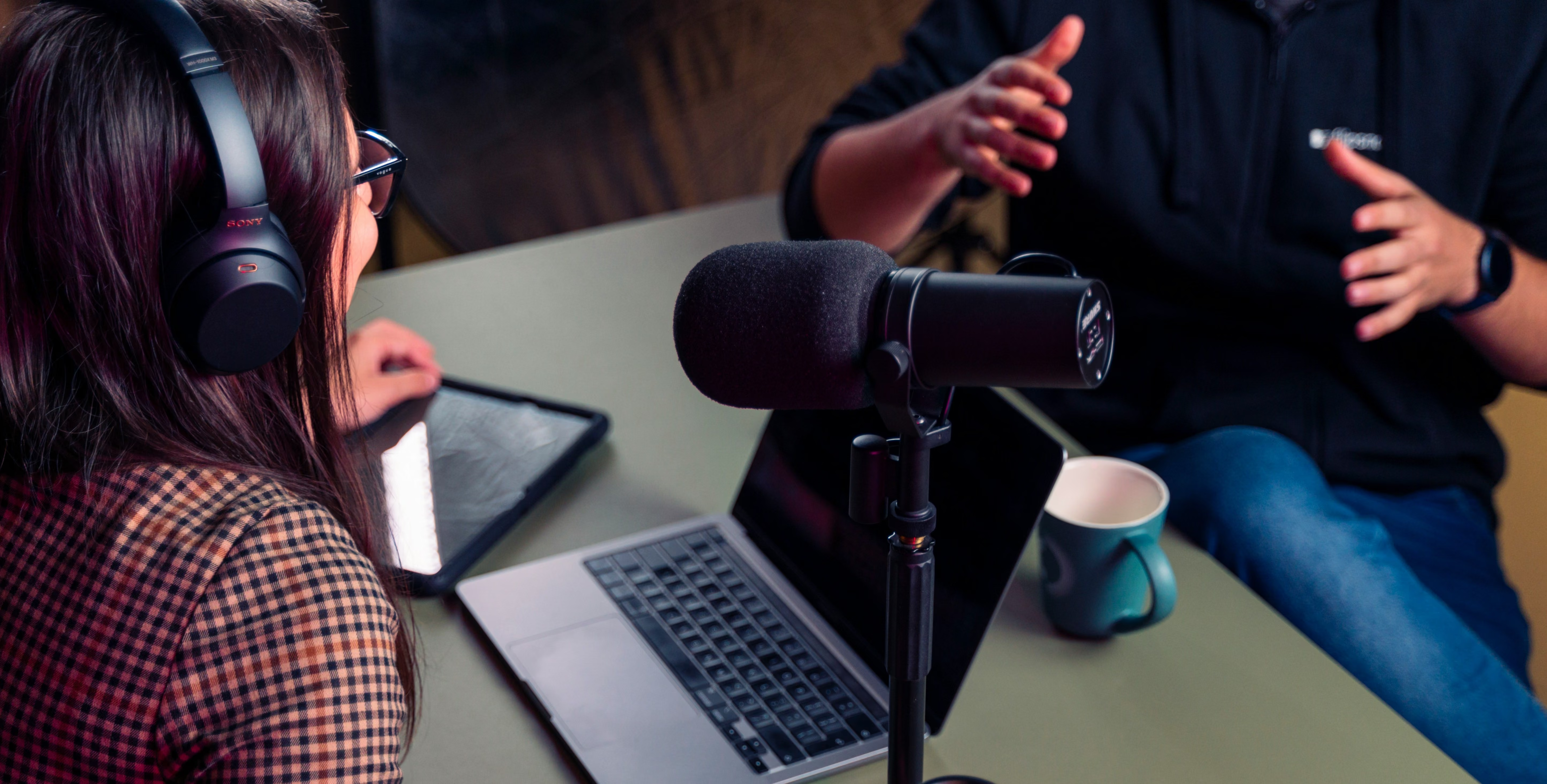
Podcast assignments turn passive learners into producers. When students plan an episode, research the topic, script their segments, and record a conversation, they practice the same skills an essay targets, plus verbal fluency, listening, and teamwork. The audience changes the effort level too. When the output is audio that classmates, parents, or the public will hear, rather than a paper only the teacher reads, students tend to prepare more carefully, speak more clearly, and care more about the quality of their ideas.
Audio also carries practical advantages for schools. Students can listen to course material away from screens, which matters for districts trying to reduce screen time. Transcripts make every episode accessible to deaf and hard-of-hearing students and searchable for revision. And the production side has matured: automatic transcription in 2026 is accurate enough to generate usable show notes and accessibility-ready transcripts with minimal manual cleanup, and browser-based editors such as Studio Cloud have removed the need to install professional audio software on school machines.
Working programs already exist at every level of education, from middle school media projects to graduate research series. The examples below come from published shows and from various educational institutions.
University podcasts move faculty research out of paywalled journals and into a format the public actually consumes. Stanford Graduate School of Business runs If/Then, where professors discuss their research conversationally instead of presenting papers. Columbia University produces Dead Ideas in Teaching and Learning, a series that challenges long-held assumptions in higher education. Both shows demonstrate the same point: a research podcast reaches audiences an academic paper never will, and it costs a fraction of a video production. For a department weighing formats, audio is the lowest-friction way to publish thought leadership on a recurring schedule.
Student-produced podcasts double as coursework and portfolio material. At the University of Iowa, medical students produce The Short Coat Podcast, an unscripted look at what medical school is actually like. Bowling Green State University publishes BG Ideas, which pairs students with academics and alumni for interviews on interdisciplinary research. Students on these shows graduate with published, searchable work attached to their names, which is a concrete hiring advantage for journalism, media, and communications candidates that a graded essay cannot provide.
K-12 examples show the format scales down without losing value. Middle school students at Kairos Leadership Academy produce The Bean Bag, interviewing school staff and fellow students.
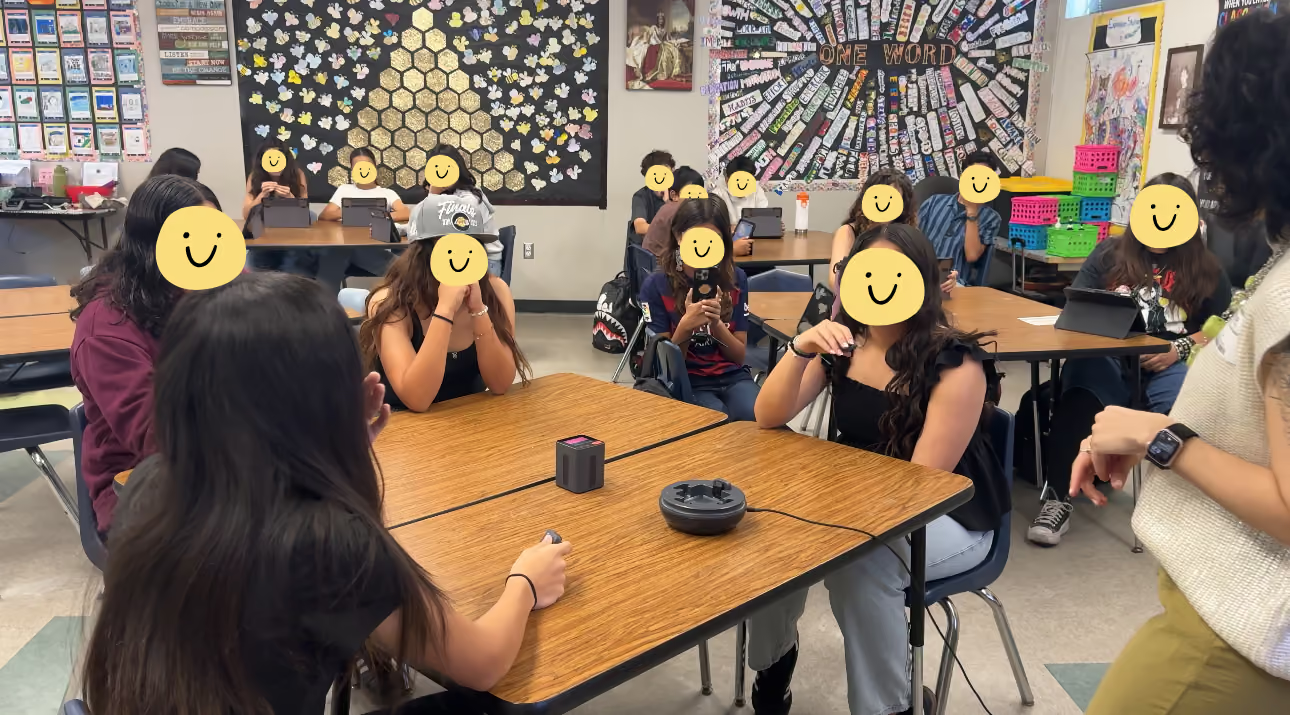
Guest hosts can jump-start a young program. Podcaster Pam Covarrubias of Cafe con Pam brought a Nomono Sound Capsule to a middle school career day and recorded with students live. Her account: "I set the capsule in the middle of the table, hit record and the kids leaned in... The audio was crisp and clean ready to publish." One visit produced a finished, publishable episode and a room of students who had seen professional recording demystified.
Several universities have standardized on portable wireless kits rather than fixed studios. Lancaster, Liverpool, Texas A&M, Arkansas, and Exeter all use podcasting across departments including management, journalism, and student media, and Texas A&M is among the institutions recording with Nomono equipment. Paul Turner of Lancaster University Management School: "All recordings have come out brilliantly... The sound quality is always superb." More educator and creator accounts are collected on the Nomono reviews page.
Podcast formats slot into existing curricula rather than replacing them. Five assignments that work across grade levels:
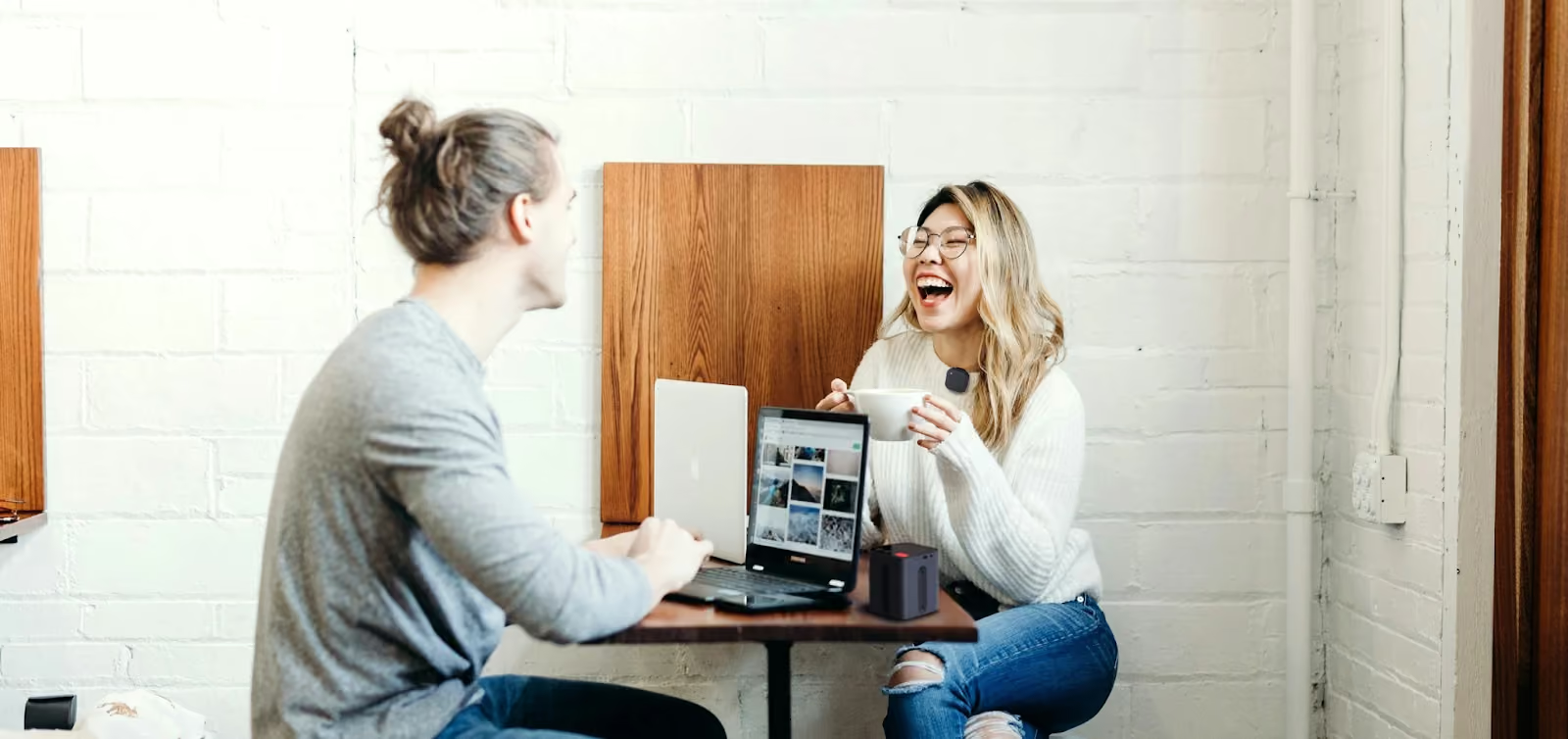
Each format shares one design rule: the audio is the assignment, so the rubric grades thinking and communication, and production polish stays out of the grade. Teachers who want a deeper primer on capture quality before the first session can read Nomono's guide to what makes recordings sound great.
Higher education uses podcasting across five recurring cases. Faculty research podcasts carry findings to audiences far beyond journal readership. Journalism and media programs produce portfolio-ready student work. Course assessment substitutes structured audio debates for some essays, the approach history students at the University of Colorado Colorado Springs used in place of traditional papers. Admissions, alumni relations, and dean's offices use campus storytelling shows for recruitment and engagement. And lecture capture plus guest speaker archiving preserves events that would otherwise vanish after the room empties.

The operational challenge differs from K-12. A university does not need to convince one teacher; it needs equipment that circulates across departments without dedicated audio staff. A kit that a management professor can check out Monday and a student journalist can carry to a stadium Wednesday has to survive non-technical users, travel, and zero engineering support. That constraint, more than any audio spec, decides which hardware scales across a campus. Nomono's guide to recording outside the studio covers the technique side of mobile capture.
Complexity kills school podcasts. Interest is rarely the problem: the traditional workflow demands multiple microphones, XLR cables, an audio interface, a digital audio workstation, SD cards, and manual file management. A teacher with no audio background loses class time to setup and troubleshooting, and after one or two painful sessions the equipment goes back in the closet. Every audio-visual coordinator has seen that closet.
Scaling adds a second failure mode. A program that depends on the one teacher who understands the mixer dies when that teacher changes schools. For a program to outlast its founder, the equipment has to work for non-technical users: fewer components, faster setup, and a clear path from pressing record to a finished, shareable episode. Purchasing decisions should weight those three properties above channel counts and preamp specs, because an unused professional console delivers exactly zero learning outcomes.
School podcast equipment falls into three realistic budget tiers: a wired classroom starter around $150 to $600, a shared wireless department kit around $399 to $1,188 in year one, and a fixed campus studio from roughly $1,800. Prices below are US list prices from Nomono's August 2026 competitive review. A broader market survey is in Nomono's podcasting equipment buyer's guide.
| Tier | Who it fits | Core equipment | Cost (USD, August 2026) |
|---|---|---|---|
| Classroom starter | One teacher, one room, recording at a desk | Zoom PodTrak P4 portable recorder ($149.99) with up to 4 wired XLR mics; or a single Shure MV7+ USB/XLR mic ($299) for solo and one-guest episodes; or the Nomono Stellar Kit with 12 months of Studio Cloud Professional ($348 upfront) | $150 to $600 |
| Department kit | Multiple classes or departments sharing one kit, recording anywhere, no technical staff | Nomono Sound Capsule: 4 wireless lav mics, one-button recording, automatic cloud upload, with Studio Cloud Premium ($99/month, $1,188 in year one); or a Rode Wireless Pro 2-person kit ($348) feeding a camera or phone | $348 to $1,188 (year one) |
| Campus studio | A fixed recording room for journalism or media programs with staff support | RODECaster Pro II desktop console ($595, mains powered, 4 wired XLR inputs) plus four Shure MV7+ mics ($299 each, $1,196 total), stands, and cabling | Roughly $1,800 to $2,200 |
One structural difference separates the tiers. The wired options in tiers one and three record to SD cards or a connected computer, and editing happens in separate software the school must license and learn. The Sound Capsule is the only option in the table with wireless mics and an included cloud workflow, so recordings upload automatically and are ready to edit in a browser with no cables, gain adjustment, or file handling. For equipment that circulates among non-technical users, that difference matters more than price. Current plans are listed on the Studio Cloud pricing page.
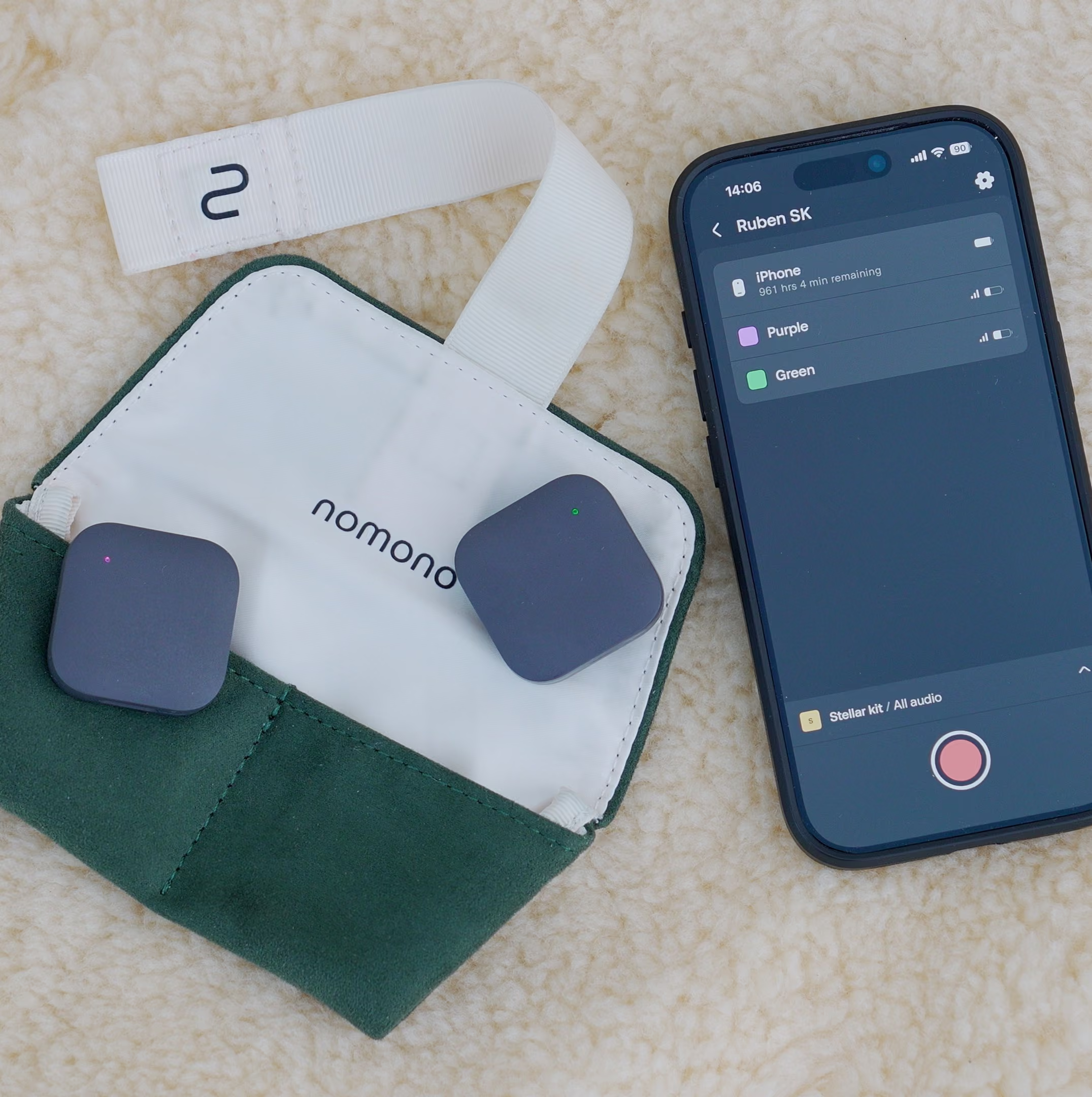
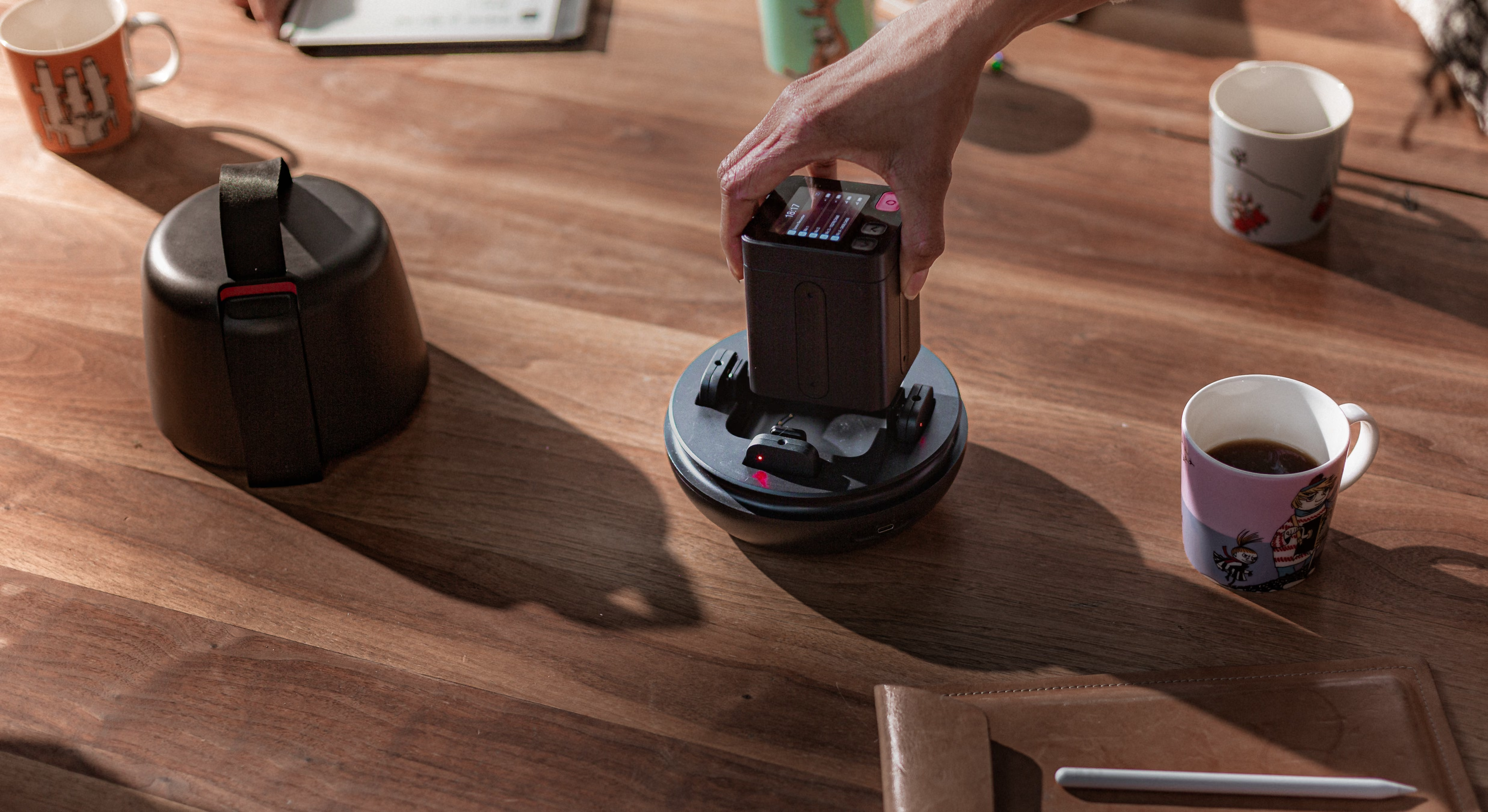
The Sound Capsule is a portable kit built around exactly the constraints schools report. Four Stellar wireless lav mics and a Space Recorder travel in a single charging case weighing 2.9 pounds, light enough for a student backpack. Recording starts with one button and needs no cables or gain setting. Each session captures four separate mono tracks plus an ambisonic room recording from the Space Recorder's 8-mic array, which supports immersive formats later; Nomono's immersive soundscapes guide shows what student projects can do with that. Files upload automatically to Studio Cloud, where AI enhancement cleans up classroom noise, transcription generates show notes and accessibility text, and students edit collaboratively in a browser.
Video-first wireless kits deserve a mention because many schools already own them. The DJI Mic 2 ($349) and the Rode Wireless Pro ($399) are two-person 32-bit float lav kits designed to feed a camera or phone, and a media class that films morning announcements can reuse either for audio-only interviews. Two limits matter for podcasting. Both kits top out at two speakers, so a four-person panel discussion needs different hardware, and neither includes editing software, so the school still needs a separate tool for cleanup and assembly. For a program whose primary output is audio with three or four voices, a purpose-built kit costs less friction than adapting camera gear.
Editing student audio should stay light. Cloud-based tools such as Studio Cloud, Descript, and Alitu run in a browser, so nothing gets installed on locked-down school machines. Teach students to trim dead air and false starts rather than attempt complex audio repair; capture quality at the source does far more for the final sound than any rescue edit, a point Nomono's podcast editing and audio quality guide makes in depth.
Publishing has three levels, and most school projects should start at the first:
Publishing student voices publicly is a compliance decision before it is a creative one. US schools fall under FERPA, and UK and EU institutions under GDPR, so check district or university policy on student media and secure parental consent for minors before any episode leaves the LMS. A practical pattern many schools use: publish internally all semester, then release a public "best of" feed containing only episodes with signed releases. Consent paperwork gathered at enrollment, alongside photo releases, removes the per-episode scramble entirely.
Durable programs share five habits, drawn from the institutional examples above:
Measurement keeps a podcast program funded past its first enthusiastic semester. Track three kinds of evidence. Learning evidence comes from the rubrics: compare research depth, argument quality, and spoken clarity across a student's episodes over the term, since growth across artifacts is the case a teacher can put in front of a principal. Participation evidence covers how many classes, teachers, and departments used the kit, how often it was checked out, and whether it sat idle, because an unused kit is the data point that cancels renewals. Audience evidence applies only to published shows: episode counts, listens, and any external attention such as a local news mention or an admissions inquiry that referenced a campus episode. Report all three annually alongside the equipment cost, which for a Sound Capsule program is a known $1,188 per kit in year one.
A pilot beats a plan. Run one class through one short episode cycle on borrowed or entry-tier equipment, log every point of friction, and let that log drive the real purchase. Teachers who want the full production walkthrough can work from Nomono's podcast recording guide.
Podcasting in education is the use of audio recording and publishing to support teaching, assessment, and communication skills. Schools apply it to student projects such as debates and explainers, while universities use it for faculty research series, journalism portfolios, and campus storytelling. The format works at every level from middle school to graduate programs, and programs succeed when the recording workflow is simple enough for non-technical teachers.
A school needs microphones, a recorder, and an editor, and the simplest versions of each. A single classroom can start with a Zoom PodTrak P4 ($149.99) and wired mics. A kit shared across classes works better wireless: the Nomono Sound Capsule provides four wireless mics, one-button recording, and automatic upload to a browser-based editor, so no cables, interfaces, or file management are involved.
A classroom podcast can start for as little as $149.99, the price of a Zoom PodTrak P4 recorder, plus wired microphones. A department-level wireless kit costs more: the Nomono Sound Capsule with Studio Cloud Premium runs $99 per month, or $1,188 in year one, including hardware, cloud storage, AI enhancement, and transcription. A fixed campus studio built on a RODECaster Pro II console and four mics lands near $1,800 to $2,200.
No, students do not need a soundproof studio. A quiet classroom, library corner, or office produces usable audio when the microphones sit close to the speakers, which is exactly what lav mics do. Wireless kits such as the Sound Capsule were built for untreated rooms, and AI noise reduction in Studio Cloud cleans up HVAC hum and hallway noise after the fact. Pick the quietest available space and prioritize mic placement over room treatment.
Grade the thinking and the communication, and keep production polish out of the rubric. Strong rubrics score research quality, argument structure, clarity of speech, listening and follow-up in conversation, and each student's fulfillment of a defined role such as host, researcher, or editor. Audio production is a means, so a slightly rough recording of an excellent debate should outscore a polished recording of a weak one.
Yes, middle schoolers already produce real shows, and simplified formats reach younger grades. Students at Kairos Leadership Academy produce The Bean Bag, interviewing staff and peers. For younger students, teachers typically run the equipment while students handle planning, questions, and speaking. One-button hardware helps here: when recording starts with a single press, a ten-year-old can operate it under supervision.
Yes, for minors, treat consent as required before public release. US schools operate under FERPA and district media policies, and UK and EU institutions under GDPR, so student voices and names generally need a signed release before appearing on public platforms. Class-internal sharing through an LMS usually falls inside normal coursework rules. The practical approach is collecting media releases at enrollment and keeping unreleased episodes internal.
Publish where the audience actually is, and start internal. Class assignments belong on the LMS, through Canvas, Google Classroom, Moodle, or private links. School-facing shows can be embedded on the school website. For public distribution, a podcast host generates the RSS feed: Spotify for Creators is free, and Blubrry offers free educator hosting with a 50 percent student discount, per its education program. The feed then reaches Spotify and Apple Podcasts automatically.
Five to fifteen minutes suits most school projects. A weekly student news show works at five minutes, a book discussion or debate at ten to fifteen. Short episodes keep planning, recording, and editing inside one or two class periods, and they force students to structure their material instead of rambling. University shows run longer, and faculty research interviews commonly reach thirty minutes or more once the workflow is established.
Yes, and shared kits are how universities including Lancaster, Texas A&M, and Exeter run podcasting across departments. Sharing works when the kit needs no specialist to operate: portable hardware, wireless mics, one-button recording, and automatic cloud upload so files never live on an SD card someone forgets to clear. The Sound Capsule's charging-case design, at 2.9 pounds, was built for exactly this checkout-desk pattern.
Nomono offers two plans, priced monthly in USD. Professional costs $348 upfront for the Stellar Kit plus 12 months of Studio Cloud Professional, then $29 per month. Premium costs $99 per month, or $1,188 in year one, and includes the full Sound Capsule with four wireless mics plus Studio Cloud Premium for AI enhancement, transcription, and collaborative browser editing. Current details are on the Studio pricing page.
Podcasting adds verbal communication, listening, and audience awareness to the research and reasoning a written assignment already demands. Students speaking to a real audience prepare more carefully and care more about the quality of their ideas than students writing for a single grader. Audio is also a complement rather than a replacement, and most teachers rotate formats, using podcasts where discussion, debate, or explanation is the skill being assessed.
Kerry Leech is an audio and content specialist writing for Nomono.
Enjoy free express shipping to the listed locations within 2–5 business days.
 Austria
 Belgium
 Bulgaria
 Croatia
 Cyprus
 Czech Republic
.svg) Denmark
Denmark Estonia
 Finland
 France
 Germany
 Greece
 Hungary
 Ireland
 Italy
Italy Latvia
 Lithuania
 Luxembourg
 Malta
Malta Netherlands
 Norway
 Poland
 Portugal
 Romania
 Slovakia
 Slovenia
 Spain
Spain Sweden
 United Kingdom
 United States