Podcasting guides
October 20, 2026



Audio quality has a measurable effect on podcast growth and monetization. Listeners rate identical content as less credible when the sound is poor (Newman and Schwarz, Science Communication, 2018), and 5% of weekly news podcast listeners have quit a show over bad audio (Sounds Profitable, 2025). Clean capture, the problem Nomono solves, protects retention and ad revenue.
Poor sound quality lowers the perceived credibility of whatever is being said, before the listener has judged a single argument. In the study Good Sound, Good Research (Newman and Schwarz, Science Communication, 2018), participants watched the same conference talks with the audio degraded or left clean. When the sound was poor, they rated the talk as worse, the speaker as less intelligent and less likeable, and the research itself as less important. The content never changed. Only the audio did.
The mechanism is processing fluency. When a brain has to work hard to decode muffled or noisy speech, it attributes that strain to the message rather than the microphone. Schwarz summarized the finding plainly: when you make information difficult to process, it becomes less credible. For a podcaster, the practical consequence is blunt. A sharp interview recorded on a laptop mic in a reverberant room will persuade fewer people than a weaker interview recorded cleanly. Credibility is the asset every show trades on, and audio quality is one of its few controllable inputs.
Retention drives podcast growth, and audio quality is one of the few retention levers a producer controls completely. Podcast discovery runs on completion and follow behavior: listeners who finish episodes come back, recommend the show, and leave the reviews that pull in the next cohort. A listener who bails ten minutes in because one guest is inaudible does none of those things.
Real abandonment data backs this up. In The News Podcast Consumer (Sounds Profitable, 2025), 5% of weekly news podcast listeners said they had stopped listening to a show specifically because of poor audio quality, alongside 9% who cited inconsistent publishing and 8% who left after a format change. Bad sound sits in the same category as skipping episodes: a self-inflicted reason to lose an audience you already earned. And unlike a format change, an audio fix requires no editorial rethink, just better capture. Our guide to podcast recording covers the fundamentals that prevent most of these losses.
Specific audio faults produce specific listener behaviors, and each fault has a known fix. The table below maps the four most common problems to what listeners actually do when they hear them.
| Audio problem | What listeners do | The fix |
|---|---|---|
| Uneven levels between speakers | Ride the volume control, then give up and skip the quiet guest's answers | Give every speaker their own mic and normalize levels before publishing; automatic loudness matching in Studio Cloud handles this in one pass |
| Background noise (traffic, HVAC, keyboard clicks) | Strain to follow, lose the thread, abandon mid-episode | Choose the quietest available space, then apply noise reduction; capturing with close-positioned lav mics keeps voice far above the noise floor |
| Distant, roomy, or echoing voice | Judge the show as amateur within seconds and rarely give it a second episode | Move the mic within a few inches of the mouth; a wireless lav does this without a boom arm or acoustic treatment |
| Episode-to-episode inconsistency | Lose trust in the show's reliability and unfollow | Standardize one capture setup for every location so a hotel room, an office, and a studio all produce the same sound |
None of these fixes require studio construction. Each one moves the work upstream, from repair in post to clean capture at the source, which is why the key to great sounding recordings is mic placement and consistency rather than plugins.
Sponsorship money follows shows that sound professional, and the pool of money is large. US podcast advertising revenue reached $2.86 billion in 2025, up 17.6% year over year, with the IAB projecting growth toward $3.74 billion by 2028 (IAB/PwC US Podcast Advertising Revenue Study, 2026). Advertisers allocating that budget audit shows before they buy, and production quality is one of the first filters. A media buyer who hears clipping and room echo hears risk to their brand.

Host-read ads raise the stakes further. Nielsen found that host-read podcast ads deliver 71% brand recall against 62% for ads not read by the host (Nielsen Podcast Ad Effectiveness studies, 2020). The premium format in podcast advertising is, literally, the host's own voice. If that voice sounds thin or distorted, the show's most valuable inventory degrades with it. Clean, consistent audio protects the exact asset sponsors pay the most for.
Monetization beyond ads follows the same logic. Paid subscriptions, premium feeds, and listener support all depend on the audience judging the show worth money. Poor audio is the fastest way to signal that it is not.
For a branded podcast, the audio is the brand. Signal Hill Insights' 2025 Branded Podcast Benchmark Report, built on more than 15,000 podcast consumers, found that 61% of listeners who heard a full branded episode became somewhat or much more favorable toward the brand, roughly three in four said the episode held their attention throughout, and 63% said they would recommend the show (Signal Hill Insights, 2025). Those numbers describe episodes people actually finished. A listener who quits at the eight-minute mark because of hiss or echo delivers none of that favorability, and may transfer the amateur impression straight onto the sponsoring company.

Enterprise and agency producers carry an extra burden here: the company's reputation rides on every episode, and recordings often happen outside a studio, at conferences, in client offices, or across a boardroom table. A four-person portable system that produces broadcast-grade audio anywhere removes that risk. Teams planning a show from scratch can start with our guide on how to start a business podcast.
Professional audio comes from disciplined capture, and every element of disciplined capture is portable. Six practices cover most of the distance:
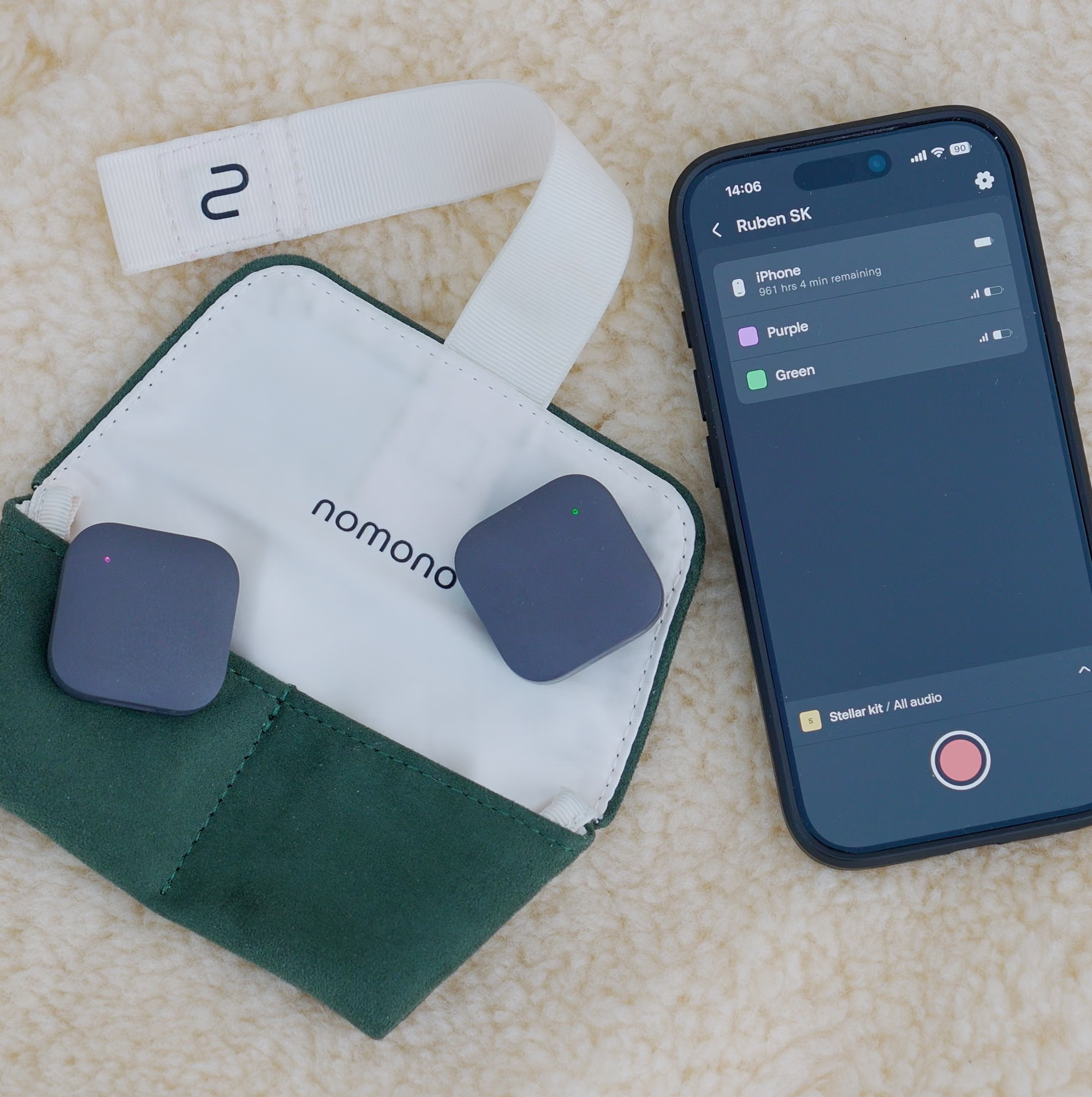
Hardware now does most of this work. The Nomono Sound Capsule packs four Stellar wireless lav mics and a Space Recorder with an 8-mic ambisonic array into a 2.9 lb charging case, records four mono WAV tracks plus a 4-track ambisonic bed, and uploads to Studio Cloud for one-click enhancement, editing, and export. The workflow runs $99 per month on the Premium plan, with a $348 first-year Professional tier for the Stellar Kit (Studio Cloud pricing, 2026). Producers who record on location can see the full method in our guide to recording a podcast outside the studio, and post-production teams should read how editing decisions affect audio quality.
The commercial case reduces to one comparison. Year one of the Premium plan costs $1,188. A single lost sponsor, or a branded show that damages rather than builds favorability, costs far more.
Yes, audio quality measurably affects podcast growth. Listeners rate identical content as less credible and the speaker as less intelligent when sound quality drops (Newman and Schwarz, Science Communication, 2018), and 5% of weekly news podcast listeners have quit a show over poor audio (Sounds Profitable, 2025). Growth depends on retention and recommendation, and both fall when audio is bad.
Listeners do abandon shows over audio alone. In Sounds Profitable's 2025 news podcast research, 5% of weekly listeners said poor audio quality was the specific reason they stopped listening to a show. Abandonment is also invisible in most analytics: the listener simply never presses play on the next episode, so producers rarely see the cause.
Sponsors weigh production quality when buying podcast inventory, so audio quality affects earning potential. US podcast ad revenue hit $2.86 billion in 2025 (IAB/PwC, 2026), and host-read ads, which deliver 71% brand recall versus 62% for non-host-read ads (Nielsen, 2020), depend entirely on the host's voice sounding clean and professional.
No, a studio is no longer required for professional podcast audio. Close mic placement, a quiet room, matched levels, and automatic enhancement produce broadcast-grade results anywhere. Portable systems such as the Nomono Sound Capsule capture four speakers wirelessly with a full ambisonic room array, so a hotel room or conference floor can sound like a treated studio.
Recording speakers too far from the microphone is the most common and most damaging mistake. Distance adds room reverb and drops the voice toward the noise floor, and neither problem can be fully repaired in post. A lav or close-positioned mic a few inches from each speaker prevents the fault entirely, at the moment of capture.
Capturing clean audio at the source always beats repairing it in editing. Noise reduction and EQ can reduce faults but leave artifacts, and echo baked into a distant recording never fully comes out. Enhancement tools work best as a finishing pass on a clean recording. Our guide to podcast editing and audio quality covers where the limits sit.
A four-person location recording needs a dedicated mic per speaker, a multitrack recorder, and a way to monitor levels. The Nomono Sound Capsule covers all three in one 2.9 lb kit: four Stellar wireless lav mics, a Space Recorder with an 8-mic ambisonic array, and a charging case, recording four mono WAVs plus a 4-track ambisonic WAV.
Audio quality matters more for branded podcasts than for independent shows, because the sound quality reflects directly on the company. Signal Hill Insights (2025) found 61% of branded podcast listeners became more favorable toward the brand after a full episode. That favorability only accrues from episodes listeners finish, and poor audio is a leading reason they do not.
Professional podcast audio starts at $348 for the first year. Nomono's Professional plan ($348 upfront, then $29/mo) pairs the Stellar wireless mic kit with Studio Cloud, and the Premium plan ($99/mo) adds the full Sound Capsule, a year-one total of $1,188. Comparable desktop setups such as a $595 RODECaster Pro II console (Rode, 2026 pricing) need mains power, separate mics, and separate editing software.
Software can improve flawed audio, within limits. Automatic enhancement in tools like Studio Cloud removes steady background noise and levels every voice in one pass. Severe faults, heavy room echo, clipping, or a voice buried under noise, cannot be fully reversed. Treat enhancement as polish for a decent recording, never as a substitute for one.
Kerry Leech, audio and content specialist writing for Nomono.
Enjoy free express shipping to the listed locations within 2–5 business days.
 Austria
 Belgium
 Bulgaria
 Croatia
 Cyprus
 Czech Republic
.svg) Denmark
Denmark Estonia
 Finland
 France
 Germany
 Greece
 Hungary
 Ireland
 Italy
Italy Latvia
 Lithuania
 Luxembourg
 Malta
Malta Netherlands
 Norway
 Poland
 Portugal
 Romania
 Slovakia
 Slovenia
 Spain
Spain Sweden
 United Kingdom
 United States